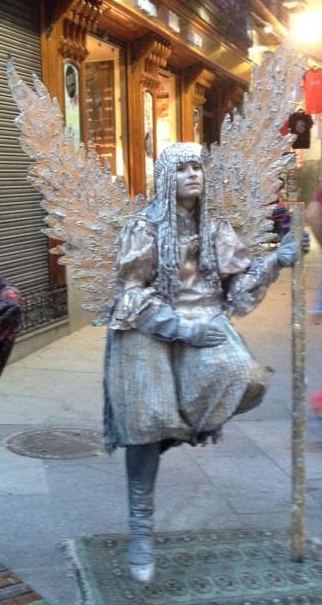
Angel Song for Healing and Before Bed

Madrid Angel

“In the name of the Holy One, the Holy One of Israel, May Michael be on my Right and on my Left be Gavriel, Before me be Uriel and at my Back be Raphael. Above my head and below my feet Shechinah-eyl.”

This is an adaptation from the prayer said before going to sleep in the Jewish tradition. It is one of several prayers that are part of what is called the Bedtime Shema. My dear friend Arik Labowitz has the Hebrew melody beautifully recorded on his CD Simu Lev (track 10, called Angel Song) and you can listen to it on his website or buy the CD. I play his music all the time. The English quote above here is slightly different from what you will find in some prayer books. Hebrew to English never translates perfectly and this is what I sing and sang to my children before they fell asleep. This prayer or any prayer or ritual practice of protection and love spoken ritually and regularly for young ones will help in so many ways. Nightmares just don’t have as much of a doorway in when you have surrounded yourself or your child with four guardian angels.

I also sing or chant these words over and around folks before and after medical procedures or if they come into my home for healing. It is very soothing. It is good to teach to others. I will look into recording a voice memo here and uploading for future reference so you can see the way I sing it. Just saying the words in any way you want is a good idea.

Whenever you see any word in Hebrew or translated into English with the “el” in it, this refers to the Divine. So El is one of the oldest, if not the oldest, Hebrew word for a Divine being. Please see Why Ha-Shem, Not Naming the Divine post for more detail about naming the Divine. In brief, we don’t name the Divine in the Jewish tradition, we use various kinds of descriptors. There is one name used in the Torah which is made up of the four Hebrew letters, but this configuration of letters has no vowels and the original pronunciation for these letters was only passed down orally from High Priest to High Priest. No one except the Cohen Ha-Gadol/High Priest ever knew how to pronounce this name and only did so once a year. See articles on Yom Kippur. This name is called the Tetragrammaton since it is made up of four Hebrew letters. It is inaccurately translated and pronounced sometimes as Yahweh or Jehovah or some variation of this.

Additionally, all Hebrew words are linked to their roots and each root spawns many, many words, which when you know the root for those words links you to a whole system of interconnected words and which informs you about the deeper meanings of a word. Translation is always tricky.

“… Translation, above all, means change. In Elizabethan England, one of its meanings was ‘death’: to be translated from this world to the next. In the Middle Ages, translation meant the theft or removal of holy relics from one monastery or church to another…” ~ Eilliot Weinberger

And my favorite teaching on taking Holy works and trying to understand them literally.

“The surest way to misunderstand revelation is to take it literally, to imagine that God spoke to the prophet on a long-distance telephone.”

~ Rabbi Abraham Joshua Heschel

Even if you cannot access it in the original language that doesn’t mean you cannot benefit from the teachings. I just like to remind folks to think of translation as a kind of very adept word yoga, with lots of bends and twists and flexibility built-in so that you don’t think there is ONLY one way to engage with a word or concept. When learning about the Hebrew prayers and practices and adapting them for any person, regardless of their religion or ethnic or cultural background, it is important to remember that the energy of the word or the prayer is what matters for those who cannot access it in the Hebrew. The other important thing to keep in mind is your kavannah/intention. If you set your intention the meaning will fall into its proper place.

Each of the angel’s names have meaning and can be translated variously as:

  • Michael is the angel of love/mercy. Mercy of El, the energy of love angel or the angel of mercy.
  • Gavriel or Gabriel is the angel of strength, so strength of El or energy of courage and boundaries, armor, protection.
  • Uriel or Ariel is the angel of light from the Hebrew word Or/Light. So, Uriel is the angel of vision and light.
  • Raphael is the angel of healing, the word for healing in Hebrew is Refuah

So, please engage how you are comfortable and for further teachings on this please see Rabbi David Cooper‘s book God is a Verb (order if from your local bookstore). Much greater detail than what I’ve given is included there and he has an excellent Archangel Meditation on page 144 of this book.  He also has CDs and other sound recordings on angels and tools for those looking to connect more deeply. Rabbi David is a master of Kabbalah and I use his materials all the time.

I have had personal experience with the Archangel Raphael and always experience his presence as being a warm wide-winged embrace that I sink into. Raphael is always a being I fall back into or sink backwards into. There is a profound feeling of trust and warmth. When I pray for others I imagine the wings of Raphael being so big that the person is completely held inside this Holy Being and is comforted and well there in the protecting and deeply healing embrace.

May you find comfort in these practices and please feel free to ask me questions and go and study more!

Introduction to Mussar

We are Holy at our core

We can uncover the core

Our difficulties, stresses, and problems in this life are the core curriculum of our lives, this is our spiritual homework

Acknowledgment: This extremely introductory and broad overview of the topic of Mussar is the result of eight years of study with my teacher Caroline Isaacs, my time with my Mussar sisters in group study, reading, reading, reading and more reading as well as studying great teachings, some of which are mentioned here. Please see all the links for more in-depth discussion and direction. This piece is truly meant as an introduction to the topic and I hope it stimulates much further study.

Mussar is introduced in Ba-Midbar/Exodus also in Devarim/Deuteronomy

Ha-Shem/The Name (see Teachings, -Naming the Divine?Why Ha-Shem article on the use of this word instead of the word God). Ha-Shem literally means The Name and it reflects the concept in Judaism that you cannot quantify or confine the Divine. It is unnameable, infinite and vast. Ha-Shem is not like my name or yours.

Ha-Shem gave us Mussar. Mussar can be translated to mean training/to train. It is also understood as the practice of Jewish ethical work. Mussar is a series of practice tools and teachings for learning to walk our talk. I often describe it as a way to shine up my soul, to work at scouring, lifting, cracking the code on the patterns, barriers, obstacles that are in the way of my greater self/soul/heart.

When first trying to describe it I wrote this short poem:

I’m trying to make my soul
shiny, shiny bright
so that everyone can see
its light

Mussar is practical and doable.

The main work of Mussar involves engaging actively  and becoming aware of the many middot/measures of energy/Divine flows that operate in our world and that we can work with to live with integrity, pursuing goodness and justice. The Hebrew word middot cannot be easily translated. The idea is that there are flows or measures of Divine Energy or Qualities that move through all of us and the world. By connecting with them in their essences and learning to identify them and dance with them or use them to help us with our lives, we can change and improve ourselves and our lives and the lives of those around us.

There are several key or central middot. Middot is the plural for middah. For the purpose of this article, using the word measure or flow of energy is the best way to conceptualize this idea. You do not have to believe in a Holy Being to practice Mussar or to understand the middot. They can also be translated as attributes, flows, energies, characteristics, or paths. Some of the central middot are:

Humility, Compassion, Faith, Trust, Generosity, Moderation, Equanimity…etc..

A student of Mussar attunes to each of these Middot for a specified period of time, usually no longer than a few weeks and studies this energy through teachings and the techniques described below. The student looks for how one is involved with this attribute and where one falls on a continuum of this particular energy. The more advanced student looks to harmonize and balance themselves with this particular energy and how to use it to improve one’s conduct and self. Throughout the year one goes through a cycle of these middot and re-visits them again and again throughout out ones lifetime of study.

Important Mussar Texts in Antiquity:

  1. Talmud
  2. Pirkei-Avot, Ethics/Teachings/Sayings of our Fathers
  3. 11th Century Spain, Medieval times: Chovot HaLevavot/Duties of the Heart by Rabbi Batya Ibn Pakuda,
  4. 12th Century: the RaMBaM (רמב”ם – Hebrew acronym for “Rabbeinu Mosheh Ben Maimon“/Maimonides continues this work with his Mishneh Torah
  5. 16th century: Yiddish translated into Hebrew Orchot Tzadikim/the Ways of the Righteous and then the Tomer Devorah/Palm Tree of Devorah by Moshe Cordovero
  6. Then into the 18th century Mesillat Yesharim/The Path of the Just by Luzzato also known as the RamChal.

There was a schism between the flowering of Hasidism/ecstatic worship of the Divine, deemed “wild” vs. the counter to the Hasidic movement. These folks went into Mussar practice and were called the Misnagdim. The Vilna Gaon was the main proponent of this and very opposed to the ecstatic Hasidic movement, in the 18th century. In the 19th Century Rabbi Yisroel Salanter pulled all the varied sources together and created and codified a system for Mussar study:

  1. Mussar Steibel (home practice)
  2. Practice Melodic Chants of Holy Phrases “with lips aflame”
  3. Don’t study alone, study with partner.
  4. Cheshbon Ha-Nefesh=Accounting of the Soul, keeping an honest journal of daily encounters and behaviors that one did and looking at them through the lense of whichever Middah one is studying.
  5. Hitpahalut: impassioned chanting of a melody, prayer or Holy phrase for 20-30 minutes for 30 days.

20th century Mussar leaders/teachers: Rabbi Abraham Twerski, Alan Morinis, Rabbi Arthur Green and many others. See The Mussar Institute.

There are real tools in Mussar practice and ways to confront our reflexive, seemingly innate and hard to change behaviors and inner inclinations. These tools work at a deep level. This is Soul Work, the deepest kind of work and central to this work is the idea that:

I am a soul NOT I have a soul

Perfecting our soul/our beings is a personal choice and everyone has their own path. There is no expectation of one size fits all or we have to all walk the same path, nevertheless Mussar practice is a tried, true and well-developed practice that has tremendous momentum, teachings, teachers as well as practical and clear results.

This is a 24/7 practice, the possibility to do it exists all the time. I think about it this way. I can put on my Middah glasses, and my Mussar cape, so that all I see and all who see me are encountering me fully present and practicing. This then reinforces and develops my awareness of my growth as a soul.

Addressing the Nefesh (first of four levels of our souls) and on up through all the levels is one part of our Mussar practice: See post on Four levels of the Soul in Tu B’Shevat Article (insert link)

Whatever we encounter or whatever obstructs us can be looked at through these Middah lenses. They may show us our particular and unique challenges and illuminate our character traits, and/or they can be indicators of the measure of the middah we are either in balance with or not.

Mussar is a striving to be more centered and includes the recognition that all of our experiences and behaviors can be measured on a kind of continuum that is not a place of judgment, but a place of informed awareness with an intention towards improvement. We will never arrive, but we can always keep practicing.

This practice, when done with devotion can undue the teem tuum Ha-Lev /stopped up heart). It is amazing and transforms one.

Our goal is Shelemut/Wholeness, but we won’t attain it necessarily. We can continue walking towards it, shoot our arrows and aim for the center which leads us to more and more moments of connection and experiences of connection and Holiness.

Mussar is a Matan/Gift from the Holy One to help us do the work

Awareness Practices:

“Take Time, Be Exact, Un-Clutter the Mind”

~Alter of Slobodka

This approach helps create a barrier between our impulse and our acting out or response to that impulse. SLOW DOWN, TAKE TIME.

Notice where you react to the teachings or to what others say, have a daily mussar journal, just note things, don’t judge yourself for reactions. This is about becoming aware of the contours of who we are and what the issues are. Mussar is not about FIXING IT. It is a subtle and very deep practice that really is about being a soul, not having a soul, being someone who is aware, not making ourselves aware. Over time you will see patterns and can work with them or just being aware of them will help them shift.

This is not a beat ourselves with horsehair whips and wear clothing that is full of needles so we bleed and remember how terrible we are kind of practice. It is not based on guilt, but on taking responsibility and awareness.

This practice is rooted in a core Jewish belief based on the idea that our souls are pure and that there is junk that obscures or occludes our souls. We can diminish the murky mess and crack through the hard shell that surrounds our souls. We can liberate and make visible the innately glorious and sparkling nature of our souls with OUR PRACTICE.

In Malachi 3:3 “He will sit smelting and purifying silver, he will purify the children of Levi and refine them like gold and like silver and they will be for him.”

When is the silver smith satisfied with the quality of her smelting and purification? When it is so clear and pure that she can see her face in it.

Basic Practice Outline:

Daily:

  • Morning Repetition of a simple saying related to the middah one is working on, this is said after the recitation of the first blessing we say upon awakening Modeh Ani L’fanecha.

  • Awareness throughout the day of the Middah and noticing of our interactions as mentioned previously.

  • Evening: writing down, briefly what you saw related to middah  and our selves in the day, any anecdotes or interactions that relate anywhere on the continuum. Just jotting them down, this is not about analyses. It is a practice without judgment. Re-read materials, jot down issues or highlight stuff you want to ask about or work with a partner on.

Weekly:

Check in for an hour or more with a partner or a group and go over materials, answer questions, check in, share from journal, not about therapy in traditional sense, return to the materials and use them to guide your encounter. Take turns being in charge or choosing a teaching to study.

Monthly:

Class with a Mussar practitioner or Rabbi and other students, discuss what questions came up during your study, share experiences, switch to a different Middah for the next month. Never spend more than a few weeks on one Middah.

All of the teachings and texts used here are excerpted from these and other texts,  and here are some links to those for further study:

©Nicole Barchilon Frank

i’m aware

Painting by Helen Redman (my mother). That's me in her tummy and my father behind her, summer 1964.
Painting by Helen Redman (my mother). That’s me in her tummy and my father behind her, summer 1964.

i’m aware

down to the roots
in my guts

of all the
twisting arguments

you use

to justify
the rape, the murder, the bombing
the constant torture
of the sacred earth and her people

there are no explanations which suffice

there is only my rage, my hurt
and my anguished cry
echoing through

the day,
the laundry blowing on the line,
the broken bloody finger laying by itself
somewhere not too far off from where
your “justifiably” executed and
perfect mission placed it

any woman bloodied by violence
any man desperate to feed his family
or child forced to play in gutters of slime

is a reminder

of the men in glass rooms with big chairs
who discuss the fate of the world
as if they didn’t live in it
or have children who might
actually grow up in this
their plotted, planned and rotten

nightmare

© Nicole Barchilon Frank 2/14/91
(the day the U.S. bombed an Iraqi shelter, killing hundreds of innocent men, women and children)

Climate Changes

Atlas Mountains: Oukmaiden, Morocco, one mile from my Uncle BB's home, April 9, 2013, photo by Nicole Barchilon Frank
Atlas Mountains: Oukmaiden, Morocco, one mile from my Uncle BB’s home, April 9, 2013, photo by Nicole Barchilon Frank

There is no comfort in the geologic record.”

We are the whimsy of Gd’s blink.

I may feel the warmth and roundness of my children’s bodies.
I may feel my husband’s tongue deep inside me and all around me.
I may feel the sunset in the singing of my blood.

I cannot know when I will die, or when my children shall.
I can love every day.
I can make mistakes over and over and over again.
I can complain,
and I do.

The clock ticks
marking what?

Time,

who is counting the seconds,
who can count them?

When will I know I’ve arrived?

Is there anything more than my attempts at connection?
I’m listening.
I’m here.

I’m comforted by his touch
by the sunset
by the taste of peaches
by the roses
bubble baths
my cat’s rough tongue

and my fountain pen.

Poem inspired by BBC report on the random and “unsurvivable” (for human life now) climate changes of this planet’s history. The reporter ended with the quote that starts the poem. © Nicole Barchilon Frank, 4 Av 5759, July 18, 1999