Today is my mother’s 75th birthday. Honoring her from afar is not easy to do. I wish I was there with her to celebrate. Luckily my brother and his partner are, along with her beloved husband, my beau père, so I know she’ll be well fêted.
I thought I’d reflect a little bit on our history together as mother and daughter. It’s been a long, complex and wondrous arc through hard stuff and into healing. There is magic in time, it really makes a huge difference, in all parenting narratives.
The early years of parenting are non-stop, no time to pee, breathe, think or sleep. This segues into the busy years of school, extra curricular activities, friend and relationship dramas, and into the teenage years and young adulthood. If you manage to get to the teenage years without too much drama, mazel tov. Most folks hit serious obstacles in the teenage years.
My family has gone through a lot together, and we’ve had long hard swatches of not very good or kind communication with each other, mostly on my part towards my mother. I cringe when I think of the nasty, blaming letters I used to write to her, ten page nasty things. She’s always tried to understand or be supportive, as best she could, even when she was devastated by what I said or was going through. It’s very difficult when your daughter steps off cliffs into territory that is absolutely not gentle, friendly, clear or what you dreamed of for her. As a mother myself, I know that this is one of the hardest parts of parenting.
My single parenthood and pregnancies were very hard on my parents. They navigated it the best they could. I still didn’t feel supported enough by them. This led me to live with a community that was not the safest place for me or my children. There have been lots of really hard months and years, angry letters and strange interactions over the last thirty years of my being a mother.
BUT, here’s the key thing, my mother NEVER stopped reaching out to me, never stopped trying to connect and bridge the distances between our ways of being and thinking. That tenacity and love for family has been a huge offering. It literally created a bridge over troubled waters; not always a sturdy one, but a place where we could cross over to each other and find our way back to loving and connecting.
The love and constant effort on her part has never wavered. As a daughter who has really gone far out on lots of shaky limbs and hung out near erupting volcanic kinds of situations, that love and effort have made all the difference. I’m so lucky to have such a vibrant, strong and creative woman as my mother.
She’s a feminist, an artist, she’s intelligent, she practices Yoga, Qi Gong, and meditation daily. She helps women navigate the territory of loss around the death of children. She is honest about her feelings, she cares deeply about her family and friends. She makes the effort again and again to get us together and to be real.
I also am happy to share that my mother has a huge retrospective show of her work coming up, full of her perspective and portraits of her/my family. If you are in the San Diego area, I hope you will go to one of these events.
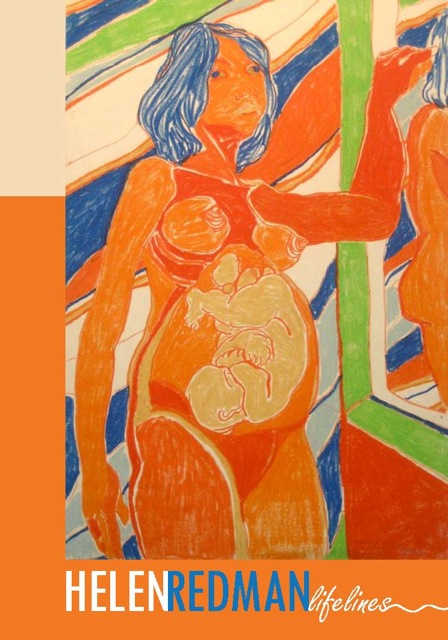
Catalogue cover: Maternal Echo, oil pastel, 43″ x 30″, 1964
Helen Redman: The Other Side of Birth
San Diego Mesa College Art Gallery
Exhibition: March, 10 — April 14, 2015
Opening reception: Thursday, March 12 from 5-7 pm
Artist’s lecture at 7 pm, immediately following reception in G101
Conversation with the Artist at gallery: Friday, April 10, 1:30 pm
7250 Mesa College Dr., San Diego, CA 92111
Phone: (619) 388-2829
Website: www.sdmesa.edu/art-gallery
Helen Redman: Through a Mother’s Eye
Women’s Museum of California
Exhibition: April 23 — May 31, 2015
Opening Reception and Conversation with the Artist: Thursday, April 23 at 6 pm
2730 Historic Decatur Road, Barracks 16
San Diego, CA 92106
Phone: (619) 233-7963
Website: www.WomensMuseumCa.org
Today I just want to say, I love you Mumu and I’m so lucky to be your daughter! I hope we have lots and lots of time to take walks and enjoy being near each other as the next many years of our lives unfold.
My Open Heart and Hands, in front of my sister Paula’s, zichrona l’vracha’s, grave marker.
Today, while cleaning through the piles of boxes and corners of my home that I need to get through before I go away, I came upon the original vow I made on January 21, 2008. I have been crying reading through my notes about this vow on scratch paper, tucked into one of my journals.
I do not speak in detail or much about the folks I have parented, cared for or held in tenuous and troubling and complex times. There are privacy issues and also, a deep desire to remain anonymous in my giving, which seems not possible, since so many folks have been involved in these adventures of mine. It’s different though when talking about things in a public context.
I’ll be honest and put down here the journal entries and notes that led to my initial vow to take some space for myself. These initial notes and thought are some of the origins that led to this process of going away for a full year Sabbatical retreat. It has been a long time coming.
The Vow I made:
In full awareness of the mysterious flow of the Universe, the River of Sparkling Light from which and to which we all return and belong, I Shoshanah Adamah Cohen/Nicole Andrée Barchilon Frank vow to attend to the Garden of my Soul and the seeds I am planting there of:
~Time for Deepened Torah Practice: Hebrew Study, Meditations, Prayer-Practice, Study of Sacred Texts, Communion with the Holy One
~Time for Writing and Art Projects: Cookbook, Arcata Eye Articles, Whatever needs to be written or created by me
~Time for Attending to my Body: Exercise, Dancing, Yoga, Walking, Massage, Trip to Hot Springs
I choose to not be distracted or drawn towards the RED LIGHT needs of others for 90 days from:
The Full Moon of Shevat, Tu B’Shevat 5768, New Year of the Trees, January 21, 2008
to
The Full Moon of Nissan, Tu B’Nissan, Erev Pesach April 19, 2008
At which time, I will reassess this vow and decide if I am called to continue this process for another period of time.
I have been re-dedicating myself to this vow for various periods of time, since the original writing. It has transformed my world. It is and has been powerful. I have said “No” so much more than I ever used to, creating Gevurah boundaries to temper my Chesed nature. I’ve included my favorite chart of the Tree of Life, that describes these qualities.
Tree of Life by Cindy Gabriel, copyright 1992
Another excerpt from the journal entry is a poem I wrote to navigate some of this territory. I’ve posted it in the Poetry section. It’s called Hineyni-Here I Am
So, from vowing to take space and saying “No” consciously more and more, I have actually managed to create the environment I have been needing. It has been a long journey. I still visit folks who are ill and attend to lots of people in various situations and generally offer myself to a lot of people in need. What is most relevant, is that my time doing this has shifted and it was the vow I took that helped shape that change.
Taking vows in the Jewish tradition is a very serious thing. We are encouraged NOT to take or make vows. They are too easy to break, and when they are made with intention/kavanah, they are seen as obligations between oneself and the Holy One and whomever we are also making a promise/vow to.
On Kol Nidre, we specifically are forgiven, in advance for all vows we take. There are lots of reasons for this, but essentially for me, what resonates in this has to do with the fact that it is VERY hard to keep promises and vows and there is a built in understanding of our human nature implicit in the practice of Kol Nidre.
So, when I take a vow, I do so knowing it is a big deal. I do not make vows lightly and I endeavor not to break them. This in itself is a very big challenge and daily practice.
May your vow taking be real and meaningful and may you find ways to release yourself from vows that are no longer relevant for you and to strengthen and engage more with the ones that are most right for you.
Attending to my vow of keeping Shabbat, so that’s all for now! Shabbat Shalom!
Once there was a man. He was one of those loose people that hang around street corners gabbing all day. One day, he was walking in the forest and there was a glen with a pond in it. The princess was just coming out from bathing in the pond. He saw her and she was very beautiful. He fell in love with her and so he hung around the palace waiting for her to come out again. Next time she went for a ride he stopped the wagon and said: “Hey, I love you. When will we be able to be together?” The princess took one look at him and said: “In the cemetery.”
He was a simple man, so he went to the cemetery to wait for her. “It’s not so easy for a princess to get away whenever she wants,” he figured to himself. “I guess whenever the coming is good she’ll be here.” He was waiting there one day, two days, getting along by a little begging, just hanging out in the cemetery. After a while he goes around looking at the gravestones and sees; this man lived to be very old, this lady died young, this one had a family, this one didn’t have a family, this one died in an accident. He started to ponder what things are all about. Every once in a while he would sit down and visualize what the princess looked like, so he wouldn’t forget why he was there.
Days go by. They bring people to the cemetery to bury them and he always watches, hangs around and eats. Nothing else is happening at the cemetery, so he watches the people who come to visit the graves. He sees people crying and hears people saying things like, “She was so pretty when she was young,” or “He was such a handsome man,” and all the other things people would say.
Weeks go by. One day he starts asking himself the question, “What is it that I have fallen in love with in the princess? If it is her physical beauty, that is very nice, but it keeps changing.” He realized that the beauty of outer forms is only one phase of beauty. There was nothing else to do in the cemetery but hang around and think and think. He was thinking about what beauty is all about, and he realized that beauty comes in so many ways that somewhere there must be the source of beauty. What could the source of beauty be? So, he kept on thinking.
Months go by. He realizes that the source of beauty must be The Holy One. Then he starts to think how beautiful The Holy One must be. All the visions of beauty he had ever seen passed before his mind’s eye. He realized how many forms beauty has. Then he started to ponder: “Maybe there is beauty without form.”
People saw this guy hanging around the cemetery sitting and thinking, so they started bringing him food so he wouldn’t have to go begging in the city. Word got out that there was a holy man sitting in the cemetery. He was still waiting for the princess but the people didn’t know that. They thought that if he’s sitting in the cemetery he must be a holy man. What else would he be doing there? People start to come and talk to him saying, “You know, I’ve got such and such troubles. What do you advise?” He would give his opinion or say, “I’ll think about it, come back some other day.” He started giving people blessings and the blessings worked.
Meanwhile the princess had gotten married, but she didn’t have any children. She tried doctors and this and that and nothing worked. One day someone said, “Listen, that holy man in the cemetery is doing great things.” She goes to the cemetery and asks the holy man for his blessing to have children.
One look at her and he recognizes the princess. “I want to thank you,” he says. “It was your beauty and your guidance that sent me to the cemetery in the first place, and since I’ve been here I’ve gotten to know many great things. If there is any merit in anything I’ve done I want that merit to be transformed into a child for you.” That’s how he blessed her.
A little while later, people saw he was sitting in very deep meditation, so they didn’t want to bother him. A few days went by and he didn’t come out of his meditation and all the food they brought was still there. The food started rotting and the flies started eating it, and soon the people saw that the flies were eating the man’s eyes too. He had died while he was contemplating the source of beauty without form.
The Raishit Chochma said that you can see from this story that one can learn from loving a woman or a man to come to the love of The Divine.
“Raising an Awareness of Awe”
“….Given that ‘the beginning of wisdom is the fear of heaven’ (Psalms: 111:10), and fear of heaven results from humility, we might expect the paradigm to begin with humility and end with wisdom. Yet Maharal is adamant that we consider a different paradigm, in which humility, and the dveykut attendant upon it, constitute the ultimate goal. Interpreting ‘Raishit Chochma Yirat Hashem’, he equates raishit with that which is primary,[1] so that fear of heaven is above wisdom both spiritually and ontologically. On the mishnah in Avot discussing the mutual interdependence of these values, Maharal further delineates the supremacy of Yirat Shamayim over Chochmah” ~ Yael Wieselberg from his paper: The Place of Yirat Shamayim in Moral Development: The Pedagogical Approach of the Maharal of Prague By Yael Wieselberg
[1] Netiv Yirat Hashem’, Chapter 1, pages 54-55.
This story was originally published in the Temple Beth El newsletter in April of 2000. It was submitted by me after asking Rabbi Aryeh, of blessed memory, if my version worked for him and was close enough to his telling.
Ethan’s baby quilt detail, made by Nicole Barchilon Frank
And lo, the people were cold in their homes. There had been sanctions and bombing and great privation for years. There was war, there was famine, there was pain.
And one day in the time of greatest darkness an Angel of God appeared dressed as an old woman. Her hair was silvery gray like the stars on cold winter nights. Her robe was pitch, like coals when they are dead of all fire. Her eyes were so black that when you looked into them, you might never find your way out again. And in all this darkness, yet she shone.
For on her robe were eight magic pockets, each one with a different light flowing from it. In one, all the children dipped their fingers and golden honey poured forth. In the second pocket, all the mothers came with their sick children and as they dipped in a warm healing salve poured forth. The fathers came and placed their hands in a third glowing pocket. From this pocket each father drew a long golden moment of rest from worry and strife. The lovers came tentatively out of their hiding places, afraid even to risk loving in such dark times. They put their hands in her fourth pocket and withdrew a radiant moment of absolute stillness and quiet where they could be alone and gaze into each others eyes. The elders came, some could barely move. And from her fifth pocket they withdrew a lone golden thread. Each thread was theirs alone and when they felt ready to sleep their final sleep, she instructed them to close their eyes and place the thread upon their navels and fall asleep to wake in the Holy One’s arms.
From the sixth pocket the warriors drew, and they wept and wept and wept as they pulled from her heart new golden hearts full of hope and strength. As they wept the roads filled with their tears and all the parched soil drank deep.
They all drew from her seventh pocket and were given a true Shabbat with dancing, laughter; time for contemplation, study and incredible foods overflowing the roads so all could be fed.
Finally when it seemed all had come forward a lone child approached the woman. She was lost, orphaned and ragged. Her hair was matted with thorns, dirt and lice. She came to the woman and rested her small head in the holy folds of the woman’s dress. The woman herself, drew from the eighth pocket a healing rich oil. She ran her fingers through the child’s hair and all the dirt and grime fled from her sacred touch. The oil smelled of roses, lavender and honey. As the child’s hair began to glow the woman pulled her hands away. As she did so, all the people drew near to the child. They wrapped her in their arms and carried her home with them.
It was the 25th of Kislev; they say when the woman came to visit. Some whispered “She was Dinah, the wounded one.” Others were sure it had been Miriam. Still others swore she was their long lost sister.
pockets of light in the universe, pockets of light in our hearts and souls
In darkness filled with sparks of light,
This midrash was originally written by me on December 16, 1998. Our teacher Rabbi Naomi Steinberg had asked our class to come up with a midrash about Hanukkah. We were on the eve of going to war somewhere. We seem perpetually to be on this eve of going to war or engaging in violent conflict. As a pacifist I am always looking at violence and its tremendous costs and trying to find a non-violent story was something that I felt called to do. The traditional Hanukkah story is full of hope and violence and exploring the theme of light in a hard time was a way for me to connect to this story from an internal place. I still tell the traditional story as well, and study it and learn from it. I just heard this old woman telling me her story and wanted to share it.
A midrash is “a method of interpreting biblical stories that goes beyond simple distillation of religious, legal, or moral teachings. It fills in gaps left in the biblical narrative regarding events and personalities that are only hinted at.” – Wikipedia
Photo taken by Frédéric Brenner, courtesy Howard Greenberg Gallery, New York. I’m the one holding the far end of the scroll, in the white skirt. This picture was taken over ten years ago.
I am looking out over a sea of yellow, green, red and orange from the fourth story window of my father’s Denver apartment. The Rocky Mountains are visible in the distance and I can even see snow on the high peaks. The sky is blue with clouds. My father (who is 91 and super healthy) and his wife Judy are napping. I am wide awake and feel energized. My time here in Boulder and Denver has been packed so full that even trying to describe one event will take me many pages. I will be finding ways to share parts of this story as slices of a much greater pie.
I was in Colorado in mid-October which coincided with the culmination of the Jewish High Holy Day season of holidays, called SimchatTorah/Joy of and in Torah. We dance around our congregations seven times with the Torah scrolls in the arms of those strong enough to carry them and then we read the very last lines and the very first lines of the Torah. We can NEVER be done with Torah, so we immediately have to read the very first line after finishing the last line. There is a seamless sounding of Hebrew words and Torah between the last letter and the first. There are numerous mystical teachings about this, but the most obvious and frequently shared one is this:
The last word of the Torah scroll is the word Yisrael, and the first word of the Torah is the word B’reishit. The last letter then is an “L” sound, which is the letter Lamed.
The first letter is a “B” sound or a “V” sounding letter named Bet or Vet. It is a letter with two names and sounds and considered one letter. It has the numeric value of two.
The Lamed has the numeric value of 30. Lamed is the tallest letter in the Hebrew alphabet, and it reaches up towards heaven. When you put the lamed in front of the bet/vet, you get the word “Lev.” Lev, in Hebrew, means heart and mind or heart/mind. It is not the word for brain. There’s an ocean of teachings in this, but I’ll stick to a strand of seaweed right now.
translation = a pure heart
Our exercise in reading the way we do is to remember and highlight that the entire Torah from end to beginning and beginning to end is about our hearts. It is a journey through the Lev that brings us into relationship with each other, the planet, our teachers and all of creation in a joyous dance of loving-kindness, righteous and just society, goodness, compassion and forgiveness.
Before we read these words of Torah in their completion and beginning, we’ve danced the seven times around our congregations with them as our dancing partners. We form a procession of joyous folks following the scrolls and their bearers around the buildings we pray in. Or, we do seven joyous dances around and around like whirling dervishes for as long as we can. I found myself at Nevei Kodesh, the Jewish Renewal congregation in Boulder, where my friend Rabbi Tirzah Firestone was leading the services. All of us in the Jewish Renewal movement are still in deep mourning for our beloved Rebbe Zalman M. Schacter-Shalomi, may his memory be for a blessing. So, our prayers were laden with tears and honoring of him and it was so wonderful to be with a community of folks all collectively mourning his death, but also celebrating his legacy.
So, in honor of our Holy Torah, we danced for several hours with the two scrolls we had and we were pumped and JOYOUS! The wonder continued beyond my wildest imaginings and became extraordinary as the evening unfolded (literally). Rabbi Tirzah’s community chose to unspool the entire scroll with all of us present. We were instructed to form a gigantic circle, there were between fifty and seventy folks in this large Torah holding circle. Each of us stood shoulder to shoulder with our hands out in front of us and as the scroll was unwound in front of us, we held the top inch of it. We had to be careful not to touch the text and only hold onto the parchment at the top. This is a very intense and rare thing, the scrolls are extremely sacred, fragile and imbued with tremendous meaning. It takes a great deal of trust and faith for any congregation to do this. If a Torah scroll accidentally falls often the entire congregation has to fast and do penance. The Torah scroll is not a book, or a piece of parchment alone, it is considered sacred in and of itself and it feels that way to anyone engaging with it.
In our imperfect human circle, there were gaps where some people were too far apart from each other and places where some folks were closer together. I moved three times, going under or around the scroll to attend to these gaps. I am acutely aware of the Torah, in my body and blood and could not tolerate or hold the place of trust about these gaps in the circle. It was literally impossible for me to not go try and make sure that the tension in the scroll was not too great, behaving as is my nature, and being a Jewish mother to the Torah scroll, not just to the people holding it.
I helped a little boy get on a chair because having him hold our sacred scroll was too awkward from his height and he really wanted to hold onto it. So, we, his mother and I, had to keep moving him, and the chair and asking the people next to us to hold our parts for us while we helped him be able to also participate. This was one of many spectacular moments for me, being next to this little boy and his excitement about being able to participate, which he would not have been able to do if we hadn’t figured out the chair for him to get him up to the right height.
The circle was somewhat liquid at first until it was all figured out, which took about twenty minutes. By the time I was not helping someone or making sure there wasn’t a gap I found myself by the end of the scroll. I was shoulder to shoulder with some very stoned young men. They were very aromatic and smiley. This did not reassure me, but they looked capable and blissful, so I just kept checking in with them. Why did the whole scroll get unrolled? It’s a special thing to just witness, but Rabbi Tirzah and several other Torah readers wanted to give all of us something brilliant. They went around to each person, Torah readers on the inside of the scroll, with us Torah-scroll holders on the outside. We were instructed, individually, to remove one of our hands and point somewhere we couldn’t see in front of us on the scroll. The Torah readers then read for us a few lines from where we had pointed. So, we each got our own unique special Torah reading.
The lines that I got were from Deuteronomy 31:7-9:
“Moses summoned Joshua and said to him before the eyes of all Yisrael. ‘Be strong and courageous, for you shall come with this people to the land that HASHEM swore to their forefathers to give them, and you shall cause them to inherit it. HASHEM is the One Who goes before you; He will be with you; He will not release you, nor forsake you; do not be afraid and do not be dismayed.’ Moses wrote this Torah, and gave it to the Kohanim, the descendants of Levi, the bearers of the Ark of the Covenant of HASHEM, and to all the elders of Israel.”
If you’ve been following my Jubilee series, you will understand why this felt perfect for me. I am planning to go away for a retreat and I am actively looking for the right “land.” I know I am not going to do retreat in Israel, but this piece of Torah was telling me to be strong and courageous. To trust and to not fear, that the land will be given or shown to me and that I should not be dismayed. This is amazingly helpful for me. The piece about the Torah being given to the Kohanim (the high priests) and the descendants of Levi and all the elders of Israel resonates as well. I am a Kohen, which means I am a descendant of the Kohanim, and as one of those descendants, who is deeply engaged with this handed down powerful scroll, I find it holds me more than I ever have the chance to hold it.
My several hours of dancing with our Holy Torah and holding it and watching over it were a small fraction of how I am held and danced and dreamed and nurtured by Torah.
To be on the safe side, since interpretation of our Holy text is very complex, let me ask outright for help. In case you happen to know where the Holy One has put that land for me to spend silent retreat away from people on, please let me know. I am moving closer to this place, and like my ancestors, it is not something that is clear to me. Is it over the next ridge or around a corner or at your vacation cabin? This is a place I am coming to and journeying to, but have not yet found.
Please use the contact form here to email me if you are aware of or have the perfect place for me to spend a few solitary, quiet months of retreat and prayer.
May all your dancings and movements bring you closer to your Lev Tahor, your pure heart!



 Open Heart Open Hands