Category Archives: Practice

Organizing Optimally, Nicole’s Outrageous Offerings on How to Navigate Large and Small Events

Pouring the Bubbly at a Rosh Hashanah Luncheon, which I organized for my Jubillee Birthday Celebration
Pouring the Bubbly or the Sparkling Apple-Cider at a Rosh Hashanah Luncheon, which I organized for my Jubillee Birthday Celebration, photo courtesy of Lorraine B. Miller-Wolf

1.     Do your homework: This means that you must approach any meeting or organizing you do from a place of knowledge and hopefully wisdom. It also means you are choosing to work as hard as you are and it isn’t on anyone else to do the same amount of work or to be as effective or extended as you are. This is your CHOICE. Just like with homework, if you are resourced well, you’ve slept and eaten and exercised and basically seen your therapist recently or done any number of things that you need to do for yourself, you will succeed and so will your event!

2.     Start at the End: Assign or find the folks who will be responsible for CLEANING-UP your event. Do this part early on in your process. I actually recommend getting this done as soon as you know the date and time of your event. When you are in charge of an event or care about it, you will be there early, you will be doing a hundred things, you will be EXHAUSTED by the time things need to get cleaned up. If you can’t find volunteers who will be in good spirits and energetic and capable to do this clean-up, HIRE someone! This is money well-spent, always.

3.     BE NICE: Expect that many things will go wrong, learn to breathe and be flexible and always BE NICE! Whatever your feelings are, no matter how valid they are, you will be remembered for your outbursts, rudeness and inappropriateness. So, try to get your anger out of the way before you organize people or communicate with large groups. People are more receptive to your agenda, your ideas and your visions when they aren’t being blasted with your (probably valid) feelings. This rule is for community organizing, not protest marches or confrontations with despots who need different approaches. Remember your community is your ally, not your enemy.

4.     DELEGATE: Get help and realize, at the same time, that if it matters to you, which it should, you will probably still do the lion’s share of the work. Do not expect other people to have your standards, your work ethic or your priorities. Be prepared to have everything stop happening if you decide to pull-out because you are overwhelmed or doing too much. Take it into consideration at the beginning of your organizing, so you don’t have to reach that place. Maybe you’ll get lucky!

5.    MONEY: You need Money, you need donations. Food is good! If you tempt people with goodies, they will come and partake. This means outreach in the community to get stuff donated for big events. This is where your presence as a nice person who people can count on is crucial. If you are a flake or unpleasant, people won’t be as interested in giving you money, stuff or time. This applies to getting musicians to donate their time as well.

6.     HUMILITY: Don’t be afraid to apologize or admit you are wrong. Community organizing means you are working with the community. Expect to learn something, to be challenged, to be confused or supported and recognize that the nature of community work is cooperative.

7.    BEING STRONG AND CLEAR WHEN YOU ARE IN CHARGE: Cooperative work requires humility but once that has been said and understood, if you don’t manage things well and take control when you should, things will either flop or get out of hand. So it behooves you to set clear agendas, have good facilitators and note-takers (this is especially important when issues are heated.)

8.    MEDIA: Media is crucial. Find out what you can get for free, there is lots of it, but all of it has deadlines and specific formats. This is the grunt work, if you can assign someone else this task, who will actually do it, great! If no one knows about your event or you don’t target the right places to advertise or alert, even if everything else is perfect, no one will be there to appreciate it!

9.    SLOW DOWN: Say less! Listen More! Slow Down! Please note, I am notoriously bad at all of these and have paid the price many times over for not following this advice. Being respectful of others is the best way to achieve your goals, no matter what is going on.

10.   YOU CAN’T DO IT ALL: Don’t try to tackle every issue. Find the category that really charges you. Some people are activated by the environment, some by social injustice, some by legal inequalities, some by police brutality, globalization etc… You will be more effective working where you have the most energy. All of these issues are interconnected though and there will be overlap.

11.   COMMUNITY: Use your community, involve yourself in where you live and work and you will find allies.

12.   BE ORGANIZED, (no kidding!): Develop a good filing system. Don’t laugh! This also applies to your computer data. Organize things in files and folders by date, organization, issue etc… If it takes you an hour to find the thingamajig that what’s his name gave you, you’ve just lost valuable time for no reason. Compile email lists and phone lists and keep them at the front of your folders so you can call what’s his name and actually remember who he is and get him to do the thing he promised. In this day and age, create a Google or other easy online Drive format and import all your contacts. Keep your contacts list current, delete old addresses/information. You don’t need 3,000 copies of your contacts. You need to have a back-up of them somewhere electronic, an online version and if you want to be very diligent a printout, so in case all computer related things stop (in a power outage for example) you can still hopefully reach folks you need to reach.

13.   REMINDERS: Remind everyone multiple times about meetings and events. I know it sounds like elementary school, but we’re all busy saving the world and one more meeting is easy to forget. I do this exclusively by email, which is unfair for all those who don’t use that system, but it is the only way I can manage to get it done quickly. If you are working with people who don’t have access to computers, you must develop phone-trees and quick post-card type reminders. Also, be early to all your meetings and endeavor to start things on time. If you care, you will always be there at the beginning and, usually be the last one to leave as well. (That’s the truth!)

14.   BE PLAYFUL OR PRAYERFUL: There is always time for a quick icebreaker activity/song or introduction circle with a brief one-word check-in or something like that. Help people arrive in the space by giving them a moment to be humans together in a room, before they tackle an issue or get down to doing a large job, this is what all coaches know, rev your team up before you send them out on the court, reassure them, remind them of why they are there and appreciate them.

15.   THANK YOUS: I endeavor to always personally write, yes, actually hand- write a note of thanks to the vendors who gave things, to anyone who really extended themselves, to your co-workers/co-leaders, to volunteers and to someone who always does things but never maybe gets a thank you. Believe me, the people you thank will remember that you sent them a thank you. This is not a minor step, just because it’s close to the end of the list. This can take two weeks or more to do, you don’t have to rush to do it, but if you were organized as you should have been, you will have the names and addresses of folks handy that you need to thank.

16.   BE NICE! I know I said that already. It just bears repeating. This is also related to “do your homework.” The more clarity you have as an individual, the more balanced you are, the more effective you will be in all that you do. When you are in the community, you are in the public eye. Your grace and intelligence will get you far, so develop them.
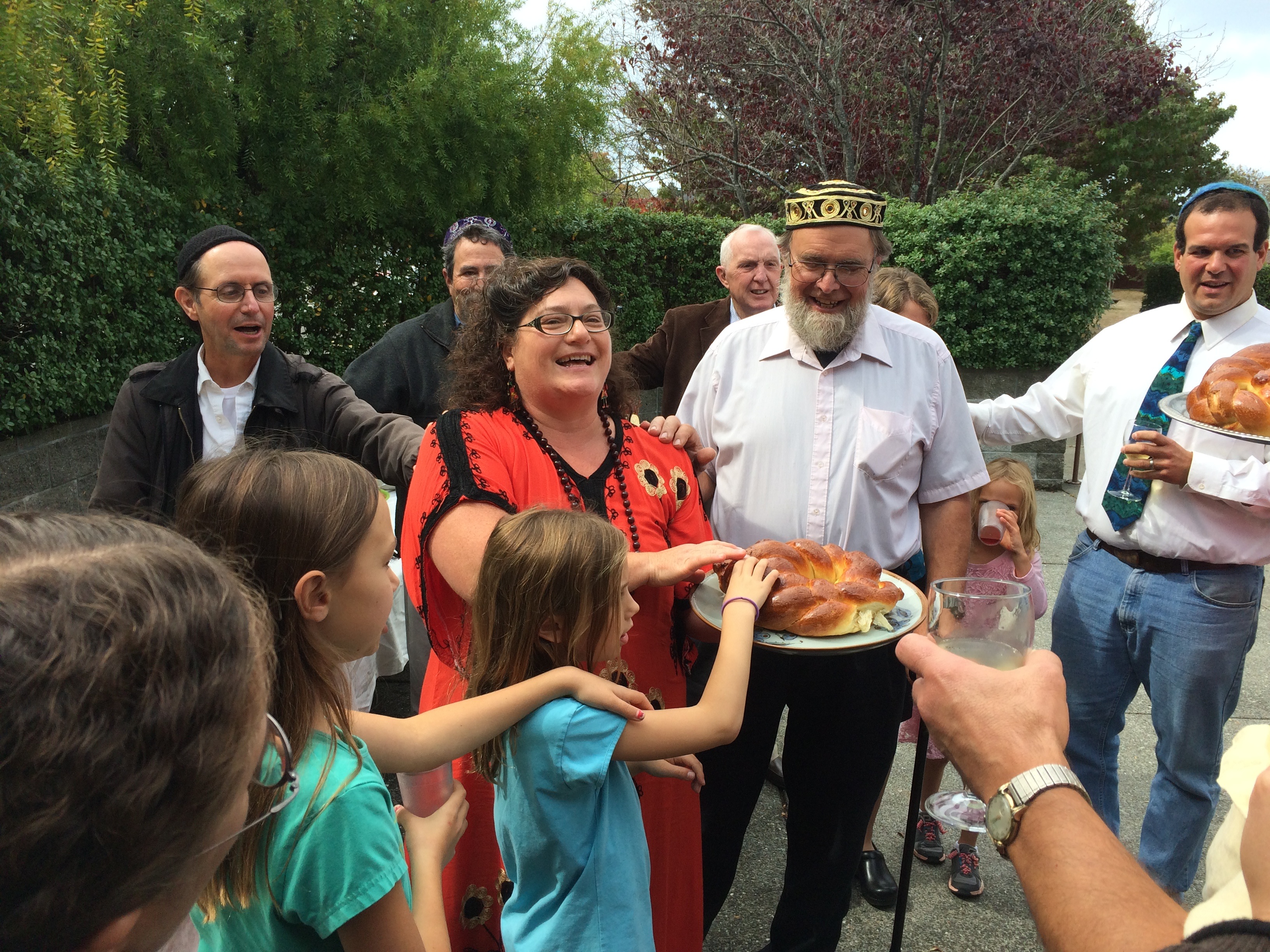
 

2014-09-26 17.03.20Breaking Bread Together at Temple Beth El, Eureka. Photo by Lorraine B. Miller-Wolf

Vows, Wow! Meaningful Kavanah (Intention) coupled with Holy Energy-Watch Out!

Nicole's Open Heart and Hands, in front of my sister Paula's grave marker.
My Open Heart and Hands, in front of my sister Paula’s, zichrona l’vracha’s, grave marker. 

Today, while cleaning through the piles of boxes and corners of my home that I need to get through before I go away, I came upon the original vow I made on January 21, 2008. I have been crying reading through my notes about this vow on scratch paper, tucked into one of my journals.

I do not speak in detail or much about the folks I have parented, cared for or held in tenuous and troubling and complex times. There are privacy issues and also, a deep desire to remain anonymous in my giving, which seems not possible, since so many folks have been involved in these adventures of mine. It’s different though when talking about things in a public context.

I’ll be honest and put down here the journal entries and notes that led to my initial vow to take some space for myself. These initial notes and thought are some of the origins that led to this process of going away for a full year Sabbatical retreat. It has been a long time coming.

The Vow I made:

In full awareness of the mysterious flow of the Universe, the River of Sparkling Light from which and to which we all return and belong, I Shoshanah Adamah Cohen/Nicole Andrée Barchilon Frank vow to attend to the Garden of my Soul and the seeds I am planting there of:

~Time for Deepened Torah Practice: Hebrew Study, Meditations, Prayer-Practice, Study of Sacred Texts, Communion with the Holy One

~Time for Writing and Art Projects: Cookbook, Arcata Eye Articles, Whatever needs to be written or created by me

~Time for Attending to my Body: Exercise, Dancing, Yoga, Walking, Massage, Trip to Hot Springs

I choose to not be distracted or drawn towards the RED LIGHT needs of others for 90 days from:

The Full Moon of Shevat, Tu B’Shevat 5768, New Year of the Trees, January 21, 2008

to

The Full Moon of Nissan, Tu B’Nissan, Erev Pesach April 19, 2008

At which time, I will reassess this vow and decide if I am called to continue this process for another period of time.

I have been re-dedicating myself to this vow for various periods of time, since the original writing. It has transformed my world. It is and has been powerful. I have said “No” so much more than I ever used to, creating Gevurah boundaries to temper my Chesed nature. I’ve included my favorite chart of the Tree of Life, that describes these qualities.

Tree of Life by Cindy Gabriel, copyright 1992

Another excerpt from the journal entry is a poem I wrote to navigate some of this territory. I’ve posted it in the Poetry section. It’s called Hineyni-Here I Am

So, from vowing to take space and saying “No” consciously more and more, I have actually managed to create the environment I have been needing. It has been a long journey. I still visit folks who are ill and attend to lots of people in various situations and generally offer myself to a lot of people in need. What is most relevant, is that my time doing this has shifted and it was the vow I took that helped shape that change.

Taking vows in the Jewish tradition is a very serious thing. We are encouraged NOT to take or make vows. They are too easy to break, and when they are made with intention/kavanah, they are seen as obligations between oneself and the Holy One and whomever we are also making a promise/vow to.

On Kol Nidre, we specifically are forgiven, in advance for all vows we take. There are lots of reasons for this, but essentially for me, what resonates in this has to do with the fact that it is VERY hard to keep promises and vows and there is a built in understanding of our human nature implicit in the practice of Kol Nidre.

So, when I take a vow, I do so knowing it is a big deal. I do not make vows lightly and I endeavor not to break them. This in itself is a very big challenge and daily practice.

May your vow taking be real and meaningful and may you find ways to release yourself from vows that are no longer relevant for you and to strengthen and engage more with the ones that are most right for you.

Attending to my vow of keeping Shabbat, so that’s all for now! Shabbat Shalom!

Remembering Rabbi Aryeh Hirschfield, zt”l, of blessed memory, Crying a River of Tears

My sweet and wonderful teacher, Rabbi Aryeh Hirschfield. Copyright 2010 The Rabbi Aryeh Hirschfield Legacy Trust

The Source of Beauty

(Story told by Rabbi Aryeh Hirschfield as he remembered it from his teacher Reb Zalman Shachter-Shalomi zt”l, of blessed memory, retold by Nicole with permission from Rabbi Aryeh)

Once there was a man. He was one of those loose people that hang around street corners gabbing all day. One day, he was walking in the forest and there was a glen with a pond in it. The princess was just coming out from bathing in the pond. He saw her and she was very beautiful. He fell in love with her and so he hung around the palace waiting for her to come out again. Next time she went for a ride he stopped the wagon and said: “Hey, I love you. When will we be able to be together?” The princess took one look at him and said: “In the cemetery.”

He was a simple man, so he went to the cemetery to wait for her. “It’s not so easy for a princess to get away whenever she wants,” he figured to himself. “I guess whenever the coming is good she’ll be here.” He was waiting there one day, two days, getting along by a little begging, just hanging out in the cemetery. After a while he goes around looking at the gravestones and sees; this man lived to be very old, this lady died young, this one had a family, this one didn’t have a family, this one died in an accident. He started to ponder what things are all about. Every once in a while he would sit down and visualize what the princess looked like, so he wouldn’t forget why he was there.

Days go by. They bring people to the cemetery to bury them and he always watches, hangs around and eats. Nothing else is happening at the cemetery, so he watches the people who come to visit the graves. He sees people crying and hears people saying things like, “She was so pretty when she was young,” or “He was such a handsome man,” and all the other things people would say.

Weeks go by. One day he starts asking himself the question, “What is it that I have fallen in love with in the princess? If it is her physical beauty, that is very nice, but it keeps changing.” He realized that the beauty of outer forms is only one phase of beauty. There was nothing else to do in the cemetery but hang around and think and think. He was thinking about what beauty is all about, and he realized that beauty comes in so many ways that somewhere there must be the source of beauty. What could the source of beauty be? So, he kept on thinking.

Months go by. He realizes that the source of beauty must be The Holy One. Then he starts to think how beautiful The Holy One must be. All the visions of beauty he had ever seen passed before his mind’s eye. He realized how many forms beauty has. Then he started to ponder: “Maybe there is beauty without form.”

People saw this guy hanging around the cemetery sitting and thinking, so they started bringing him food so he wouldn’t have to go begging in the city. Word got out that there was a holy man sitting in the cemetery. He was still waiting for the princess but the people didn’t know that. They thought that if he’s sitting in the cemetery he must be a holy man. What else would he be doing there? People start to come and talk to him saying, “You know, I’ve got such and such troubles. What do you advise?” He would give his opinion or say, “I’ll think about it, come back some other day.” He started giving people blessings and the blessings worked.

Meanwhile the princess had gotten married, but she didn’t have any children. She tried doctors and this and that and nothing worked. One day someone said, “Listen, that holy man in the cemetery is doing great things.” She goes to the cemetery and asks the holy man for his blessing to have children.

One look at her and he recognizes the princess. “I want to thank you,” he says. “It was your beauty and your guidance that sent me to the cemetery in the first place, and since I’ve been here I’ve gotten to know many great things. If there is any merit in anything I’ve done I want that merit to be transformed into a child for you.” That’s how he blessed her.

A little while later, people saw he was sitting in very deep meditation, so they didn’t want to bother him. A few days went by and he didn’t come out of his meditation and all the food they brought was still there. The food started rotting and the flies started eating it, and soon the people saw that the flies were eating the man’s eyes too. He had died while he was contemplating the source of beauty without form.

The Raishit Chochma said that you can see from this story that one can learn from loving a woman or a man to come to the love of The Divine.

“Raising an Awareness of Awe”

“….Given that ‘the beginning of wisdom is the fear of heaven’ (Psalms: 111:10), and fear of heaven results from humility, we might expect the paradigm to begin with humility and end with wisdom. Yet Maharal is adamant that we consider a different paradigm, in which humility, and the dveykut attendant upon it, constitute the ultimate goal. Interpreting ‘Raishit Chochma Yirat Hashem’, he equates raishit with that which is primary,[1] so that fear of heaven is above wisdom both spiritually and ontologically. On the mishnah in Avot discussing the mutual interdependence of these values, Maharal further delineates the supremacy of Yirat Shamayim over Chochmah” ~ Yael Wieselberg from his paper: The Place of Yirat Shamayim in Moral Development: The Pedagogical Approach of the Maharal of Prague By Yael Wieselberg

[1] Netiv Yirat Hashem’, Chapter 1, pages 54-55.

This story was originally published in the Temple Beth El newsletter in April of 2000. It was submitted by me after asking Rabbi Aryeh, of blessed memory, if my version worked for him and was close enough to his telling.

Hanukkah Grinchyness and Cozy Christmas Musings

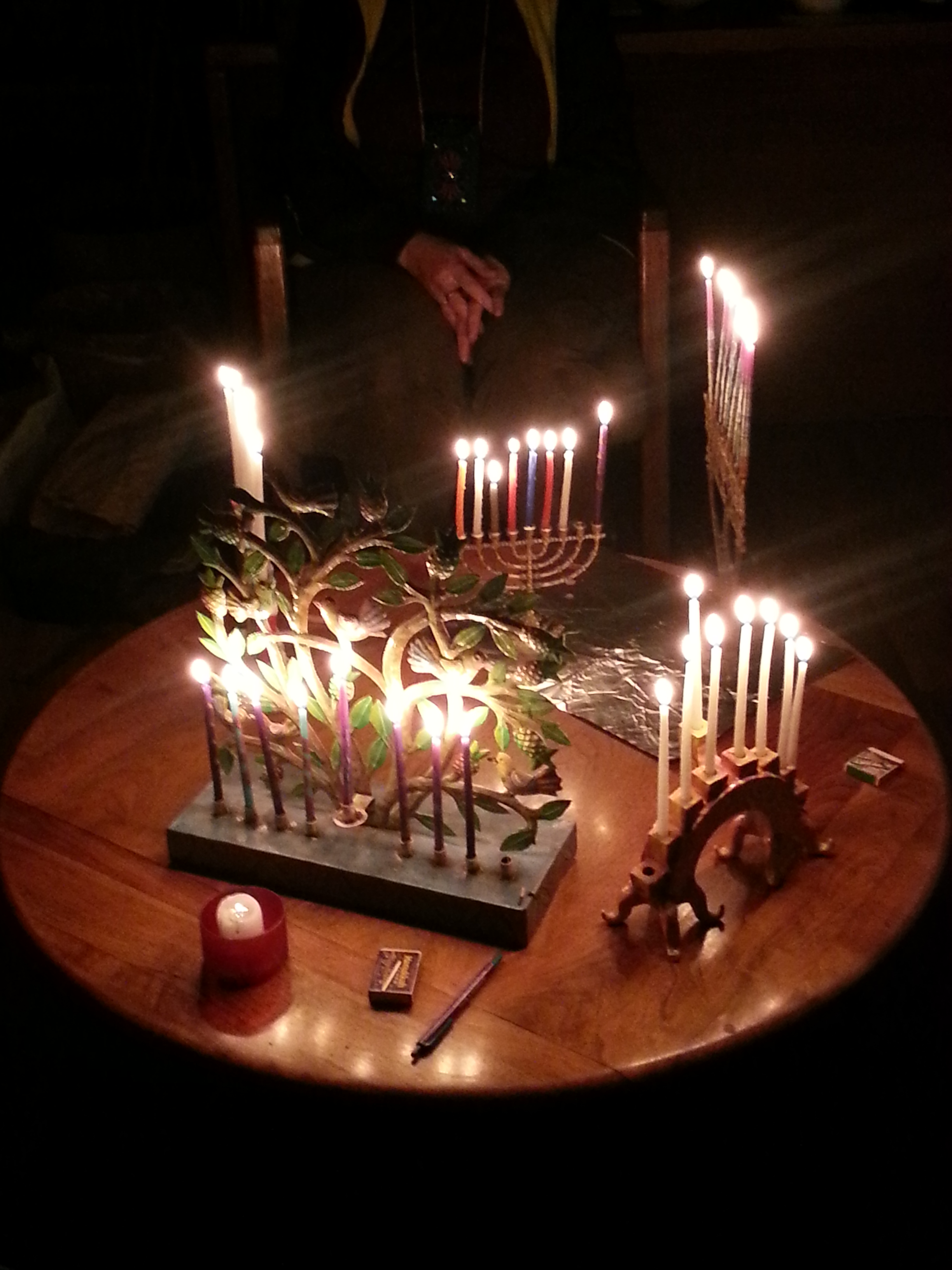
Hanukkah candles burning so beautifully. Picture by Nymiah Eliyahu

This is an older piece, from my Just Being Frank Column in the Arcata Eye. It was originally published on December 7th, 2004. It is still relevant. This post is an edited version of that original. My youngest son is no longer seven, he’s almost eighteen! I hope you will appreciate these thoughts and perhaps understand a little more about what being Jewish is like at this time of year.

This is normally a very hard time of year for a more observant Jewish person. The Christmas hype and buying craze is so intense. Everywhere I go, from the doctor’s office to the bank to the grocery store I am confronted with my difference. It’s not so terrible to be different. It’s mildly irritating when folks perceive me as a “Scrooge” because I don’t have “Christmas Spirit.” The hardest thing this year, so far, was my seven-year-old son asking if we could do Christmas too, since it was cozier than Hannukah. These were his words. He actually said, “Christmas is cozy.”

Now mind you, we do not own a television. Our youngest son doesn’t watch television at home and is allowed an occasional ½ hour at the neighbor’s house or an occasional hour at his friend’s house if he’s visiting over there. So, his mainstream exposure results in an average of about three hours a month. This is a very reduced amount of cultural exposure impacting his seven-year-old brain. He goes to a small school where they do a lot less of the Santa stuff. Still, he thinks Christmas is cozy. We have a Jewish home and celebrate Jewish holidays in it. We participate in other folk’s celebrations from Eid al-Fitr celebrations connected to Ramadan to Losar the Tibetan New Year but not generally in our own home. We have never celebrated Christmas.

Channukah gets turned into an alternative Christmas by many Jewish parents in order to confront this image of coziness. Gift giving at Hannukah (it can be spelled and celebrated so many different ways) is very new. It’s the result of modern American Judaism needing to find some alternative for their children during a time that makes them feel different or less special.

“Jonathan Sarna, professor of American Jewish history at Brandeis University, explains that Jews used to exchange gifts only on Purim, but in the late 19th century there was a shift from Purim to Hanukkah. Christmas itself became magnified in the late 19th century when it became a national holiday in America. The Jewish custom shifted in imitation of Christmas, as its consumerism grew.”~Natasha Rosenstock

As a confident adult, my feelings of difference aren’t going to cause me any lack of sleep. For children it’s just not the same. And there’s the whole consumer present thing. I mean no disrespect to all the vendors and artisans whose livelihoods are dependent on the buying which folks do at this time of year. I’m delighted if folks buy local art, music, foodstuffs, crafts or other Humboldt County creations. Unfortunately most folks are shopping at Old Navy or massively stressing themselves, their credit cards and/or their families out.

In December of 2003, I was in a car accident when two twelve-year old girls thought it would be a good idea to go for a joy ride. They came out of their driveway late at night with no lights on, during a wet and rainy night. They struck me, and dented my car and also ran over a water main pipe. I was driving home from my gig on the Arcata Plaza teaching and singing Chanukah songs. It was a wet mess, but no one was injured. They did run away and drove off, leaving me to confront the police and the grandparents, in the rain and water spuming and sloshing side of the road.

So, this year being told Christmas is cozier than Channukah seems mild in comparison. I’m not the kind of parent that enforces her beliefs on her children or even on others or my spouse. I’m an equal opportunity believer. The only caveat to that is while your beliefs and mine do not have to be the same, I do not allow my children, or folks in my home, to engage in behavior that hurts others physically or emotionally. You’re just not welcome at my place if you need to insult others, condemn them to hell, or use racist, sexist, or homophobic language. While you might not be welcome in my home if you engaged in these behaviors, I’d still agree to meet you for tea somewhere else and try to understand you or work hard to find common ground with you.

I have engaged in a few common ground activities since my article about needing to interact with the “other.” My rabbi, Naomi Steinberg, five other congregants and myself sang at the Eureka Interfaith Fellowship’s Thanksgiving Sing. We were the only non-Christians there and we were welcomed, applauded, thanked and honored. It was a very beautiful evening of sharing with only a few hard moments for me personally. There was one song about having a thankful, joyful heart that was specifically thankful for “God’s burning justice.”

I’m not fond of burning justice; the two terms are oxymorons in my opinion. Burn and justice don’t really belong in conjunction with one another. Burning crosses on lawns, burning Jews, burning Iraqi children with American bombs, burning Vietnamese people with Napalm, burning our planet with toxic wastes, are just some forms of burning, I don’t associate with justice. Other than that one line in one song though, it was lovely. I was also invited into Arcata’s Pacific Coast High School (on the Arcata High campus) to talk about Judaism for two World Religion classes there. They want me back for their panel discussion with other folks from different religious paths. I am continuously moving along on this journey of dialoguing with people who see the world differently than I do.

These conversations are a kind of light kindling that resonates more closely with Channukah. It’s not about eight days of presents. It’s about finding something to be grateful for, some new light shed on an old problem and because we focus on it for eight days we get to see the light growing and hopefully end up a little wiser. Hanukkah is actually a very cozy holiday, full of family, food, friends and beautiful glowing candles. So, I invite you to kindle some light in your homes and in your hearts and shed some light on any places in your life that need more than just one candle’s worth of illumination.

~~~~byline ~~~~ Nicole Barchilon Frank, lives, loves, prays, struggles and is cozy in her home in Northern California and she is always looking for a way to make Hanukkah and the world cozier for all children.


Applesauce and Hanukkah!

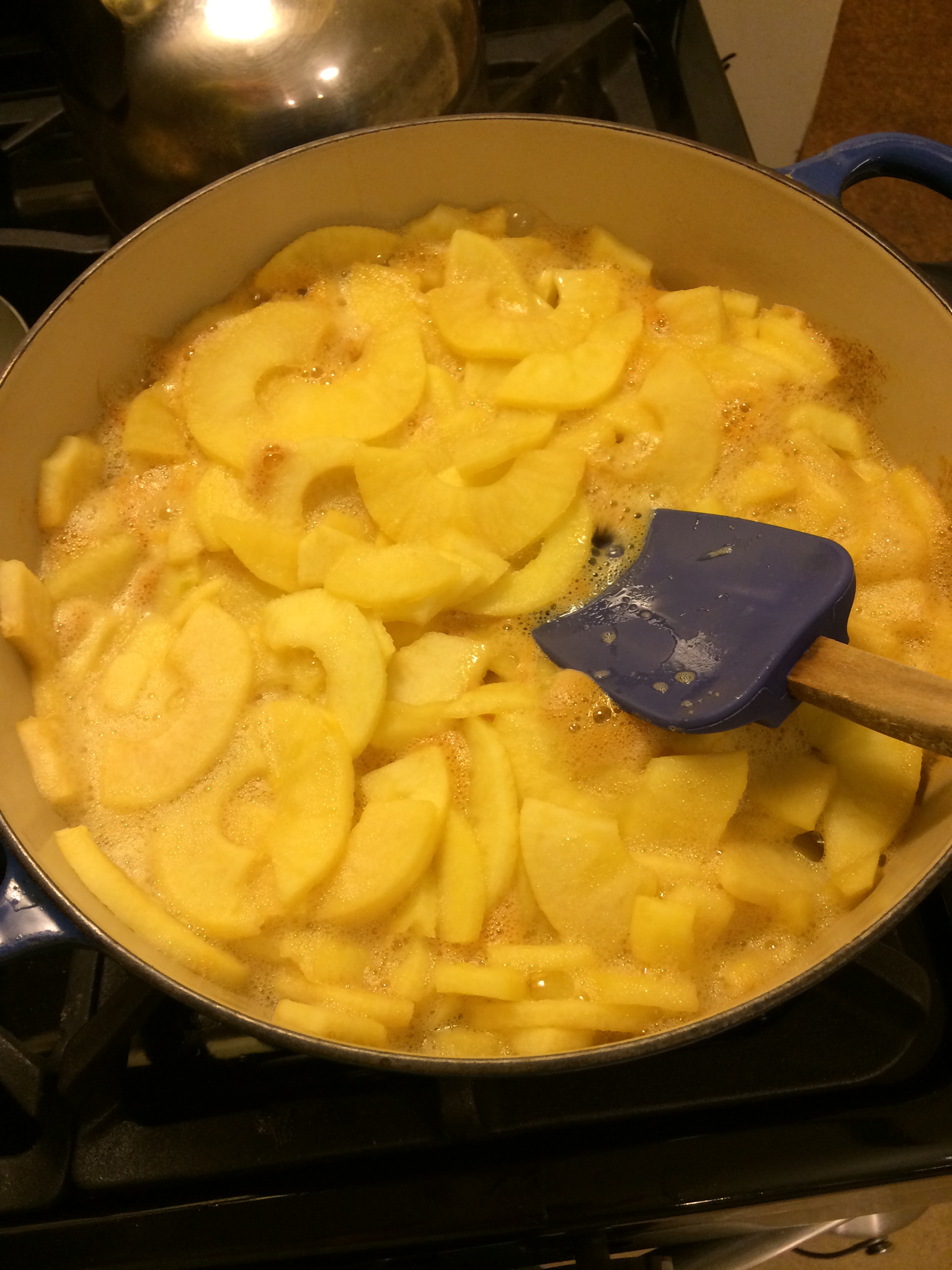
Peeled and Sliced apples cooking in applejuice.
Peeled and Sliced Apples cooking in apple-juice.

Perfect applesauce is not hard to make. Mine is sugar free as well. The apples are sweet enough, especially if you cook them in pure apple-juice (organic, unfiltered) or apple-cider (unsweetened). The thing is, like most of my recipes, time is the crucial ingredient. It takes a few hours, really to make applesauce, at least two. It’s a process. First you need to peel lots of apples, why bother making fresh applesauce if you are only making a little bit? It keeps for a while, you can give it away or you can preserve it. However you do it, it’s worth making a significant amount.

I have an old fashioned apple-corer/peeler that is hand held. This makes my apple-peeling and coring much easier. But you still have to navigate the stray peels and parts that don’t come off. Or you can just peel by knife. I like to have help when I am doing this job, so it goes quicker, and also because having help in the kitchen is the way to go.

I put enough juice in the pot to almost cover the apples, a little less or more, won’t make a big difference. You do want enough liquid though. I cook on a medium-low heat, uncovered for a long time, stirring frequently until there are no recognizable apple pieces and it gets very broken down and looks like brown mush. It’s done then. I put a dash of salt, just a dash and sometimes add a 1/2 teaspoon of vanilla as well, (optional).

Applesauce, of course, is the perfect complement to Latkes (potato pancakes) for Hanukkah. It’s best to make the applesauce a day or two ahead, because making and cooking the Latkes is time-consuming and messy (see my gluten-free Latke Recipe). You can enjoy applesauce all year round though. I don’t think using old apples is always the best. I use different apples based on who has dropped off a bag of them at my house, or what I find in the stores. This batch, photographed above, was made with Fuji apples, and it came out great.

I’ve used “applesauce” apples, meaning they were the rejects or less than appealing looking apples. Using older apples often means you have to cut out a lot of bad parts. I am not a fan of using less than excellent ingredients in what I cook. You can make good applesauce with funky apples, but you can make great applesauce with good apples as well. That said, making applesauce with older apples is a good way to use an apple that is no longer appealing to eat fresh. I would prefer if you used an older apple in a crisp or something because the crisp has sugar and butter and oats also happening and the apple is part of the story, not the WHOLE story. Apples are the WHOLE story when you are making my applesauce. Please, do NOT add other things to my applesauce recipe, if you do, then it is no longer my version. Lots of people like combination applesauce versions; peach/apple, apple/cranberry, apple/pear etc.. I think those are fine, but this is not the recipe for those, since I’ve never made those. I am a purist in certain things. I guess applesauce is one of those things!

Applesauce is also a really good first food to give someone after surgery, once they’ve been cleared for that kind of food, or for folks who are feeling under the weather. Serve it warm, not cold, it makes a person feel better. It is for sure a comfort food. See my Surgery Support: Pre and Post Lists for Optimal Recoveryand the other fabulous thing about making your own applesauce is how your home smells while it is cooking, Absolutely AMAZING!!!!!

Enjoy your applesauce and check out my Latke Recipe also, Happy First Day of Hannukkah/Channukah/Chanukkah/Hanukkah (however you choose to spell it!)