Most folks are clueless about salt. I mean this with no disrespect, but I have found it to be true. Salt is not your enemy, nor is it bad for you. It is only a problem when you are eating too much processed foods or if you have a specific medical condition. Even then, talk to your doctors, but I bet if you eliminated processed foods you could actually salt your food with real salt.
“Salt was to the ancient Hebrews, and still is to modern Jews, the symbol of the eternal nature of God’s covenant with Israel. In the Torah, the Book of Numbers, is written, “It is a covenant of salt forever, before the Lord…” On Friday nights Jews dip the Sabbath bread in salt. In Judaism, bread is a symbol of food, which is a gift from God, and dipping the bread in salt preserves it—keeps the agreement between God and his people. Loyalty and friendship are sealed with salt because its essence does not change. Even dissolved into liquid salt can be evaporated back into square crystals. In both Islam and Judaism, salt seals a bargain because it is immutable.”
~©Mark Kurlansky, Salt: A World History
If you really want to know more about Salt, beyond what I am sharing here, please read Mark Kurlansky’s book Salt: A World History. If you can, please order directly from his website or your local bookstore.
I no longer use soy sauces of any kind, even gluten-free tamari has left my cooking. I tried the coconut aminos, and occasionally when I am doing something with a particularly Japanese, Korean, or Chinese kind of flavor and I feel it absolutely needs that kind of taste I will use those instead. Some folks really hate all the soy alternatives and need that flavor. If you are mostly cooking from that part of the world, you may need to use soy based products, but I prefer not to at this point.
Just say YES to SALT
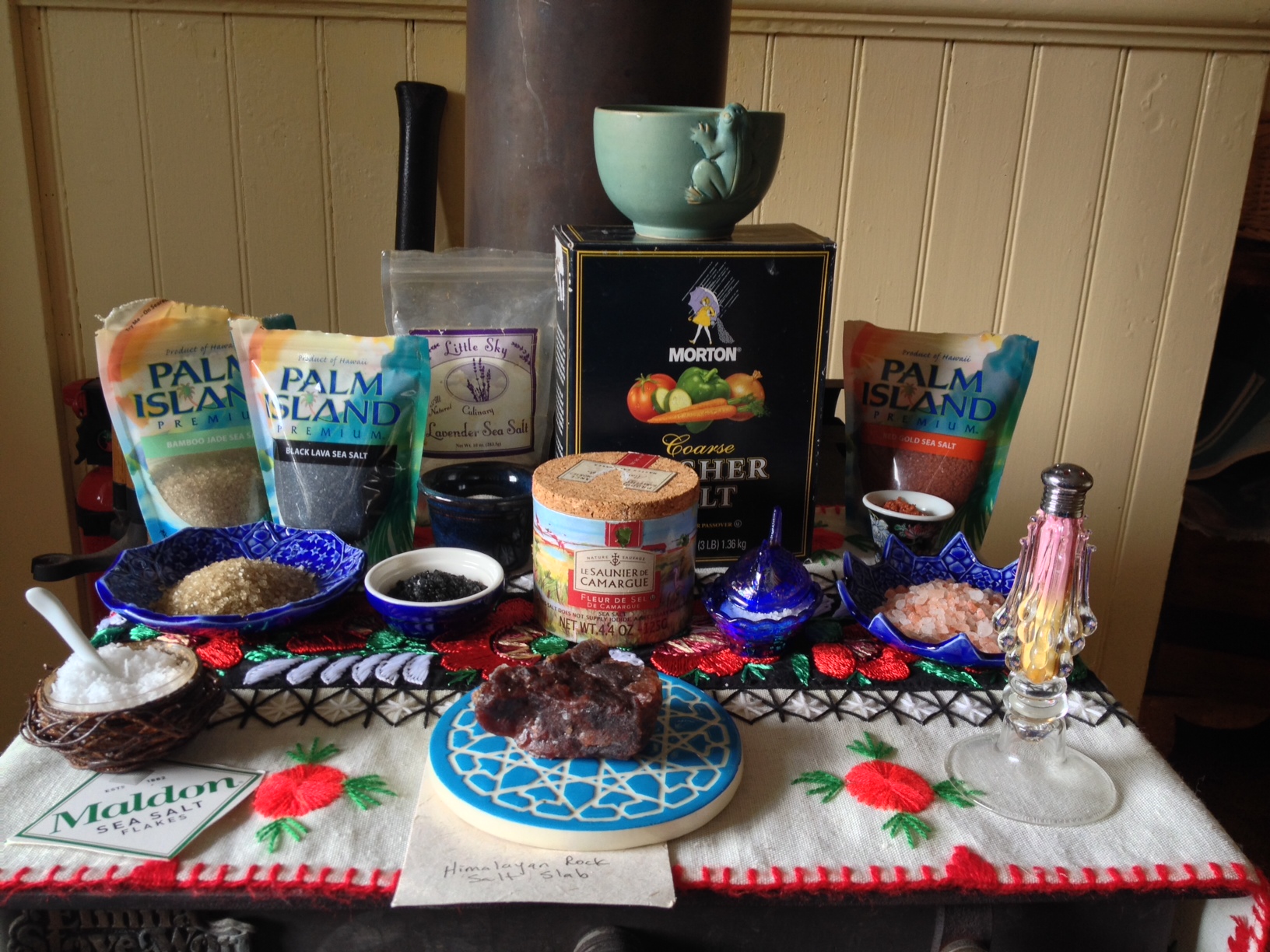
So, let’s talk salt. I usually have on hand at least five or six different salts, as you can see from this picture above. I am always on the lookout for different salts and will tell friends when traveling, “if you want to bring me something back, I am always in the mood for salt.” One friend while traveling in the Himalayas returned with a purple rock and reverentially handed it to me. “I said what is it?” He said take a lick, and I did and sure enough it was a sulphur flavored salt slab. This is the purple salt in the picture sitting on one of my brother Paul Barchilon’s coasters. The green and large pink rock salts are also on dishes of his.
Sometimes, when I want to engage folks with their taste buds and they are up for it, I give them the Himalayan purple slab and tell them to take a taste. Most folks are not happy with this particular salt’s flavor, but I love the intense mineral taste that brings me to the stark and high-peaked mountains. One lick and I am standing above it all, yet grounded right here in my body.
Nicole’s Salt Rules:
(Salt does RULE!)
- You don’t need a lot of salt to make things taste good.
- Experiment with different salts and combining or pairing them with what you are cooking.
- If you cannot afford a wide array of fancy expensive salts, and most folks cannot or wouldn’t dream of spending a lot of money on salt, you can get away with just having kosher salt flakes. Kosher Salt flakes are cheaper than any other salts and stand far above almost any other salts that the average person buys. Rock Salt can be found cheaply now as well. Also Real Salt, from Utah, if you are in the U.S.A. or bulk pink Himalayan Salts are not that expensive.
- Salt your food at the very end, not while you are cooking. This is almost always the case, but sometimes I salt mushrooms or soups close to the end of what I am doing. I also salt meat, chicken or fish before cooking them or have the salt in the marinade, but not during.
- Salt changes things, it is a chemical, it is powerful, it shifts the flavors, either enhancing them or transforming them. A little can go a long way, if you do it right.
- If you are cooking fish it is a good idea to soak it for at least 1/2 hour in a large stainless steel or glass bowl (NEVER PLASTIC) with about 1/2 cup or so of kosher salt flakes. When you do this, you will see a scummy layer of stuff that is in the water. Salt purifies and removes toxins. It is not a guarantee that you are getting all the nasty chemicals in our oceans and rivers out of your fish, but it helps. Rinse the fish off and then marinate or cook. You do not need to salt your fish too much.
- Brine, Brine, Brine your poultry. If you cook chicken or turkey and you don’t brine it, you are missing out. There is a world of difference. There are many different brining recipes, but I stay pretty simple with mine. I use about a cup of kosher salt, a half-cup of brown sugar, lots of fresh ground black pepper, some red pepper too and whatever herbs I’m in the mood for, tarragon, oregano etc… I combine the salt, sugar and herbs in a large one quart glass mason jar and pour boiling water over it and let it sit and shake it up so it all combines nicely. I then pour this into a large brining tub/bucket that I use only for this purpose. This bucket is filled 2/3 way up with cold water and the brine. I then put in a whole chicken or two and stick it in my fridge. It does take up space. You can also do this in a cooler with ice if you don’t have room in your fridge. You can use a stainless steel large soup pot as well. Please always clean all your surfaces when handling raw chicken. I always do this in a clean kitchen and use a natural cleanser on every surface the chicken touched or I touched, including faucets, sink and counters. I recommend leaving the chicken in the brine for at least 24 hours, but I’ve gone 48. When you remove the chicken to cook it, repeat the cleaning steps. You’ll have to go to one of my chicken recipes to get suggestions on cooking. But you can just remove the chicken from the brine, and pat it dry or let it air dry in the baking dish you will be cooking it in. Contact me if you have questions about this and I will clarify.
- Some folks say that if you use metal and salt together you eliminate the benefit of using a better quality salt. This is complicated and I am not going to address it in full here. I do tend to salt my food in the dish I am serving it in and have taken to stirring or tossing the food when I can with a wooden serving utensil. I always use my fingers to distribute salt, since they are better indicators of how much I want than any spoon or measuring device. I keep salt shakers on my table for those who don’t want to do that, but I also always have several small bowls with different salts on the table, for those like me, who prefer their fingers. Remember commandment # 6 from The Ten Commandments of Nicole’s Kitchen.
©Nicole Barchilon Frank
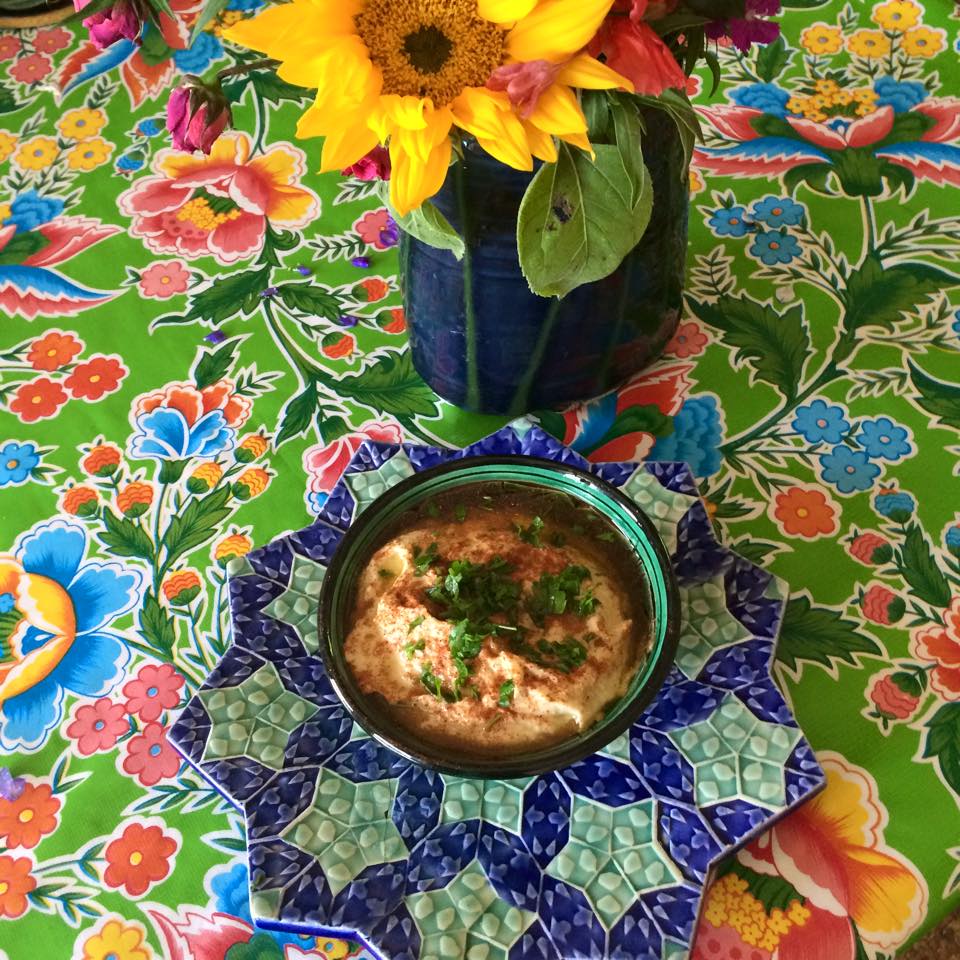
 Pour out into a bowl for serving and then liberally douse with paprika, cover the entire surface with it, then drizzle olive oil over that and sprinkle freshly and finely chopped parsley or the Za’atar all over it. Serve with dinner, lunch, bread, and crackers or make sandwiches with artichoke hearts, tomato, lettuce, Dijon mustard and hummous, on French bread is best. (This is one of my favorite sandwiches.) This Who?Moose will keep for a week in a glass container.
 Open Heart Open Hands