garlic 1:1.5 ratio, one eggplant to 1.5 cloves of garlic pressed
lots of fresh ground pepper
feta cheese (I prefer French sheep milk feta, it is less salty and softer) If you won’t be using this kind, your dish will be saltier, so use less salt in your preparation.
Heat ¼ cup or more of olive oil in a non–stick or well–seasoned cast iron pan on medium heat. Slice the eggplants lengthwise in long thin oblong strips about 3–4 per eggplant. Slash them with a knife on the pulp side two or three slashes per strip and give them a quick slight dash of salt. Place them in the hot oil and fry them until they are reddish brown on both sides. Layer them into a glass baking or other nice baking dish, one layer only, so use a larger dish if you need to. Grind fresh pepper over each wedge. When all the eggplant has been fried, empty the oil out of the pan and grate the tomatoes, with a cheese grater over the pan, this is the quick way to peel tomatoes, because the skin stays in your hand and the pulp goes in the pan. Heat the tomato pulp on medium for awhile. You are trying to burn off the liquid, stir frequently. You shouldn’t need to add olive oil, because the pan was previously coated in it. Add the pressed garlic and a dash of salt. Let this cook down until it’s mostly a thick pulpy sauce, not too watery, 20 minutes perhaps. Spoon the tomato sauce over the eggplant and sprinkle the dish with the feta. Cover with an oven–safe lid or aluminum foil and cook in the oven at 375º for about 20 minutes. Serve with a nice fresh salad and some corn on the cob and good bread to soak up the juices.
Eggplant Realities and Recipes
All the eggplant dishes I cook require the following knowledge; picking the proper eggplant is what makes the difference between a dish that is bitter and one that is sweet and lovely tasting. Whether the eggplants are Japanese style or your traditional fat purple variety; the key is how heavy they are. The only proper way to pick an eggplant is to get involved in the veggie bin or with your farmer. If you are at your local market you may need to rearrange or make a mess for the grocery clerk to deal with. I actually recommend budgeting the time to arrange the eggplants back when you are done so as to ensure future harmony between yourself and the person who stocks your groceries. The deal is, you have to pick up every eggplant and compare it with every other eggplant. The heavier ones go in the reject pile, the lighter ones go in the keep pile. If there are ten eggplants and you only want three, after you’ve selected the five lighter ones, repeat the process with your remaining five until you’ve got the three lightest eggplants. If they are all heavy, make a different dish because it just isn’t worth the time and effort. All the eggplant recipes I know take hours to make, (with the exception of this recipe and Baba Ghanoush) so if you don’t have a good eggplant to start with, why bother?
All the eggplant dishes I cook require the following knowledge; picking the proper eggplant is what makes the difference between a dish that is bitter and one that is sweet and lovely tasting. Whether the eggplants are Japanese style or your traditional fat purple variety; the key is how heavy they are. The only proper way to pick an eggplant is to get involved in the veggie bin or with your farmer. If you are at your local market you may need to rearrange or make a mess for the grocery clerk to deal with. I actually recommend budgeting the time to arrange the eggplants back when you are done so as to ensure future harmony between yourself and the person who stocks your groceries. The deal is, you have to pick up every eggplant and compare it with every other eggplant. The heavier ones go in the reject pile, the lighter ones go in the keep pile. If there are ten eggplants and you only want three, after you’ve selected the five lighter ones, repeat the process with your remaining five until you’ve got the three lightest eggplants. If they are all heavy, make a different dish because it just isn’t worth the time and effort. All the eggplant recipes I know take hours to make, (with the exception of Baba Ghanoush) so if you don’t have a good eggplant to start with, why bother?
The following recipe is an adaptation of one from Madhur Jaffrey’s World- of-the-East Vegetarian Cooking. This cookbook is in my Top Five Cookbooks List. Check out Ms. Jaffrey’s blog and link to her books above.
three to five eggplants (depends on size of eggplant, this dish always amazing, so making more means left-overs and this dish is amazing a day later as well)
olive oil, grape-seed or canola oil (at least 1/3 inch or more so you cover the pan for frying the eggplant in)
two to three large tomatoes or 5 small ones (chopped small)
one bunch of green onions (chopped finely)
one bunch of fresh Italian (flat leaf) parsley, chopped finely
fresh ground pepper
lots of good salt (kosher or other high quality, see Let’s Talk Salt for details)
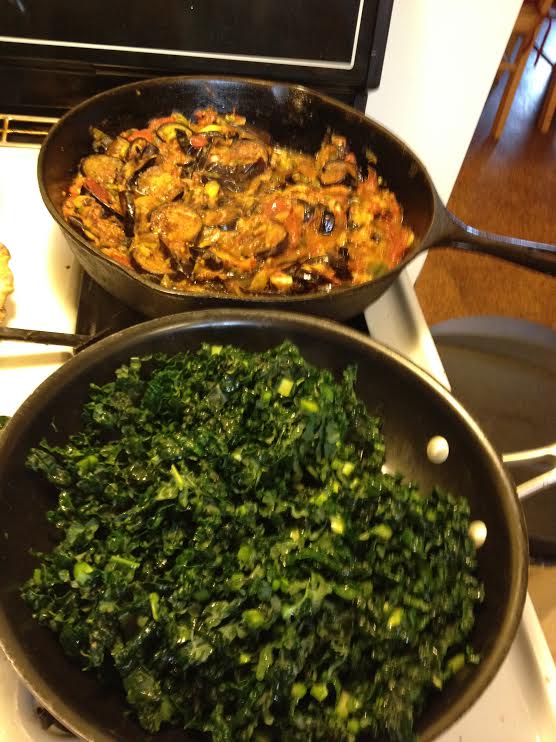
Slice the eggplants into rounds, not super thin, ½ inch thick. Cut into wedges or halves if you are using a big eggplant or just keep them in the rounds if you are using the thinner japanese style eggplants. Sprinkle with a goodly amount of salt and put them in a colander. Place the colander in a large bowl so the liquid that sweats off the eggplants can drain. They will have to sweat for at least 30 minutes.
I recommend having 2 non–stick or well–seasoned cast–iron pans going to speed up the cooking process. Heat a lot of oil, olive oil is my preference, or some combination of olive oil and another oil, about 1/3 inch of oil per pan until the oil is hot, but not smoking ever! Medium heat will work fine. Lay out several clean dish towels and put the salted eggplant rounds or wedges on the towels. With another dry dish towel pat the eggplants dry. I endeavor not to use paper products in my kitchen, but if you have to use paper towels, I’ll never know.
Place the dried wedges in the oil. They will be in the oil for a while, until they turn reddish-brown, then turn them over somewhere between three and five minutes per side. Have another colander next to your stove, also sitting in a bowl. When the wedges are reddish-brown on both sides, take them out with a fork, letting as much oil as you can drip back into the pan, and put them in the clean colander. This process is the time-consuming part of this adventure in cuisine . It will take about 40 minutes to an hour or more standing over several pans of hot oil with lots of wedges of eggplant in them for a dish that everyone will love and which will be consumed in ten minutes.
You have to love your guests to make this dish for them. While the eggplants are cooking and you are checking on them, you can prepare the tomatoes and the onions. Chop finely the parsley, and green onions. You can do the tomatoes in smallish chunks, not tiny, and place all of this in a bowl together.
When all the eggplant wedges have been cooked, drain the largest of your pans (that has a lid) of the hot oil. Do not wash out this pan just drain it. Put it back on the stove and turn it on low, put the cooked eggplant wedges and all the other ingredients in the pan and stir them up so they are combined well. Grind a ton of black pepper over all of this, mix and cover. Cook on low heat for about 15–20 minutes, stirring two or three times. You won’t need extra oil or salt.
Serve this with Paul’s Perfect Raita and some fresh greens. You can make a grain like couscous or rice and some kind of tofu or fish dish or just eat this plain with a good ethnic bread. Make sure you scrape the pan of the yummy juices when you are done. This dish is also great a few days later, so if you want to make it ahead of time and then refrigerate it, that’s fine. It takes two to three hours from start to finish to make. Important tips, using more than one pan to fry wedges in, lightly wiping the salt or salt sweat off each wedge, breathing a lot and not attempting this dish with children nearby. If it didn’t take so long to do, I’d make it every week in the summer months when eggplants and tomatoes are at their peak.
Two young Jews, my brother Paul and I, in Islamic Morocco, in a garden, at the inner tiled pool.
I fasted from food and water on Tuesday July, 15, this year. I don’t always observe this particular traditional Jewish fast day. For practicing Jewish folks the 17th of Tammuzthis year fell on July15th. This is a Jewish day of mourning when we fast and meditate on the destruction of sacred territory and the breaching of the walls of Jerusalem. This is the exact same territory that folks are currently violently hating and killing each other over.
There was a call for a joint fast and prayer vigil between Jews, Christians, and Moslems for Peace. It was open to all peoples who wished to join in, not just members of these three religions. I participated here, in our little hamlet, and joined in spirit with my friends in Israel and Palestine. All over the world there were folks engaging together in this activity, but it wasn’t front page news anywhere. I spent several hours in prayer in the morning and actually went through the older more traditional siddur (Jewish prayer book). It took me two hours to complete the morning prayers. I also cried and did my own personal prayers. The traditional Jewish fast for this day is from all water and food between sunset and sundown. All practicing Moslems observe this kind of fast for the entire month of Ramadan, which we were still in.
This territory of violence and harm seems to be perpetually cycling in the Holy Land and it certainly looks like and feels like it has not really changed despite the several thousand years of time between now and then. And yet it has or it is changing all the time. People are also coming together in love and solidarity across great walls and divides, now and even in the past also. If you study history you know it is not simple and always polarized.
There are shades of color and depth to every narrative. This is true in the past and today. Some people in the world are guided by love, caring, a desire to learn, grow and improve and they work to help and heal wherever they can. There are also people in the world whose lives and hearts are constricted by wounding, fear, violence, poverty, hunger, greed and rage and they create more hurt. Often we are some of both, in fact mostly, we are all of the above. If you only listen to or look at the narratives of wounding, hate and violence you begin to think this is all that is going on, or has ever gone on and you give up hoping and growing.
For some reason we think all the horror on the front-page is the story all the time. We look for the bloody, gory, ugly, painful stories first. We are drawn to them. This may be based on some deep primal self-preservation instinct. We need to be aware of the dangers around us so we can stay safe and keep our families and communities safe. Unfortunately, this kind of thinking emotionally stunts us, makes us anxious, and keeps us looped into a flight or fight pattern. This is well-documented and not just some rambling thought from me. You can read all about this in Dr. Daniel Goleman’s 1995 best-selling book Emotional Intelligence. I consider his book to be a must read for anyone who wants to understand the way the human mind and emotions work.
So, our need to be safe precludes our higher functioning and higher thinking. We jump and run or go right into a fear or anxiety place. This is a human thing to do. If we have been traumatized, and who hasn’t on some level or another, in childhood or in a war, or an illness or any painful hard time, we create a groove, a tire-track, wheel-rut that takes us immediately to that place. This is not the place where we reason, where we breathe, where we remember to call a friend or that what we are feeling is disproportionate to what is going on. This is the pure fear place. When you are actually in a war zone, it is intelligent to pay attention in this accelerated and highly sensitized way, it may save your life or the lives of those you love or who are near you. Living this way all the time takes its toll though and is not good for anyone.
People in marketing and advertising know you need to stimulate folks sexually and/or engage their primal fears. If you are successful in doing this they will buy your product or your story-line. We consume in fear more than we do when we are calm. We hoard and grab and gather in greater amounts when we are worried. So, if you stimulate this tendency in humans with a constant beat of horror and fear around the world you create an atmosphere that lends itself to folks consuming more than they need to and believing the story they are being told everyday. They literally cannot see beyond the blood and sex veil.
For me, and for many others, stepping outside of the circle of news and information is one way to avoid this wheel rut pattern in my mind. When I actually am not fearful or overwhelmed with sadness and grief about the grotesqueness and wrongness in the world, I start to see something different. I cannot do this when the violence and hate speakers are on loud, or if the television or the facebook or twitter streams are jamming my heart and brain.
I can only do this when I push back this veil, this screen that is playing these loud and angry and yes also real picture of things going on. When I manage to do that, something else emerges. I realize that really 99% of the folks I have ever met are GOOD people. The really angry, violent mean people are a tiny percentage of the world’s population. They are powerful and they wreak great damage, but they are not the majority, they aren’t even close to it. We feed the beast by believing it. When we have the courage to reach out towards those who are different or who look like our enemies, something entirely different happens. We no longer want to go shopping or hide; instead we want to think and be still and feel. This kind of shifting is what needs and must happen for peace and love to grow, and the only way I know to do that is to stop walking on the wrong path and to invite others to join me. We just have to turn, to do a Teshuvah. Teshuvah can be translated to mean turning or re-aligning, it is normally just translated as repentance, but the Hebrew has much more depth and cannot be parsed into a one word translation. Real teshuvah is a game-changer.
Is there any way that my veil parting efforts and path-shifting can manifest in some way to help others get off the misery-fear road? All my prayers start with wanting all the suffering and pain of the world to stop. My prayer and need for peace is cell-deep in me and in most of the humans I have ever met or encountered through their teachings. To answer this question, to see if there is something I can do that is more than just being present for my family, friends and community, I have to get away from this loud and in my/your face constant stream of ugliness. This doesn’t mean I think it is all ugly here. I live in paradise, Humboldt County, U.S.A. in the 21st century. There are hospitals, antibiotics, organic gardens, community, beauty and love all around me. There are also murders, rapes, betrayals, violence, stupidity etc… I try and avoid the latter and if I do engage with these elements it is as a counselor or helper to someone who has been hurt. We can change and grow, switch the channel, and emerge even from extremely difficult circumstances. I know so many folks who have.
So, part of why I need to get away on a Jubilee retreat has to do with wanting to exit the story that most folks on this planet are currently on. I want to see what story exists beyond this one that is currently obvious and playing out on all of our communal screens and minds. Is there some other narrative thread that I can connect to so strongly and so well that I can return from sanctuary and solitude and be able to share it and offer it? I cannot know until I go looking. So, I am consciously turning off the well-beaten path, as so many others have done before me. I am going on a quest to see what is real that is not tainted by someone’s agenda or need for me to eat, drink, be afraid, consume or vote one way or another. My own agenda is something else entirely, and I am sure I will spend a great deal of time having to navigate whatever territory it throws up, but as I turn and align with being fifty I am no longer a novice at looking at my own stuff. I’m ready for this challenge and hungry to begin….to be continued…
—byline—
Nicole parts the veil from her beautiful home in Bayside, where she has no television and where she does live in a kind of bubble of her own making of good food, love and kindness, she endeavors to stretch the bubble to include all those she encounters and prays every day for us all to live in a bubble bath of Epic and Glorious proportions! She invites you to jump in with her here in these pages.
This article was originally published in the Mad River Union on July 23, 2014, it is slightly adapted here from the original. It is number three in a larger series. Please see My True Heart Opens and Quaking for the Divine if you are just arriving to my site for the first time.
Nicole, in her red riding hood cape, age seven in Morocco
This is the second of several installments in the Jubilee Retreat Series, the first one is My True Heart Opens and should be read first.:
Seven cycles of seven equals forty-nine. In the Jewish tradition, this is very significant. Since, every seventh day is the sabbath and every seventh year is a Sabbatical called the shmita. The Jubilee (Hebrew yovel יובל) is the year at the end of seven cycles of shmita, So, my forty-ninth birthday was last September. My birthday is always around the Jewish New Year/Rosh Hashanah. I will turn fifty this coming September, so it is my Jubilee. I have been planning to go away for a long retreat for many years. I have told all my family members and most of my friends about this for at least ten years now. Since my youngest is only seventeen (another number with a seven in it), I cannot actually take my Jubilee retreat when I turn fifty. I am determined though to start on my Jubilee year-off before I turn fifty-one.
Both of my parents are Jewish by birth. Neither of them are Jewishly observant or religious. I wanted some connection to the force moving within and around me, to Holy Presence, and since neither my father nor my mother had any relationship to religious practice, nor any connections to Jewish community, my father chose the Quakers also known as The Friends. My father took me to Quaker meetings as a child. He liked them because they were mostly silent, they were educated, there were lots of intellectuals, and they were pacifists. I was in heaven from the first time I sat in Friends Meeting. Here, finally, were a bunch of folks/Friends all communing with and in relationship with Holiness. They were not discussing it or trying to argue against it, they were simply sitting in stillness and waiting for the voice, the still small voice, within them to make itself known.
I am anything but still, small and quiet. I was a slender young girl, but I was never quiet. The Boulder Friends Meeting was my first spiritual home. I would sit in meeting and, of course, The Divine would start talking to me. I would sit on my hands, try and be calm and as patient as a young girl can be, but eventually I would have to stand up and shaking and with tears streaming down my face, share how much The Holy One loved everybody and how beautiful they were. This was the most common theme that seemed to be coming through me. It is still my most common theme and my forever “good news.”
I was a young girl when this was going on and I felt as if I was the only child doing this kind of thing. Usually, the elders would speak or occasionally someone older would share something. I became a favorite of the elders and also made tremendous friendships with the other children at meeting. These friends were different from any other friends because I was encountering them in a spiritual context. They were truly Friends with a capital letter “F.” I spent years with the Boulder Friends Meeting and going to the Inter Mountain Yearly Meetings in New Mexico during the summers was one of the highlights of my early teen years.
The Boulder Friends Meeting was also home to Elise and Kenneth Boulding. These were two maverick human beings. Married for forty-plus years by the time I encountered them. They were white haired, tall, strong and beautiful. Kenneth was originally from England and a world-renowned and respected economist and Elise was originally from Norway and was a professor at Dartmouth prior to being in Boulder and also a world-renowned Sociologist. Both of them were intellectual giants. They had five children, all grown, by the time I met them as a young girl. Kenneth had written many books and several long love poems/sonnets of love for his wife. These were just the best and most wondrous people. Kenneth would sometimes speak after I did at meeting. When he spoke, you knew the voice of Wisdom, and Holiness was coming through. He was gentle and kind and had a slight stutter sometimes, his hair was like pictures of most mad scientists, white and wiry and going in ten directions at once. He was well over six feet tall. He had a strong accent and an extremely distinct voice, which was forceful and strong, even with the stutter.
He would often speak about my sharing as being a gift and he likened my young tears to tears of baptism. He would affirm that all of us need to experience this love and joy of Holiness, that the tears were a place of cleansing and newness and youth. He made me feel at home. I am crying just thinking of these people and this time in my life, when I was honored, even at the young age of eleven or so, as a person of merit and depth with something to share. In school, I was perpetually taunted and teased. At home there was still pain from my parents divorce and so much confusion. At Meeting, I was heard and seen and honored and not for anything I did, but for the voice of love and hope inside of me that couldn’t help but bubble up as soon as I got still and quiet in communion with other folks sitting still and waiting for inspiration and connection.
The first time I learned of the idea of a year retreat was when I was a young girl. Elise Boulding was a mother and an inspired feminist, professor, peace activist, and she wrote many books. My mother is also a feminist and artist and she collaborated with Elise when she was writing a book called The Underside of History: A View of Women through Time, first published in1976. My mother, Helen Redman, did the illustrations for this book. My mother and Elise worked together and I remember sitting at Elise’s table one summer afternoon with them both. Elise was speaking about her retreat, her year long silent retreat. What was this busy mother, grand-mother, author, professor and extraordinarily busy activist talking about? How could she have taken a year long retreat? But she had. Elise and Kenneth were very deep thinking and deeply feeling folks, their relationship to Holiness was not casual. Elise Boulding planted the seed in my young mind that a mother, wife, maverick thinker and activist, could retreat from all of that to seek stillness and connection with Holiness.
This seed, planted so long ago has been growing since then. It is now a veritable oak tree inside of me. I will always love my first spiritual base, my Friends from Boulder and New Mexico. I still love Quakers and the Friends Meeting and feel at home there. I am no Quaker though, I’m just too damn loud and very definitely practicing and in love with my Judaism now.
Imagine my delight when I uncovered that the Jewish tradition, which any well-versed Christian Quaker (like Elise), knew, has retreat practices related to the Jubilee Year and to daily meditation and stillness. There are instructions in the Talmud that suggest one should take time to get still and calm for an hour or so before beginning prayers and then do the prayers. After the prayers one is also instructed to sit in stillness and communion for another hour or so. If you do this the three proscribed times a day, that’s about seven hours of prayer and meditation. Not really something the average person is doing, but it is still there as the model of what should be done; an ancient instruction to engage in daily meditation and retreat.
There are also teachings about how a man should take a retreat when he is fifty to re-assess his life and prayer practices. I’m not sure a whole year is specified, but again the seed is there. There are lots of fascinating and deep practices related to the Jubilee Year. All debts are supposed to be forgiven, all land is supposed to revert to its original owners, and many other amazing and not easy to do things. To my knowledge, these practices were rarely observed, and alterations and amendments were made. Who wants to forgive all their debts? Who wants to give their land back to the original natives? Who are the original, original natives? How far back does one go, etc..?
I know that I need a retreat year to be by myself with the Divine only and I’d love to have all my debts forgiven, or at least take a break from thinking about them! It is also very hard for me to find my own sense of what is MINE to do and be around others. I am looking forward to the time and space, a luxurious amount of both, to go deep into the great mystery and see what I find and how best to serve Holiness, my family and community on the other side of fifty. Please stay tuned here, before I go away, and follow me to know more abut this adventure as it unfolds. To be continued………….
___________________
Nicole writes and remembers, with tears and laughter, from her home in Bayside she dedicates this teaching in honor and memory of her greatest teacher Rabbi Zalman Schacter-Shalomi, May his Memory be for a Blessing. He came into this world on August 28, 1924 and left it on July 3, 2014. This piece was originally published in The Mad River Union on Wednesday, July 9th, 2014
My true heart opens most in prayer, in songs of praise and communion of the Divine and those I love. My deeper heart, the part of me that is the central core of my soul heart and is woven into and connected to the Great Heart of Holiness really opens differently in prayer. I’m not sure what more to say after that, but being me, I guess I’ll try. I’m starting here, with my heart, the true one, because I need to talk about my need to do something really different from what most folks do or even imagine doing.
I am not sure if there is a study that has been done to gage the percentage of folks on this earth who feel called to serve the Divine. I’m not talking about people who attend religious services of one sort or another, or folks who casually engage in religious practices around holidays, family events, or out of obligation or a sense of tradition. I’m talking about the percentage of folks who feel pulled across time, space, mountains, rivers, streams, their families, reason, logic and any number of political beliefs or even being tortured or sacrificed to HAVE to engage, praise, serve and be with the Divine. The rabbis, the nuns, the Buddhist monks and nuns, the Shamans, the priests, the imams and the leaders of spiritual journeying wherever and however they connect to it, are the members of my tribe. It’s probably the same percentage of folks who feel they HAVE to climb Mount Everest or explore the deepest canyons of the oceans; not too big a percentage. I’m a serious member of this fringe group though. The relatively puny size of my tribe doesn’t really make any difference to me, and I am not talking about climbing high mountains physically.
The mountains and canyons I need to climb are linked to stars on distant galaxies and they are deep inside the cellular structure of my body and yours. They are the essential mountains, the true north peaks of the Soul. Really, not a big deal at all! I sometimes have to laugh at my ridiculous grandiose metaphors. I hope you can too. All kidding aside though, this is BIG.
I need to place myself in a context that can be related to in some shape or form by those who do not share my proclivity or my calling. I often have a profound and deep instant connection with the devout. It makes no difference whether they are practicing Christians, Buddhists, Moslems, Hindus, Native Americans, Jews, Pagans or any other stripe of folks who feel called to be in serious relationship with their sense of Holiness, there is an immediate spark of recognition and camaraderie that ignites between us.
So, where am I going with this? If I were living in a different century and I wasn’t Jewish, I’d definitely be pursuing retreat in a monastery or abbey or going on a long-term vision quest. Since, I am most definitely Jewish, in my true heart, my need to find space and time to connect in a more complete way is something I have to craft. It’s not something completely unheard of in the Jewish world. There are parables and stories about various rabbis in antiquity and even more recently who go off to commune with the Divine. The most well-known story is the one about Rabbi Shimon Bar Yochai, which you can read about in detail elsewhere. Sometimes, other people say things better than I do, and in this instance Rabbi Elliot J. Cosgrove of Park Avenue Synagogue from his sermon: The Caves of Our Lives perfectly encapsulates what I need to say next:
“Jewish spirituality, though not oblivious to the allure of otherworldly pursuits, is better described as the ongoing effort to bring the mystical into the everyday. As our own Milton Steinberg explained, it is our ability to function as kinsman, congregant, citizen and human being which serves to advance God’s design. Bar Yochai, our greatest Jewish mystic, did not remain in the cave. Not even Moses himself stayed on top of the mountain too long; even he was ordered to return to his people to live in the company of the everyday world. Our spiritual heroes always bring the extraordinary back into the ordinary, the sacred to the mundane, or as the prayer book says over and over, carry the hope that the peace of the heavens is brought upon us, Israel and humanity. From Elijah in the cave, to Jesus in the desert, to Mohammad’s night journey, this is the oldest story of all – the call to enter another world in order to acquire wisdom and experience not available in the here and now. Each one of us, I suppose, if we chose to do so, could linger in the wild rumpus of those alternative realities, and perhaps someone would even suggest that we be made king of Where the Wild Things Are. But as Jews, more appealing than being crowned the philosopher king of the wild things, is our hope to return to the place where we are loved – to bring that other world back into this one, always returning home, hopefully in time to find our supper still hot. It is the oldest story of all, but the Jewish version always ends here – in this world, with our family, our fellow citizens and our obligations – each and every day, tending and tilling the very fields of this earth that God has given us all.” Rabbi Elliot J. Cosgrove
So, I am announcing here my intention to enter the cave, there are no wild beasts chasing me or Romans threatening to kill me (as in the case of Rabbi Bar Yochai). Instead there is a loud and very constant ringing inside of me, a slow and steady gong beating, sort of like a heart beat. It is calling me to get still, to get away, to get into a completely different rhythm than the one I’ve been attending to for the last 49 years of my walk on this earth. I will be going into detail about the whys, the mechanics, the details, but not the LOCATION of my upcoming retreat here in these pages with all of you. This first installment here is part one of a larger series, most likely six or ten more articles.
Whether you are called or not, if you want to understand a little more about what it means to be called and to step away and outside of the spinning fast wheel that most folks are on, I invite you to get a taste here with me over the next few weeks. I’m not going away yet, but I am getting ready to be gone for a full year, this is your notice of my upcoming Jubilee Retreat. I’ll explain that term next time!
Nicole emerges from the cave of her wacky brain to write these thoughts down for you, she did so, this week, from her deck in Bayside. There were lots of flowers, bees and cawing birds giving her prompts and feedback about what she should or shouldn’t say here, bzzzzzzzzzz, tweet, caaaaaw, caaaw and also the flowers had some input for you, which she has shared here as well.
*This piece was originally published in The Mad River Union: Wednesday, July 2nd, 2014




 Open Heart Open Hands
