Jubilee Part 10: High, Dry and Wildish

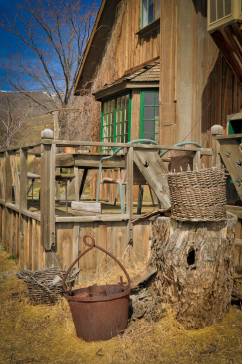
The Old Pioneer Garden Inn, Photo by  Janeen Singer
The Old Pioneer Garden Inn, Photo by Janeen Singer

November 23, 2014 I am on my way to Salt Lake City to celebrate my daughter’s 30th birthday. I am with my youngest “child,” Ethan, who will be eighteen in January. Ethan’s older brother will be 28 one week before him. It is just Ethan and I journeying to spend time with my daughter, her partner and their adopted seventeen-year-old daughter. We will be there for five days and it will take us two days driving one way and the same back to do this journey.

I found us an off-the-beaten-path place to stay. It was about ½ an hour from Interstate I-80 East, between Loveloc and Winnemucca in Nevada. This is about the half-way spot on the long two-day drive. Despite my best efforts, we arrived in the dark, because even if you leave Humboldt County at 7:00 a.m. and just drive all day, in the winter the sun sets at 4:30 p.m. We did stop for lunch, but otherwise we drove solidly.

So we got here around 5:30 p.m. I had printed out directions and spoken with the proprietor many times, because there is no cell-phone service or gps that works for parts of the drive out here. I still did manage to get us here. The trusty odometer on the car worked, and we turned off I-80 East and drove the seventeen miles on a paved empty road into the Nevada night. We turned right at the road that was exactly where it was supposed to be, once we hit that seventeen mile mark. It was a  well-graded gravel road. We drove three more miles and sure enough, there was the sign for the Old Pioneer Garden Inn on our left.

The first sound I heard upon getting out of the car was that of the goats bleating and greeting. I love that sound. There is something so goofy and friendly about it. I also know it means goat cheese and goat milk, which are certainly favorites of mine. David, our host, pulled up in his truck, when we arrived and said I should follow him to our cabin. We pulled into a lovely wooden cabin. It was 37° outside, but David had turned on the heat in the cabin, so it was nice and warm. He showed us around our old pioneer-style rustic cabin and told us breakfast would be at 8:30 a.m. at the main house where he had met us.

So, my boy and I settled in and went to bed pretty early, since we were tired and even though there was WiFi access, it was slow, which was fine. We have been listening to an excellent book on tape, at the suggestion of my son; the Brother’s K by David James Duncan.  I listened to a little more of it, snuggled under my warm down comforter and handmade quilt and then went to sleep.

Now, the best part, was waking up in the wee hours of the night, something I do all the time, wrapping up in my wool scarf and walking out the front door to a crystal clear sky of stars that looked so bright and so close it was hard to believe they really were millions of miles/light years away.

Crisp, cold and stunning, stunned again and again by the beauty of this universe I live in. My sense of loneliness and also belonging deeply intertwine when I am alone in nature. The only sounds being goats or water running over stream, the only light–star-shine, the only distraction from encountering wonder and Holiness–my own mind and thoughts. This is what I long for, crave and need. As I approach the time when I will have retreat, the hunger for these qualities is growing exponentially. It is as if the spaces between my cells and the distance between the stars are all in collusion with one another and in communication of some sort. If I can just get still enough, quiet enough and away from all the other wonderful distracting and important things in my life, some vital and true song and story is embedded there for me.

I could do my retreat here, perhaps, or someplace like this, off the beaten path, that’s what I’m looking for. I’m also looking at a monastery in Ireland that has hermitage cabins I have been granted permission to stay in. I’m still searching and asking folks to help me find a home or homes to plant my hungry soul for several months of solitary contemplation and writing and praying.

If you know of somewhere, high, dry or wet, wildish and isolated, that’s the place for me. I am hoping to only have to change locales three to four times over the course of a year. Four months in one place or three at a time seems ideal to me and will allow for me to not be in a fierce winter climate while I am isolated, which definitely does not appeal to me. This is not about being an endurance naturalist. I need electricity, warm water, a stove, a river or stream or some other form of living water nearby and quiet.

I am looking forward to my time alone with the goats, stars and river sounds, and trying mightily to manage the next seven months of my life before then with some semblance of grace instead of irritation or frustration. I am already on my way out the door. This is perhaps difficult for those that are used to my being so fully in the door and in their kitchens, homes and business.

This journey outward and away to go inward has begun and I am slowly disengaging from responding or getting involved in all the myriad situations and stories of those around me.

It feels good and right for me, even as I worry and fret just a little, about how it feels for those I love and who love me. This need though, is not a mild wish or dream on my part, it is pretty much the loudest sound inside of me, besides the beating of my heart.

Where I want to be--table and view outside the cabin we stayed in at the Old Pioneer Garden Inn
Where I want to be–table and view outside the cabin we stayed in at the Old Pioneer Garden Inn


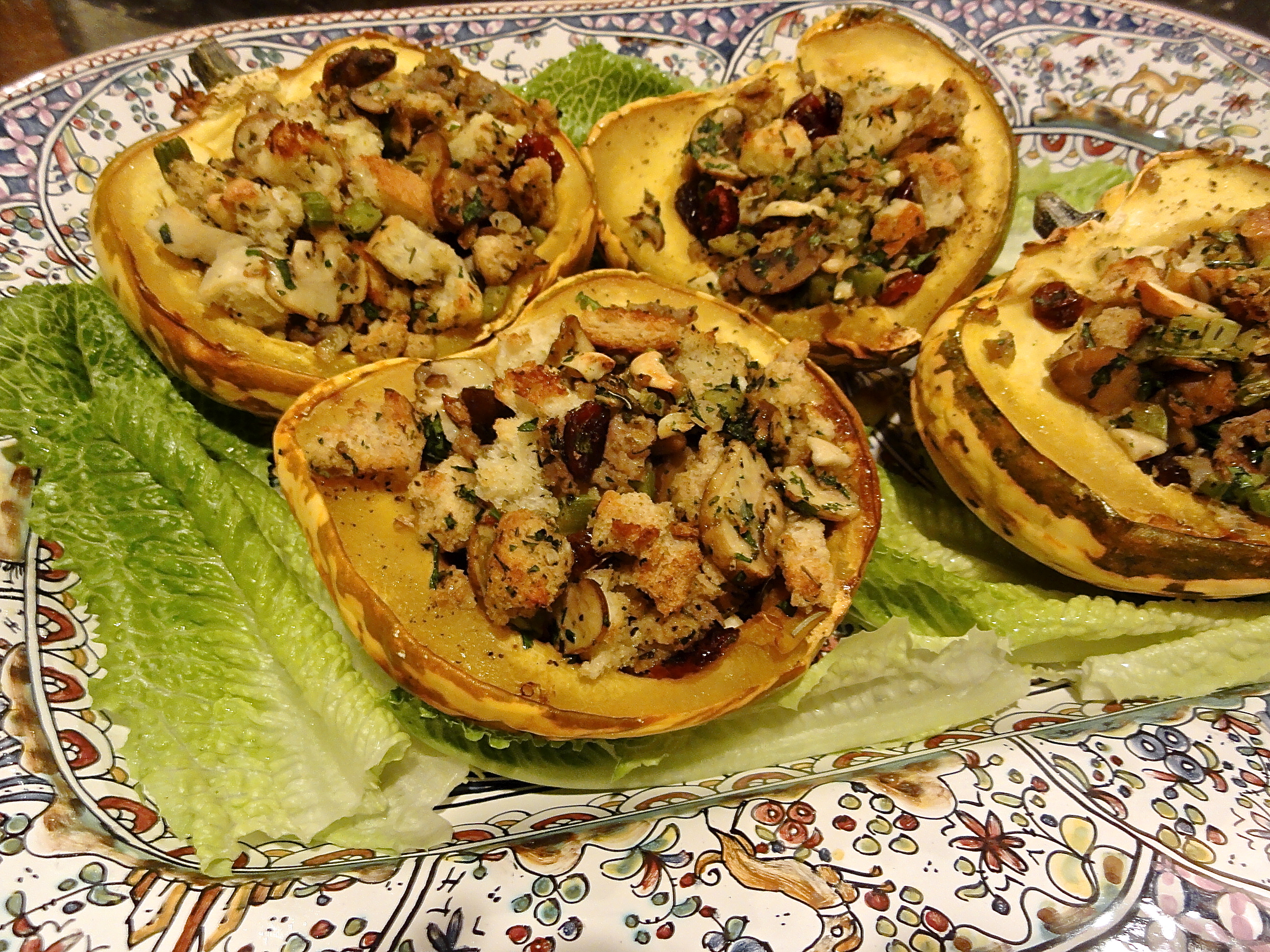
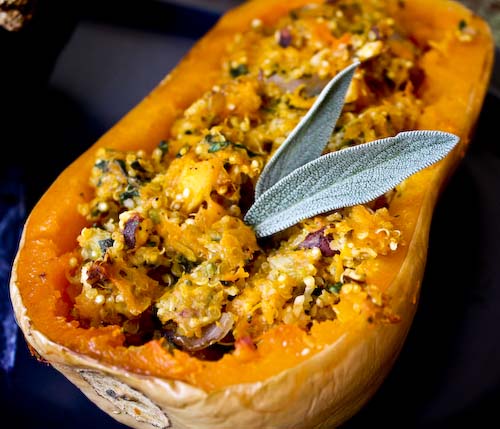
Stuffed Squash Instead of Turkey or with it–as you prefer!

Not my recipe, but I am traveling and don't have a picture of this dish. This one looks close to mine though.
This picture is not my recipe, but I am traveling and don’t have a picture of this dish on hand. This one looks close to mine though.

This recipe is the result of trying to make something vegetarian and vegan for various members of my family over the years around Thanksgiving. I wanted something complex and that takes time, not as much as a turkey does, but still, not simple, something special so they feel included in the festivity. This recipe is the result of that and I have made it vegan many times for when I have vegan guests. It does take some time and has lots of ingredients, so don’t try to do this at the last-minute.

  1. anywhere from 3–5 delicata or 1-2 other larger squashes like butternut or acorn or red kuri or hokkaido
  2. 3–5 celery stalks or fennel stalks or a combination of both (chopped in long thin sections lengthwise and then into tiny chunks)
  3. 1–2 onions (chopped finely)
  4. ½–1 cup of chopped in small to tiny pieces of dried apricots, prunes, nectarines or other dried fruit (you can do a combo, or just one)
  5. 1-2 cups of finely chopped shiitake or other wonderful mushrooms
  6. 2–5 tablespoons of butter (or olive oil for the vegans)
  7. Omit this ingredient if you are doing gluten-free or use gluten-free bread instead, but this recipe is fine without bread (see ingredient 8, below). 1–2 cups of stale or older dried bread chopped up tiny (by hand or in a food processor) or toast up some bread & chop into tiny chunks
  8. (optional) 1 cup or more of cooked quinoa, barley or wild rice can be used instead of the bread crumbs. Don’t do bread and grain, use one or the other or neither.
  9. 1 cup or more of almonds coarsely chopped
  10. 1–2 apples cut up into tiny pieces, with the skins on, you can use Asian Pears instead or pears or some combination of apples and pears
  11. 3–5 leaves of freshly chopped sage, if you have it, otherwise a dash of dried
  12. 1/2 cup or more of cooking sherry (I prefer the really good stuff, not the cheap kinds, but even a cheap cooking sherry will do)
  13. 1 cup or more of roasted root vegetable or other vegetable stock, apricot juice (for a very sweet stuffing) or water
  14. ground white pepper to taste
  15. salt to taste
  16. dashes of dried marjoram, oregano and/or savory to taste
  17. dash of mace or nutmeg if you want that flavor (some do, some don’t)
  18. fresh feta (sheep or goat milk preferred by Nicole) obviously don’t add this ingredient if you are making this for vegans.

The first step is to bake the squashes while they are whole. I really do not like working with raw squash. You can easily cut yourself if you are not adept in the kitchen or with cutting raw squash. They are large, bumpy, hard and complicated to work with raw. If you cook them first and let them cool down a little bit they are a hundred times easier to work with. So, cook them first in the morning or something, this part is easy. Preheat the oven to 375º. Wash the outside of the squashes and while they are still wet, pour a little oil into your hands and rub around the squash. You are giving them an oil rub. Place them on a baking sheet with the stems up or on the side, do not puncture them. Cook for 20–40 minutes depending on the squash and the number of them on a baking dish. When they are pretty soft, but not all the way cooked, take them out of the oven.

If you didn’t do this step hours ahead of time, then leave your oven on, but reduce heat to 350º. While the squashes were in the oven, you should have been preparing the stuffing. If you did this step hours ahead of time, then start preparing the stuffing part now.

The key here is your preparation ahead of time, before you start cooking ingredients together it is best to have everything chopped up and in small bowls or piles on hand, so you can add the ingredients when you need to. In a large heavy–duty frying pan or cast iron frying pan heat the butter or the oil. When it is warm (almost brown for butter, just hot for oil) throw in your onions and sauté for 10 minutes or if you have lots of time and are doing this ahead of time, go ahead and carmelize them, which means cooking them on medium to low heat for at least 30-50 minutes with a lid and stirring frequently. It’s okay to just cook them for the shorter time, I give you permission, if you are in a hurry to just sauté them for the shorter time.

Add in the celery and the mushrooms and the fresh herbs, sauté for five minutes, add the apples, nuts, dried fruit, sherry and ½ cup or so of water or vegetable stock, mix it all up cook for a minute or so, then add the bread crumbs. You may need to add more cooking sherry or water if this is sticking to the bottom of the pan. You can also add more butter or more oil. Taste often and adjust your spices.

At this point your squashes will have had time to cool down. Cut the delicatas or butternuts in half lengthwise (this should be easy, now that they are cooked), remove seeds. For the other kinds that are more pumpkin or rounder shaped, cut a circle around the stem and take the top off and remove the seeds with a spoon. In a nice baking dish, place your squash halves or whole rounds and then ladle the stuffing into them, pack the stuff in.

You can add a drop of butter or oil to the top of each for more richness or not. I also put fresh sheep or goat milk feta on top of mine, which I think makes this recipe, but my husband cannot abide goat or sheep milk feta. His squashes don’t ever get that on them and he still loves them. So, do whichever appeals to you. Put them back in the oven and cook for another 15-20 minutes or so. If you have left over stuffing put it in a small well oiled baking dish and bake it with the squash. I make this dish at Thanksgiving or whenever I get fresh squashes from my local CSA (Community Supported Agriculture) farm Redwood Roots. This is a great alternative to a Turkey for your vegetarians. I also recommend doing this a day before any large feast, so you can work on other dishes if you are making a variety of foods. This dish keeps well overnight and you can just warm these up in the oven before serving them.

Another variation that looks close to how mine do.

Batata Ben Lamoun-That’s Potato Lemon Soup to you!

Batata Ben Lamoun soup in a Fire&Light dish, next to coasters made by Paul Barchilon
Batata Ben Lamoun soup in a Fire & Light dish, next to coasters made by Paul Barchilon

Ingredients: for a large pot of soup, you can cut in half for a smaller soup, but it freezes well and most folks want seconds and thirds. This recipe was adapted from Sephardic Cooking: 600 Recipes Created in Exotic Sephardic Kitchens from Morocco to India by Copeland Marks (in my top ten cookbooks list).

  1. 4-6 carrots (large)
  2. 6-8 stalks celery
  3. 6-12 Yukon gold or other yummy potato (peeled and sliced or cut into chunks so that they will cook fairly quickly and mash down)
  4. olive oil
  5. 8 or more cloves of garlic (prepared properly with the centers removed)
  6. juice of 2-3 lemons
  7. 1/2-1 tsp turmeric
  8. salt to taste (use good salt)
  9. Several quarts of water or if you have time make Roasted Root Veggie Stock (see recipe for this nested in my post for Brazilian Sweet Potato, Tomato and Carmelized Onion soup).

Fill your soup pot 3/4 of the way full with water, or stock. Place on stove and start the heat. In a food processor grind up the carrots and celery. Add them to the water and let the whole shebang boil vigorously. Skim the scum off the top and discard.

Serious scummy stuff


Removing scummy stuff from the soup

In a small saucepan heat the oil on low and add the garlic, cook until foamy. Don’t let the garlic get brown. Add this to the scum-free soup, turn the heat to medium, let cook for 5–10 minutes. Add potatoes and cook on low to medium for twenty minutes, stirring occasionally. Soup is ready for the other ingredients when you can mush up the potatoes in the soup with a masher. Mash up the potatoes in the soup, then add the turmeric, lemon juice and a salt. This soup is better with mashing then with food processing. You want to have small bits of potato and carrot and celery, occasionally engaging with your spoon. My daughter doesn’t food process the celery and carrots, she just cuts them really tiny. I do prefer my version, but go ahead and try hers if you want. Let the flavors blend together and cook at least another ten minutes after you’ve mashed the potatoes in the soup, serve with other yummy foods, Esti’s Parsley, Garlic, Lemon, Jalapeno Supremely Special Sauce or by itself with bread.

Jubilee Part Nine: Coming Home to My Land and Simchat Torah

Photo taken by Frederic Brenner, courtesy Howard Greenberg Gallery, New York.
Photo taken by Frédéric Brenner, courtesy Howard Greenberg Gallery, New York. I’m the one holding the far end of the scroll, in the white skirt. This picture was taken over ten years ago.

I am looking out over a sea of yellow, green, red and orange from the fourth story window of my father’s Denver apartment. The Rocky Mountains are visible in the distance and I can even see snow on the high peaks. The sky is blue with clouds. My father (who is 91 and super healthy) and his wife Judy are napping. I am wide awake and feel energized. My time here in Boulder and Denver has been packed so full that even trying to describe one event will take me many pages. I will be finding ways to share parts of this story as slices of a much greater pie.

I was in Colorado in mid-October which coincided with the culmination of the Jewish High Holy Day season of holidays, called Simchat Torah/Joy of and in Torah. We dance around our congregations seven times with the Torah scrolls in the arms of those strong enough to carry them and then we read the very last lines and the very first lines of the Torah. We can NEVER be done with Torah, so we immediately have to read the very first line after finishing the last line. There is a seamless sounding of Hebrew words and Torah between the last letter and the first. There are numerous mystical teachings about this, but the most obvious and frequently shared one is this:

The last word of the Torah scroll is the word Yisrael, and the first word of the Torah is the word B’reishit. The last letter then is an “L” sound, which is the letter Lamed.

Lamed

The first letter is a “B” sound or a “V” sounding letter named Bet or Vet. It is a letter with two names and sounds and considered one letter. It has the numeric value of two.

betvet-h


The Lamed has the numeric value of 30. Lamed is the tallest letter in the Hebrew alphabet, and it reaches up towards heaven. When you put the lamed in front of the bet/vet, you get the word “Lev.” Lev, in Hebrew, means heart and mind or heart/mind. It is not the word for brain. There’s an ocean of teachings in this, but I’ll stick to a strand of seaweed right now.

translation = a pure heart

Our exercise in reading the way we do is to remember and highlight that the entire Torah from end to beginning and beginning to end is about our hearts. It is a journey through the Lev that brings us into relationship with each other, the planet, our teachers and all of creation in a joyous dance of loving-kindness, righteous and just society, goodness, compassion and forgiveness.

Before we read these words of Torah in their completion and beginning, we’ve danced the seven times around our congregations with them as our dancing partners. We form a procession of joyous folks following the scrolls and their bearers around the buildings we pray in. Or, we do seven joyous dances around and around like whirling dervishes for as long as we can. I found myself at Nevei Kodesh, the Jewish Renewal congregation in Boulder, where my friend Rabbi Tirzah Firestone was leading the services. All of us in the Jewish Renewal movement are still in deep mourning for our beloved Rebbe Zalman M. Schacter-Shalomi, may his memory be for a blessing. So, our prayers were laden with tears and honoring of him and it was so wonderful to be with a community of folks all collectively mourning his death, but also celebrating his legacy.

So, in honor of our Holy Torah, we danced for several hours with the two scrolls we had and we were pumped and JOYOUS! The wonder continued beyond my wildest imaginings and became extraordinary as the evening unfolded (literally). Rabbi Tirzah’s community chose to unspool the entire scroll with all of us present. We were instructed to form a gigantic circle, there were between fifty and seventy folks in this large Torah holding circle. Each of us stood shoulder to shoulder with our hands out in front of us and as the scroll was unwound in front of us, we held the top inch of it. We had to be careful not to touch the text and only hold onto the parchment at the top. This is a very intense and rare thing, the scrolls are extremely sacred, fragile and imbued with tremendous meaning. It takes a great deal of trust and faith for any congregation to do this. If a Torah scroll accidentally falls often the entire congregation has to fast and do penance. The Torah scroll is not a book, or a piece of parchment alone, it is considered sacred in and of itself and it feels that way to anyone engaging with it.

In our imperfect human circle, there were gaps where some people were too far apart from each other and places where some folks were closer together. I moved three times, going under or around the scroll to attend to these gaps. I am acutely aware of the Torah, in my body and blood and could not tolerate or hold the place of trust about these gaps in the circle. It was literally impossible for me to not go try and make sure that the tension in the scroll was not too great, behaving as is my nature, and being a Jewish mother to the Torah scroll, not just to the people holding it.

I helped a little boy get on a chair because having him hold our sacred scroll was too awkward from his height and he really wanted to hold onto it. So, we, his mother and I, had to keep moving him, and the chair and asking the people next to us to hold our parts for us while we helped him be able to also participate. This was one of many spectacular moments for me, being next to this little boy and his excitement about being able to participate, which he would not have been able to do if we hadn’t figured out the chair for him to get him up to the right height.

The circle was somewhat liquid at first until it was all figured out, which took about twenty minutes. By the time I was not helping someone or making sure there wasn’t a gap I found myself by the end of the scroll. I was shoulder to shoulder with some very stoned young men. They were very aromatic and smiley. This did not reassure me, but they looked capable and blissful, so I just kept checking in with them. Why did the whole scroll get unrolled? It’s a special thing to just witness, but Rabbi Tirzah and several other Torah readers wanted to give all of us something brilliant. They went around to each person, Torah readers on the inside of the scroll, with us Torah-scroll holders on the outside. We were instructed, individually, to remove one of our hands and point somewhere we couldn’t see in front of us on the scroll. The Torah readers then read for us a few lines from where we had pointed. So, we each got our own unique special Torah reading.

The lines that I got were from Deuteronomy 31:7-9:

“Moses summoned Joshua and said to him before the eyes of all Yisrael. ‘Be strong and courageous, for you shall come with this people to the land that HASHEM swore to their forefathers to give them, and you shall cause them to inherit it. HASHEM is the One Who goes before you; He will be with you; He will not release you, nor forsake you; do not be afraid and do not be dismayed.’ Moses wrote this Torah, and gave it to the Kohanim, the descendants of Levi, the bearers of the Ark of the Covenant of HASHEM, and to all the elders of Israel.”

If you’ve been following my Jubilee series, you will understand why this felt perfect for me. I am planning to go away for a retreat and I am actively looking for the right “land.” I know I am not going to do retreat in Israel, but this piece of Torah was telling me to be strong and courageous. To trust and to not fear, that the land will be given or shown to me and that I should not be dismayed. This is amazingly helpful for me. The piece about the Torah being given to the Kohanim (the high priests) and the descendants of Levi and all the elders of Israel resonates as well. I am a Kohen, which means I am a descendant of the Kohanim, and as one of those descendants, who is deeply engaged with this handed down powerful scroll, I find it holds me more than I ever have the chance to hold it.

My several hours of dancing with our Holy Torah and holding it and watching over it were a small fraction of how I am held and danced and dreamed and nurtured by Torah.

To be on the safe side, since interpretation of our Holy text is very complex, let me ask outright for help. In case you happen to know where the Holy One has put that land for me to spend silent retreat away from people on, please let me know. I am moving closer to this place, and like my ancestors, it is not something that is clear to me. Is it over the next ridge or around a corner or at your vacation cabin? This is a place I am coming to and journeying to, but have not yet found.

Please use the contact form here to email me if you are aware of or have the perfect place for me to spend a few solitary, quiet months of retreat and prayer.

May all your dancings and movements bring you closer to your Lev Tahor, your pure heart!

Sapta Rachel’s Eggplant with Balsamic, Black Pepper and Parsley

Balsamic Parsley & Black Pepper Eggplant
Balsamic Parsley & Black Pepper Eggplant (four layers of rounds)

This dish is fairly quick, can be made hours or days ahead, and will bring you and your guests within inches of Heaven. You can only get to Heaven, once you’ve left your body, which we don’t want this recipe to precipitate. If anything, this dish, reminds you of how great it is to have taste buds and be ALIVE!

I learned this recipe from my daughter who got it from her Israeli-Italian grandmother (Sapta Rachel Heller). She is an amazing artist and cook and all credit should accrue to her for this dish!

  1. 1–3 eggplants, not Japanese–style, un–peeled and cut into ¼– ½ inch rounds
  2. A lot of good olive oil
  3. One bunch or more of fresh parsley (Italian flat leaf is preferred) minced finely
  4. Good salt (see my Let’s Talk Salt post). Current favorite salts are Maldon and Himalayan Pink Salt
  5. Freshly ground black pepper (optional, I love pepper, some folks don’t)
  6. Your favorite balsamic vinegar (not cherry or fruit flavored, just good balsamic vinegar and not balsamic syrup)

If the eggplant is fresh you can skip this step, if not, you need to do the following: Salt the eggplant rounds in a strainer and let them sit for a 1/2 an hour or so. When you salt them ahead of time make sure you pat each piece dry of the sweated salty liquid before you fry them in the oil. You will need to use less salt in between your layers if you do this step.

Have all your ingredients ready and in bowls nearby before you begin. Heat  ½ an inch or more of good olive oil, a fairly liberal amount, in your heavy cast–iron skillet or in a good non–stick one.

Sauté the eggplant circles until they are reddish/dark brown on both sides. You may have to heat up more oil to finish all your eggplant slices. Have an attractive glass serving dish with a rim of at least an inch on it, or a small sort of casserole or round deep dish pie plate next to your stove.

Remove each piece of eggplant, once it is cooked, and place it in a single layer on the bottom of your dish. Add a sprinkling of the sea salt, a liberal sprinkling of the parsley, freshly ground black pepper, and sprinkle each round with balsamic vinegar, so that each round is getting a light shower of the stuff for each single layer. Repeat this process with each layer until all of your eggplant is cooked, and layered. On the final layer, drizzle a little bit more olive oil. This dish should marinate or sit for at least 1/2 hour, and is best served warm or at room temperature. If you are going to put it in the fridge please remove it a few hours before serving. Keep it covered with a plate or lid when it is in the fridge. Serve with a summer tomato salad, rice or on good bread. It’s hard to stop eating this one, you’ve been warned!