Remembering Rabbi Aryeh Hirschfield, zt”l, of blessed memory, Crying a River of Tears

My sweet and wonderful teacher, Rabbi Aryeh Hirschfield. Copyright 2010 The Rabbi Aryeh Hirschfield Legacy Trust

The Source of Beauty

(Story told by Rabbi Aryeh Hirschfield as he remembered it from his teacher Reb Zalman Shachter-Shalomi zt”l, of blessed memory, retold by Nicole with permission from Rabbi Aryeh)

Once there was a man. He was one of those loose people that hang around street corners gabbing all day. One day, he was walking in the forest and there was a glen with a pond in it. The princess was just coming out from bathing in the pond. He saw her and she was very beautiful. He fell in love with her and so he hung around the palace waiting for her to come out again. Next time she went for a ride he stopped the wagon and said: “Hey, I love you. When will we be able to be together?” The princess took one look at him and said: “In the cemetery.”

He was a simple man, so he went to the cemetery to wait for her. “It’s not so easy for a princess to get away whenever she wants,” he figured to himself. “I guess whenever the coming is good she’ll be here.” He was waiting there one day, two days, getting along by a little begging, just hanging out in the cemetery. After a while he goes around looking at the gravestones and sees; this man lived to be very old, this lady died young, this one had a family, this one didn’t have a family, this one died in an accident. He started to ponder what things are all about. Every once in a while he would sit down and visualize what the princess looked like, so he wouldn’t forget why he was there.

Days go by. They bring people to the cemetery to bury them and he always watches, hangs around and eats. Nothing else is happening at the cemetery, so he watches the people who come to visit the graves. He sees people crying and hears people saying things like, “She was so pretty when she was young,” or “He was such a handsome man,” and all the other things people would say.

Weeks go by. One day he starts asking himself the question, “What is it that I have fallen in love with in the princess? If it is her physical beauty, that is very nice, but it keeps changing.” He realized that the beauty of outer forms is only one phase of beauty. There was nothing else to do in the cemetery but hang around and think and think. He was thinking about what beauty is all about, and he realized that beauty comes in so many ways that somewhere there must be the source of beauty. What could the source of beauty be? So, he kept on thinking.

Months go by. He realizes that the source of beauty must be The Holy One. Then he starts to think how beautiful The Holy One must be. All the visions of beauty he had ever seen passed before his mind’s eye. He realized how many forms beauty has. Then he started to ponder: “Maybe there is beauty without form.”

People saw this guy hanging around the cemetery sitting and thinking, so they started bringing him food so he wouldn’t have to go begging in the city. Word got out that there was a holy man sitting in the cemetery. He was still waiting for the princess but the people didn’t know that. They thought that if he’s sitting in the cemetery he must be a holy man. What else would he be doing there? People start to come and talk to him saying, “You know, I’ve got such and such troubles. What do you advise?” He would give his opinion or say, “I’ll think about it, come back some other day.” He started giving people blessings and the blessings worked.

Meanwhile the princess had gotten married, but she didn’t have any children. She tried doctors and this and that and nothing worked. One day someone said, “Listen, that holy man in the cemetery is doing great things.” She goes to the cemetery and asks the holy man for his blessing to have children.

One look at her and he recognizes the princess. “I want to thank you,” he says. “It was your beauty and your guidance that sent me to the cemetery in the first place, and since I’ve been here I’ve gotten to know many great things. If there is any merit in anything I’ve done I want that merit to be transformed into a child for you.” That’s how he blessed her.

A little while later, people saw he was sitting in very deep meditation, so they didn’t want to bother him. A few days went by and he didn’t come out of his meditation and all the food they brought was still there. The food started rotting and the flies started eating it, and soon the people saw that the flies were eating the man’s eyes too. He had died while he was contemplating the source of beauty without form.

The Raishit Chochma said that you can see from this story that one can learn from loving a woman or a man to come to the love of The Divine.

“Raising an Awareness of Awe”

“….Given that ‘the beginning of wisdom is the fear of heaven’ (Psalms: 111:10), and fear of heaven results from humility, we might expect the paradigm to begin with humility and end with wisdom. Yet Maharal is adamant that we consider a different paradigm, in which humility, and the dveykut attendant upon it, constitute the ultimate goal. Interpreting ‘Raishit Chochma Yirat Hashem’, he equates raishit with that which is primary,[1] so that fear of heaven is above wisdom both spiritually and ontologically. On the mishnah in Avot discussing the mutual interdependence of these values, Maharal further delineates the supremacy of Yirat Shamayim over Chochmah” ~ Yael Wieselberg from his paper: The Place of Yirat Shamayim in Moral Development: The Pedagogical Approach of the Maharal of Prague By Yael Wieselberg

[1] Netiv Yirat Hashem’, Chapter 1, pages 54-55.

This story was originally published in the Temple Beth El newsletter in April of 2000. It was submitted by me after asking Rabbi Aryeh, of blessed memory, if my version worked for him and was close enough to his telling.
Hanukkah Grinchyness and Cozy Christmas Musings

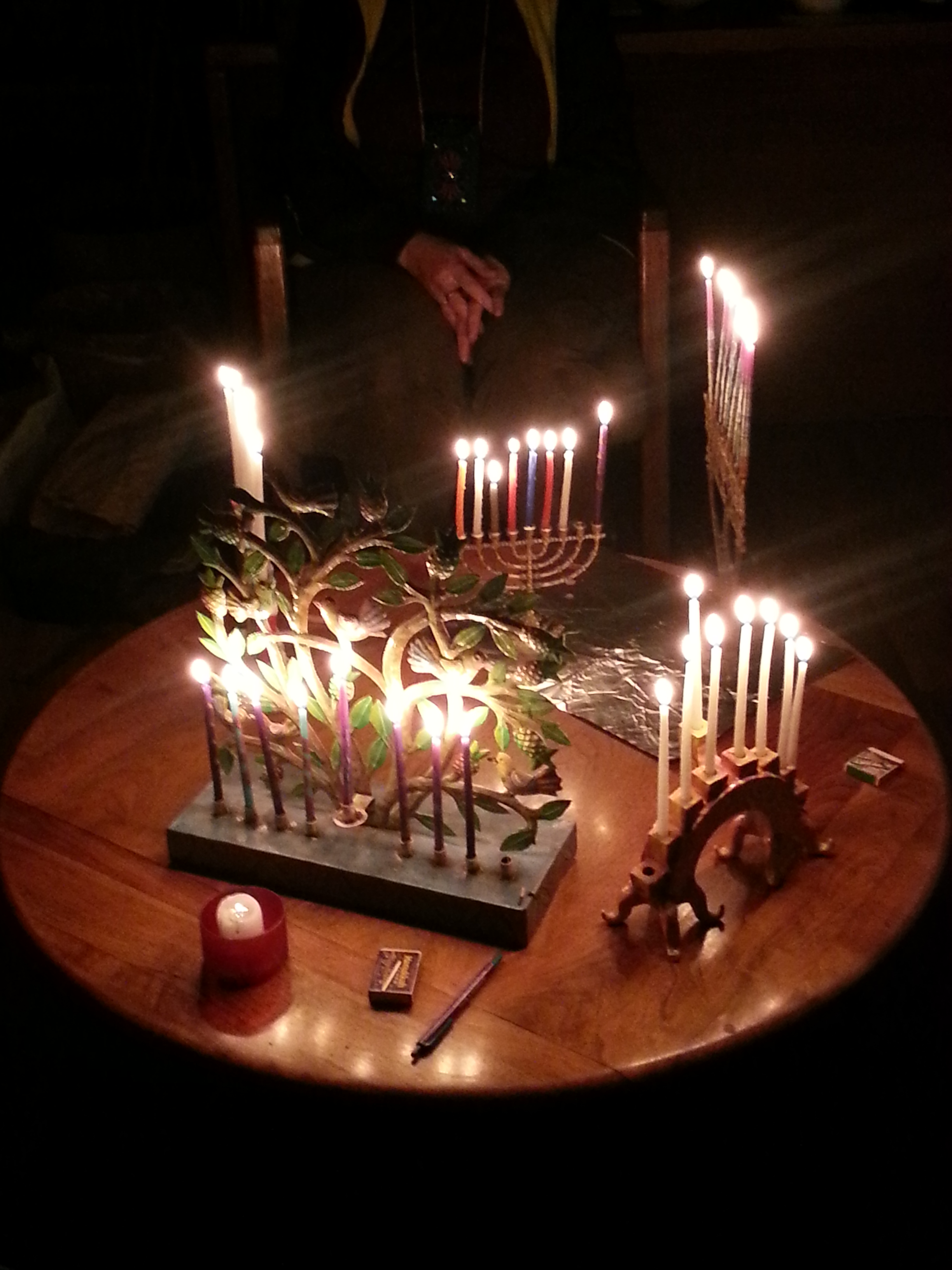
Hanukkah candles burning so beautifully. Picture by Nymiah Eliyahu

This is an older piece, from my Just Being Frank Column in the Arcata Eye. It was originally published on December 7th, 2004. It is still relevant. This post is an edited version of that original. My youngest son is no longer seven, he’s almost eighteen! I hope you will appreciate these thoughts and perhaps understand a little more about what being Jewish is like at this time of year.

This is normally a very hard time of year for a more observant Jewish person. The Christmas hype and buying craze is so intense. Everywhere I go, from the doctor’s office to the bank to the grocery store I am confronted with my difference. It’s not so terrible to be different. It’s mildly irritating when folks perceive me as a “Scrooge” because I don’t have “Christmas Spirit.” The hardest thing this year, so far, was my seven-year-old son asking if we could do Christmas too, since it was cozier than Hannukah. These were his words. He actually said, “Christmas is cozy.”

Now mind you, we do not own a television. Our youngest son doesn’t watch television at home and is allowed an occasional ½ hour at the neighbor’s house or an occasional hour at his friend’s house if he’s visiting over there. So, his mainstream exposure results in an average of about three hours a month. This is a very reduced amount of cultural exposure impacting his seven-year-old brain. He goes to a small school where they do a lot less of the Santa stuff. Still, he thinks Christmas is cozy. We have a Jewish home and celebrate Jewish holidays in it. We participate in other folk’s celebrations from Eid al-Fitr celebrations connected to Ramadan to Losar the Tibetan New Year but not generally in our own home. We have never celebrated Christmas.

Channukah gets turned into an alternative Christmas by many Jewish parents in order to confront this image of coziness. Gift giving at Hannukah (it can be spelled and celebrated so many different ways) is very new. It’s the result of modern American Judaism needing to find some alternative for their children during a time that makes them feel different or less special.

“Jonathan Sarna, professor of American Jewish history at Brandeis University, explains that Jews used to exchange gifts only on Purim, but in the late 19th century there was a shift from Purim to Hanukkah. Christmas itself became magnified in the late 19th century when it became a national holiday in America. The Jewish custom shifted in imitation of Christmas, as its consumerism grew.”~Natasha Rosenstock

As a confident adult, my feelings of difference aren’t going to cause me any lack of sleep. For children it’s just not the same. And there’s the whole consumer present thing. I mean no disrespect to all the vendors and artisans whose livelihoods are dependent on the buying which folks do at this time of year. I’m delighted if folks buy local art, music, foodstuffs, crafts or other Humboldt County creations. Unfortunately most folks are shopping at Old Navy or massively stressing themselves, their credit cards and/or their families out.

In December of 2003, I was in a car accident when two twelve-year old girls thought it would be a good idea to go for a joy ride. They came out of their driveway late at night with no lights on, during a wet and rainy night. They struck me, and dented my car and also ran over a water main pipe. I was driving home from my gig on the Arcata Plaza teaching and singing Chanukah songs. It was a wet mess, but no one was injured. They did run away and drove off, leaving me to confront the police and the grandparents, in the rain and water spuming and sloshing side of the road.

So, this year being told Christmas is cozier than Channukah seems mild in comparison. I’m not the kind of parent that enforces her beliefs on her children or even on others or my spouse. I’m an equal opportunity believer. The only caveat to that is while your beliefs and mine do not have to be the same, I do not allow my children, or folks in my home, to engage in behavior that hurts others physically or emotionally. You’re just not welcome at my place if you need to insult others, condemn them to hell, or use racist, sexist, or homophobic language. While you might not be welcome in my home if you engaged in these behaviors, I’d still agree to meet you for tea somewhere else and try to understand you or work hard to find common ground with you.

I have engaged in a few common ground activities since my article about needing to interact with the “other.” My rabbi, Naomi Steinberg, five other congregants and myself sang at the Eureka Interfaith Fellowship’s Thanksgiving Sing. We were the only non-Christians there and we were welcomed, applauded, thanked and honored. It was a very beautiful evening of sharing with only a few hard moments for me personally. There was one song about having a thankful, joyful heart that was specifically thankful for “God’s burning justice.”

I’m not fond of burning justice; the two terms are oxymorons in my opinion. Burn and justice don’t really belong in conjunction with one another. Burning crosses on lawns, burning Jews, burning Iraqi children with American bombs, burning Vietnamese people with Napalm, burning our planet with toxic wastes, are just some forms of burning, I don’t associate with justice. Other than that one line in one song though, it was lovely. I was also invited into Arcata’s Pacific Coast High School (on the Arcata High campus) to talk about Judaism for two World Religion classes there. They want me back for their panel discussion with other folks from different religious paths. I am continuously moving along on this journey of dialoguing with people who see the world differently than I do.

These conversations are a kind of light kindling that resonates more closely with Channukah. It’s not about eight days of presents. It’s about finding something to be grateful for, some new light shed on an old problem and because we focus on it for eight days we get to see the light growing and hopefully end up a little wiser. Hanukkah is actually a very cozy holiday, full of family, food, friends and beautiful glowing candles. So, I invite you to kindle some light in your homes and in your hearts and shed some light on any places in your life that need more than just one candle’s worth of illumination.

~~~~byline ~~~~ Nicole Barchilon Frank, lives, loves, prays, struggles and is cozy in her home in Northern California and she is always looking for a way to make Hanukkah and the world cozier for all children.


Applesauce and Hanukkah!

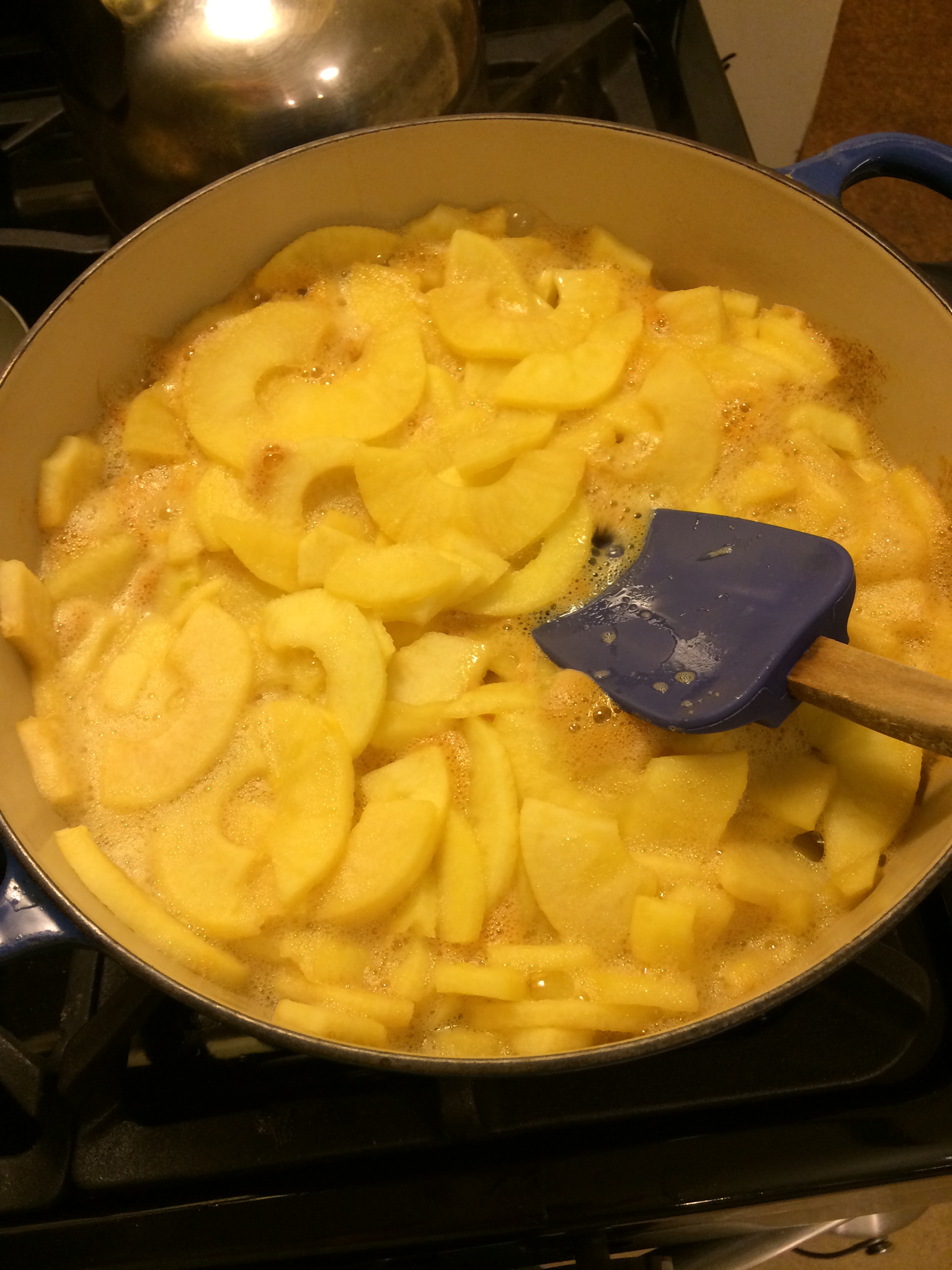
Peeled and Sliced apples cooking in applejuice.
Peeled and Sliced Apples cooking in apple-juice.

Perfect applesauce is not hard to make. Mine is sugar free as well. The apples are sweet enough, especially if you cook them in pure apple-juice (organic, unfiltered) or apple-cider (unsweetened). The thing is, like most of my recipes, time is the crucial ingredient. It takes a few hours, really to make applesauce, at least two. It’s a process. First you need to peel lots of apples, why bother making fresh applesauce if you are only making a little bit? It keeps for a while, you can give it away or you can preserve it. However you do it, it’s worth making a significant amount.

I have an old fashioned apple-corer/peeler that is hand held. This makes my apple-peeling and coring much easier. But you still have to navigate the stray peels and parts that don’t come off. Or you can just peel by knife. I like to have help when I am doing this job, so it goes quicker, and also because having help in the kitchen is the way to go.

I put enough juice in the pot to almost cover the apples, a little less or more, won’t make a big difference. You do want enough liquid though. I cook on a medium-low heat, uncovered for a long time, stirring frequently until there are no recognizable apple pieces and it gets very broken down and looks like brown mush. It’s done then. I put a dash of salt, just a dash and sometimes add a 1/2 teaspoon of vanilla as well, (optional).

Applesauce, of course, is the perfect complement to Latkes (potato pancakes) for Hanukkah. It’s best to make the applesauce a day or two ahead, because making and cooking the Latkes is time-consuming and messy (see my gluten-free Latke Recipe). You can enjoy applesauce all year round though. I don’t think using old apples is always the best. I use different apples based on who has dropped off a bag of them at my house, or what I find in the stores. This batch, photographed above, was made with Fuji apples, and it came out great.

I’ve used “applesauce” apples, meaning they were the rejects or less than appealing looking apples. Using older apples often means you have to cut out a lot of bad parts. I am not a fan of using less than excellent ingredients in what I cook. You can make good applesauce with funky apples, but you can make great applesauce with good apples as well. That said, making applesauce with older apples is a good way to use an apple that is no longer appealing to eat fresh. I would prefer if you used an older apple in a crisp or something because the crisp has sugar and butter and oats also happening and the apple is part of the story, not the WHOLE story. Apples are the WHOLE story when you are making my applesauce. Please, do NOT add other things to my applesauce recipe, if you do, then it is no longer my version. Lots of people like combination applesauce versions; peach/apple, apple/cranberry, apple/pear etc.. I think those are fine, but this is not the recipe for those, since I’ve never made those. I am a purist in certain things. I guess applesauce is one of those things!

Applesauce is also a really good first food to give someone after surgery, once they’ve been cleared for that kind of food, or for folks who are feeling under the weather. Serve it warm, not cold, it makes a person feel better. It is for sure a comfort food. See my Surgery Support: Pre and Post Lists for Optimal Recoveryand the other fabulous thing about making your own applesauce is how your home smells while it is cooking, Absolutely AMAZING!!!!!

Enjoy your applesauce and check out my Latke Recipe also, Happy First Day of Hannukkah/Channukah/Chanukkah/Hanukkah (however you choose to spell it!)

Latkes, Latkes, Latkes: How to Make them, How to Eat them, How to Survive them!

Naja Luz Tepe’s plate with one of my Ladino Latkes, and Nicole’s Home-made Applesauce

How to Make Them:

There are as many ways to make Latkes, as there are Jewish homes. Everyone has their own style and preferences. Here is my Ladino Latke Recipe

  1. Yukon gold or russet potatoes (8-10)
  2. 1-2 yellow or white onions
  3. 5-10 garlic cloves pressed (always remove the centers)
  4. a good handful of parsley, chopped up
  5. 2-3 carrots
  6. juice of 1-2 lemons
  7. salt & pepper to taste (a goodly amount)
  8. lots of eggs (7-10)
  9. A cup or more of Matzah meal which I prefer to flour
  10. lots and lots of sunflower oil or canola oil or schmaltz (oy vey!)
  11. Fresh thyme
  12. Freshly ground turmeric root
  13. Feta cheese (optional, but I highly recommend)
  14. Aloe Vera juice and ice-water on hand for when you burn yourself, and you will probably burn yourself, I do and I’m a seasoned pro!

So, I hand grate a lot of potatoes, uggghhh! It takes a long time and you have to be careful not to get your fingers grated in the process. I have made them with a food processor, but I have to tell you, the grater gets the potatoes thinner and into smaller pieces that cook quicker and absorb slightly less oil. You can make your own decision about this. I never bother peeling the potatoes, but I do clean them really well and remove any bad spots. Use a big bowl for this. I have also experimented with grating them into water and straining them. I’ve concluded that this particular idea is just one more step in a long and intense process, and it doesn’t seem to make any real difference. So, I no longer do it. I just grate them into a big bowl and try and pour out as much of the potato juice as I can.

I add the juice of one or two lemons, depending on how many potatoes I’m using, and stir that up, then I grate two or three carrots. The ratio of carrot to potato should be 1:3. So, one carrot for every three potatoes, for the non-math oriented folks. Since I am one of those kinds of people, it’s always a good idea to repeat myself when numbers are involved. You may have noticed, I rarely give exact amounts or numbers of things in my recipes. My apologies, I just don’t do numbers very much or very well. It’s an organic kind of thing in my kitchen with amounts shifting all the time.

I throw in some chopped parsley, fresh thyme and freshly pressed garlic (remember to remove the center parts, see Esti’s Parsley Sauce for pictures), lots of salt and pepper and then about 7-10 eggs and a bunch of larger crumbles of feta. If you are making these gluten-free, then you are done with the batter. If you want to add some Matzo Meal or flour then go ahead and put some of that in. I’ve made latkes so many different ways. I have not yet experimented with coconut flour or almond flour to see how that works. I often just go flour-less, since so many folks are not eating wheat or gluten these days.

You then will need three frying pans, four is too many to manage. If you use only one or two, good for you, it will take you another hour to be done, but you probably won’t burn yourself and need the aloe. Since I am always making these for a crowd, I am the three and sometimes four frying pan kind of woman. You can use any oil you want, but this recipe is about frying things in hot OIL.

Oil-rich foods are traditional for this time of year and this holiday because they are an additional way to get oil into our celebrations. The oil connects us to the miracle of the sacred oil lasting for eight days in the re-dedication of the Temple that is part of our traditional Hanukkah story. So, frying foods in oil and having lots of oil is just part of the holiday. I alternate between sunflower oil and coconut oil, depending on which I am more in the mood for. Both flavors are good.

Heat the oil to medium high, you can turn it down once you get going, but it needs to be pretty hot. Have lots of pot holders on hand and dishtowels on hand. Have two or more trays in the oven with cooling racks over them so you can put finished latkes on the rack and let the extra grease drip onto the pan below. Keep the oven on 250º so the latkes you’ve made stay warm, while you keep frying the rest of them.

This is the tricky part and the time-consuming part and the get yourself burned part. I wish I could say there was another way to do this, but basically, it’s a labor of love or love of tradition or some form of craziness. Take a slotted spoon, or a 1/2 cup measure and ladle the latke batter into three or four patties in the hot oil. Let them cook for a good five minutes or more per side, depending on the thickness. Smush them down so they are flatter after you turn them. I sometimes turn them too soon and then they are not golden brown and so I have to fry them on that side again.

The speed of this process and the timing are pretty hard to get down perfectly. It’s sort of a dance between flipping, checking, frying, ladling and then putting them on the trays in the oven so they stay warm until you are done. If you want to be just a servant to your guests, you can omit the keeping them warm in the oven part and just fry them and then dish them out. People always say they only want one or two, but end up eating four or more. I promise you they will eat more than they say they will. There’s just something deeply compelling about a latke, cooked properly and served hot.

How to Eat Them:

You can serve them with applesauce (see my recipe) and sour-cream, with Esti’s Parsley Sauce and Greek yogurt, with hot-sauce of your choosing, with whatever condiments you like. There will rarely be left-overs, but if there are, they are good with eggs the next morning.

Apparently, if you cool the potatoes the night before, by putting them in the fridge, they cook better. This is the tip I got from the appliance repair man who was over at our house this morning. I cannot verify this, but am putting it in as a tip that may prove to be true. I only make these ONCE a year and last night was the night, so my testing this particular theory will have to wait. You can let me know if it makes a difference for your latke frying.

How to Survive Them:

To survive Latkes, only eat them one of the nights of Hanukkah, not all eight! Or make sure you eat lots of bitter greens (like mustard greens) or radishes, daikon is my favorite, and lots of green salads as well. This is the secret to making your tummy happy with vegetables and flavors that compliment the fat-oil zone you get into this time of year by over-eating latkes. You can also substitute yams for the potatoes, but those are very different tasting, and still need to be cooked in lots of oil.

Also, if you want a different/alternative Hanukkah story, check out my Midrash, The Woman Whose Pockets Gave Light.

Happy Hanukkah!

The Woman Whose Pockets Gave Light ~ A Hannukah Midrash

Ethan Quilt detailEthan’s baby quilt detail, made by Nicole Barchilon Frank

And lo, the people were cold in their homes. There had been sanctions and bombing and great privation for years. There was war, there was famine, there was pain.

And one day in the time of greatest darkness an Angel of God appeared dressed as an old woman. Her hair was silvery gray like the stars on cold winter nights. Her robe was pitch, like coals when they are dead of all fire. Her eyes were so black that when you looked into them, you might never find your way out again. And in all this darkness, yet she shone.

For on her robe were eight magic pockets, each one with a different light flowing from it. In one, all the children dipped their fingers and golden honey poured forth. In the second pocket, all the mothers came with their sick children and as they dipped in a warm healing salve poured forth. The fathers came and placed their hands in a third glowing pocket. From this pocket each father drew a long golden moment of rest from worry and strife. The lovers came tentatively out of their hiding places, afraid even to risk loving in such dark times. They put their hands in her fourth pocket and withdrew a radiant moment of absolute stillness and quiet where they could be alone and gaze into each others eyes. The elders came, some could barely move. And from her fifth pocket they withdrew a lone golden thread. Each thread was theirs alone and when they felt ready to sleep their final sleep, she instructed them to close their eyes and place the thread upon their navels and fall asleep to wake in the Holy One’s arms.

From the sixth pocket the warriors drew, and they wept and wept and wept as they pulled from her heart new golden hearts full of hope and strength. As they wept the roads filled with their tears and all the parched soil drank deep.

They all drew from her seventh pocket and were given a true Shabbat with dancing, laughter; time for contemplation, study and incredible foods overflowing the roads so all could be fed.

Finally when it seemed all had come forward a lone child approached the woman. She was lost, orphaned and ragged. Her hair was matted with thorns, dirt and lice. She came to the woman and rested her small head in the holy folds of the woman’s dress. The woman herself, drew from the eighth pocket a healing rich oil. She ran her fingers through the child’s hair and all the dirt and grime fled from her sacred touch. The oil smelled of roses, lavender and honey. As the child’s hair began to glow the woman pulled her hands away. As she did so, all the people drew near to the child. They wrapped her in their arms and carried her home with them.

It was the 25th of Kislev; they say when the woman came to visit. Some whispered “She was Dinah, the wounded one.” Others were sure it had been Miriam. Still others swore she was their long lost sister.

pockets of light in the universe, pockets of light in our hearts and souls

In darkness filled with sparks of light,

Nicole

This midrash was originally written by me on December 16, 1998. Our teacher Rabbi Naomi Steinberg had asked our class to come up with a midrash about Hanukkah. We were on the eve of going to war somewhere. We seem perpetually to be on this eve of going to war or engaging in violent conflict. As a pacifist I am always looking at violence and its tremendous costs and trying to find a non-violent story was something that I felt called to do. The traditional Hanukkah story is full of hope and violence and exploring the theme of light in a hard time was a way for me to connect to this story from an internal place. I still tell the traditional story as well, and study it and learn from it. I just heard this old woman telling me her story and wanted to share it.

A midrash is “a method of interpreting biblical stories that goes beyond simple distillation of religious, legal, or moral teachings. It fills in gaps left in the biblical narrative regarding events and personalities that are only hinted at.” – Wikipedia