Category Archives: Support

Angel Song for Healing and Before Bed

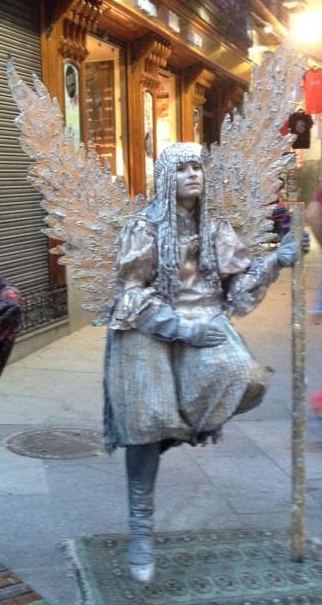
Madrid Angel

“In the name of the Holy One, the Holy One of Israel, May Michael be on my Right and on my Left be Gavriel, Before me be Uriel and at my Back be Raphael. Above my head and below my feet Shechinah-eyl.”

This is an adaptation from the prayer said before going to sleep in the Jewish tradition. It is one of several prayers that are part of what is called the Bedtime Shema. My dear friend Arik Labowitz has the Hebrew melody beautifully recorded on his CD Simu Lev (track 10, called Angel Song) and you can listen to it on his website or buy the CD. I play his music all the time. The English quote above here is slightly different from what you will find in some prayer books. Hebrew to English never translates perfectly and this is what I sing and sang to my children before they fell asleep. This prayer or any prayer or ritual practice of protection and love spoken ritually and regularly for young ones will help in so many ways. Nightmares just don’t have as much of a doorway in when you have surrounded yourself or your child with four guardian angels.

I also sing or chant these words over and around folks before and after medical procedures or if they come into my home for healing. It is very soothing. It is good to teach to others. I will look into recording a voice memo here and uploading for future reference so you can see the way I sing it. Just saying the words in any way you want is a good idea.

Whenever you see any word in Hebrew or translated into English with the “el” in it, this refers to the Divine. So El is one of the oldest, if not the oldest, Hebrew word for a Divine being. Please see Why Ha-Shem, Not Naming the Divine post for more detail about naming the Divine. In brief, we don’t name the Divine in the Jewish tradition, we use various kinds of descriptors. There is one name used in the Torah which is made up of the four Hebrew letters, but this configuration of letters has no vowels and the original pronunciation for these letters was only passed down orally from High Priest to High Priest. No one except the Cohen Ha-Gadol/High Priest ever knew how to pronounce this name and only did so once a year. See articles on Yom Kippur. This name is called the Tetragrammaton since it is made up of four Hebrew letters. It is inaccurately translated and pronounced sometimes as Yahweh or Jehovah or some variation of this.

Additionally, all Hebrew words are linked to their roots and each root spawns many, many words, which when you know the root for those words links you to a whole system of interconnected words and which informs you about the deeper meanings of a word. Translation is always tricky.

“… Translation, above all, means change. In Elizabethan England, one of its meanings was ‘death’: to be translated from this world to the next. In the Middle Ages, translation meant the theft or removal of holy relics from one monastery or church to another…” ~ Eilliot Weinberger

And my favorite teaching on taking Holy works and trying to understand them literally.

“The surest way to misunderstand revelation is to take it literally, to imagine that God spoke to the prophet on a long-distance telephone.”

~ Rabbi Abraham Joshua Heschel

Even if you cannot access it in the original language that doesn’t mean you cannot benefit from the teachings. I just like to remind folks to think of translation as a kind of very adept word yoga, with lots of bends and twists and flexibility built-in so that you don’t think there is ONLY one way to engage with a word or concept. When learning about the Hebrew prayers and practices and adapting them for any person, regardless of their religion or ethnic or cultural background, it is important to remember that the energy of the word or the prayer is what matters for those who cannot access it in the Hebrew. The other important thing to keep in mind is your kavannah/intention. If you set your intention the meaning will fall into its proper place.

Each of the angel’s names have meaning and can be translated variously as:

  • Michael is the angel of love/mercy. Mercy of El, the energy of love angel or the angel of mercy.
  • Gavriel or Gabriel is the angel of strength, so strength of El or energy of courage and boundaries, armor, protection.
  • Uriel or Ariel is the angel of light from the Hebrew word Or/Light. So, Uriel is the angel of vision and light.
  • Raphael is the angel of healing, the word for healing in Hebrew is Refuah

So, please engage how you are comfortable and for further teachings on this please see Rabbi David Cooper‘s book God is a Verb (order if from your local bookstore). Much greater detail than what I’ve given is included there and he has an excellent Archangel Meditation on page 144 of this book.  He also has CDs and other sound recordings on angels and tools for those looking to connect more deeply. Rabbi David is a master of Kabbalah and I use his materials all the time.

I have had personal experience with the Archangel Raphael and always experience his presence as being a warm wide-winged embrace that I sink into. Raphael is always a being I fall back into or sink backwards into. There is a profound feeling of trust and warmth. When I pray for others I imagine the wings of Raphael being so big that the person is completely held inside this Holy Being and is comforted and well there in the protecting and deeply healing embrace.

May you find comfort in these practices and please feel free to ask me questions and go and study more!

Life and Death Matters

Life and Death Matters

by Amanda Devons & Nicole Barchilon Frank

 And the days of Israel drew near to die, and he called his son Joseph, and said unto him: If now I have found favor in thy eyes, put, I pray thee, thy hand under my thigh, and deal with me kindly and truly; bury me not, I pray thee, in Egypt.” (Genesis 47:29)

The eleventh century commentator Rashi said about this passage: “The kindness which is shown to those who are dead is a true kindness (literally, a kindness of truth) for then one does not look forward to the payment of recompense.”

In 1999, around three years ago, in Eureka the Humboldt Hevra Kadisha was formed. Chevra or Hevra Kadisha means “Sacred Society.” It is more commonly translated as “Jewish Burial Society.” For more than 2000 years, as Jewish communities formed throughout the world, a Hevra Kadisha was one of the first groups to be organized in order to attend to the preparation and burial of the deceased in accordance with Jewish law. Our Humboldt Hevra Kadisha, meets regularly to discuss the work we’ve been doing, learn more about ritual, tradition, and practices, and to find out what needs we have. At our last meeting, we had in attendance both men and women. This was very gratifying because the ritual of tahara is done by men for males and by women for females.

Some of us discussed our feelings about our recent experiences doing tahara. Although it was agreed upon that this is not an easy task, physically or mentally, members of our group said it was one of the deepest spiritually meaningful things we had participated in. Responses from our group have been very positive. People feel they have “been transported to other realms,” “gone to the gates of death and found life,” “received extraordinary spiritual strength” “departed from the mundane and touched the holy!” The work deepens our understanding of life and makes us better able to truly live our lives.

It is difficult to find time in our busy lives to stop and do this work. Often, we have to be available in the middle of the afternoon. Returning to work feels very bizarre! We have also found that having some quiet meditative time together as a group before we begin is very important. Traditionally, men and women do mikva (ritual immersion in living waters), before re-entering their daily lives. Even if we can’t do everything the best way, we all know we are striving to be of service to the person who has passed away. The deceased is referred to as the met (for a man) or meta (for a woman) and by their name (Hebrew name when possible).

Some Terms and Definitions:

Shemira–watching over the body. The body is normally covered with a sheet or blanket upon death. We sit Shemira until the met has tahara and is laid to rest in a closed casket. We also sit shemira with their casket until the person is buried. This practice of maintaining a vigil so that the deceased’s body is never left alone is designed to comfort the neshama (soul) before it ascends to heaven. Selected Tehillim (psalms) are read aloud in either English or Hebrew.

Tahara—the preparation of a deceased’s body involving washing and dressing, by someone of the same gender, accompanied by prayers seeking forgiveness from the deceased and asking for eternal peace. After washing the met is dressed in a shroud of simple pure white linen or cotton, and then wrapped in a sheet called a sovev for burial.

Gemilut Hasadim—support services for the mourner and his or her family. This includes making funeral arrangements, holding a graveside service, and bringing the necessary siddurim to read prayers and shovels to cover the simple wood coffin with earth. Other services include bringing food to the house of mourning, finding a minyan (group of ten Jewish folks) to say Kaddish, and attend to the mourner who is sitting shiva. This is not the traditional purview of the Hevra Kadisha, but due to the small size of our community, we often find ourselves doing this task as well.

Chesed shel emes—the ultimate good deed, since those who perform the deed can never be repaid for their kindness. The members of the Hevra Kadisha are often called upon to serve with little or no notice, since they must spring into action promptly upon death.

Some ways you can get involved:

Even though a person may not have been active Jewishly in their life, they or their families might desire a Jewish burial. If you know anyone not affiliated, and feel comfortable discussing the matter, let them know about the beautiful practices of our tradition. Perhaps you can show them this article.

We need 100% white or off-white cotton or linen material for burial and or sheets to wrap the met in. If you have any white all-cotton sheets, please contact Nicole to donate. (We don’t actually need folks all over the internet to send us sheets!)

Because our services are often needed with very little notice, extra volunteers to help with any part of the process are very welcome, especially the Gemilut Hasadim. We have had great help from many of you.

Our Hevra Kadisha has a form that we are currently working on improving. This form looks at wishes concerning burial, funeral services, internment, memorials, etc. It is very important, within our tradition, to think about end–of–life issues. They often arrive suddenly, as we have painfully been learning of late. Communicating our wishes prior to emergencies makes everything easier for those we love and who love us. Start thinking now about what you want for yourself and those you love. We will be sending you a form to help with this process in the coming year.

~ From the Temple Beth El, Eureka California Newsletter