Category Archives: Jubilee

Aligning and Attuning on the First Yahrzeit of Rabbi Zalman Schachter-Shalomi’s Passing

zalman

2:22 am, June 23, 2015. Sleep not happening, at least not much, right now. I’m vibrating at a pretty intense frequency. Full of feeling and energy. On this journey from my home and life out to a new solo adventure, I’ve found myself moving backwards across the landscape of my life and across the geology of it as well. I left California on June 14th, nine days ago. I planned for some time here, in Colorado, where I am now. I lived off and on in Boulder from the time I was six months old until I was twenty-two. I’m headed to Paris in thirteen days, where I was born over fifty years ago. Going backwards in time and space and encountering myself in all these places is quite a voyage.

On Sunday evening, June 21st, as the long day of Solstice wound down, I joined with Holy community here in remembering our beloved Rebbe Zalman Schachter-Shalomi. The fifth of Tammuz, which this year corresponded to the 21st of June, marked the one year anniversary of his death. In the Jewish world, this is called a Yahrzeit. We remember our beloveds on the day they left the earth in various ways, with prayer, with candle-lighting, with stories and gathering together. We say their names out loud in our congregations and stand to say the Mourner’s Kaddish, while the community supports us. We never forget those we love.

When a great teacher dies it is a huge parting and loss for the whole world. A great teacher hopefully leaves behind a legacy of teachings, works, and folks who can carry on the Light and Wisdom that this individual teacher managed to shine on all around them. Our Rebbe, was one of these kinds of teachers. He left behind and empowered huge numbers of people to carry on the work, and still, there was no one like him and he is and always will be missed.

So, we gathered in Boulder at Nevei Kodesh, with Rabbi Tirzah Firestone and Rabbi Mark Soloway for a Zikr in honor of our teacher, Reb Zalman. Zikr/Dhikr is an Arabic word similar to the Hebrew word Zahor, for remember. In a Sufi Zikr practice you chant the name of the Divine and move in simple steps. This practice is a physical way of connecting ecstatically to the Divine. Rabbi Mark shared a teaching about sunflowers and their aligning/turning towards the sun. He spoke about how our teacher was someone whose love-affair with the Divine was so great that it made him shine. This was so true. Rabbi Mark also talked about a Zalman teaching about how all of us are like sunflowers turning towards the light of the Divine in our hearts and souls. Some folks forget this or they do not realize that their purpose is to grow like a sunflower, towards goodness, towards Light, towards nourishing all we encounter.

Rabbi Tirzah, along with a gifted group of musicians, led us so sweetly and beautifully in several hours of chanting and movement to lift up our spirits on this sad day of remembrance, but also to align ourselves with Holy purpose, prayer and connection to the soul of our teacher as he joined and became a luminous link on his ancestral lineal chain. Lineage is something, in the United States and the modern world, we don’t talk about so much. There is a kind of bias here against having a lineage, as if being a free agent without adherence or obligation to our ancestors or the past is some kind of blessing.

Lineage, in a religious realm, is very significant and it isn’t just about your blood or ancestral line. I am now aligned with Reb Zalman’s lineage because he was my teacher, he is my teacher still, even across the territory of death. And, his ancestral and spiritual lineage has merit and meaning. Who he aligned with and learned from, who his parents were and who their parents were back to the beginning is present in him and in his teaching. This is true for all of us and becomes real for us when we remember to engage with lineage and with the meaning of Zahor.
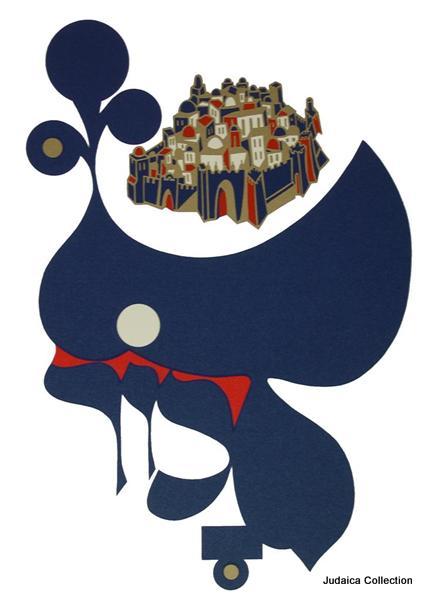
Zachor #44 by Mordechai Rosenstein
When I visit and share with child-prisoners in the penal juvenile “justice” system, I often talk to them about the fact that they are the product of thousands of successful heroic ancestral survivors making it across the ravages of time. Most often these children think of themselves as failures and since many of them have been brutalized by their families of origin in one form or another, trying to get them to see or find merit in who they are, at their core, is important. One of the ways I try to do this is to remind them that they are already miracles, just by virtue of being alive.

If you are awake and present on the planet now, no matter where you are, your ancestors survived plagues, wars, ice-ages, volcanoes, tidal waves, epic catastrophes and all kinds of crazy stuff to make it to this moment. It’s extraordinary that any of us are here. If we are here, it’s significant and not something to be wasted or ignored.

We don’t have to reproduce physically to create lineage, we only have to align with goodness and great teaching and embody those things. You can’t help being part of a lineage that you were born from, you can choose which lineage you want to align with as you move through your life. This choosing is a fundamental step in making connection to Holiness. You might be lucky enough to come from an ancestral lineage that is full of great teachers that you know about and have ready connection to.

You might be adopted and not have any idea who your grandparents or great-greats were, but no matter what, you have lineage and you can connect and adhere to the lineage of those you love, those you find home with emotionally, intellectually and spiritually.

As we chanted and moved in our Zikr for Reb Zalman, Rabbi Tirzah invited us to concentrate on the world we wished to see and to find a specific prayer to offer up along with our bodies and voices. The merit inherent in this communal practice connected to the Aliyah (rising up) of our teacher’s soul would add ummph and power to our prayers. This was palpable. So, while we all moved and swayed, we also were praying. We were praying for peace on this earth, for healing of the planet, for tikkun olam, for personal well-being or personal familial reconciliations. We were praying with our bodies, breath, hearts, minds and feet. No matter what our individual internal prayers were, we attuned with Heaven in our joining together in honor of our teacher. This practice will help all of us and the world move through our wounding towards healing.

After our movements and singing we said Kaddish for Reb Zalman and then we were invited to visit his gravesite where his headstone was now in place. We were asked to do this after his family had their own smaller private ceremony in the morning. So, throughout the day, various folks gathered at the grave of our teacher. We brought stones and stories, tears and songs, silence and sitting still to listen. There were birds and a bunny that kept hopping by, I saw dragon-flies and so many kinds of birds wheeling about. The fellowship and communion continued for us as we sat on the ground surrounding the body of our beloved teacher. 
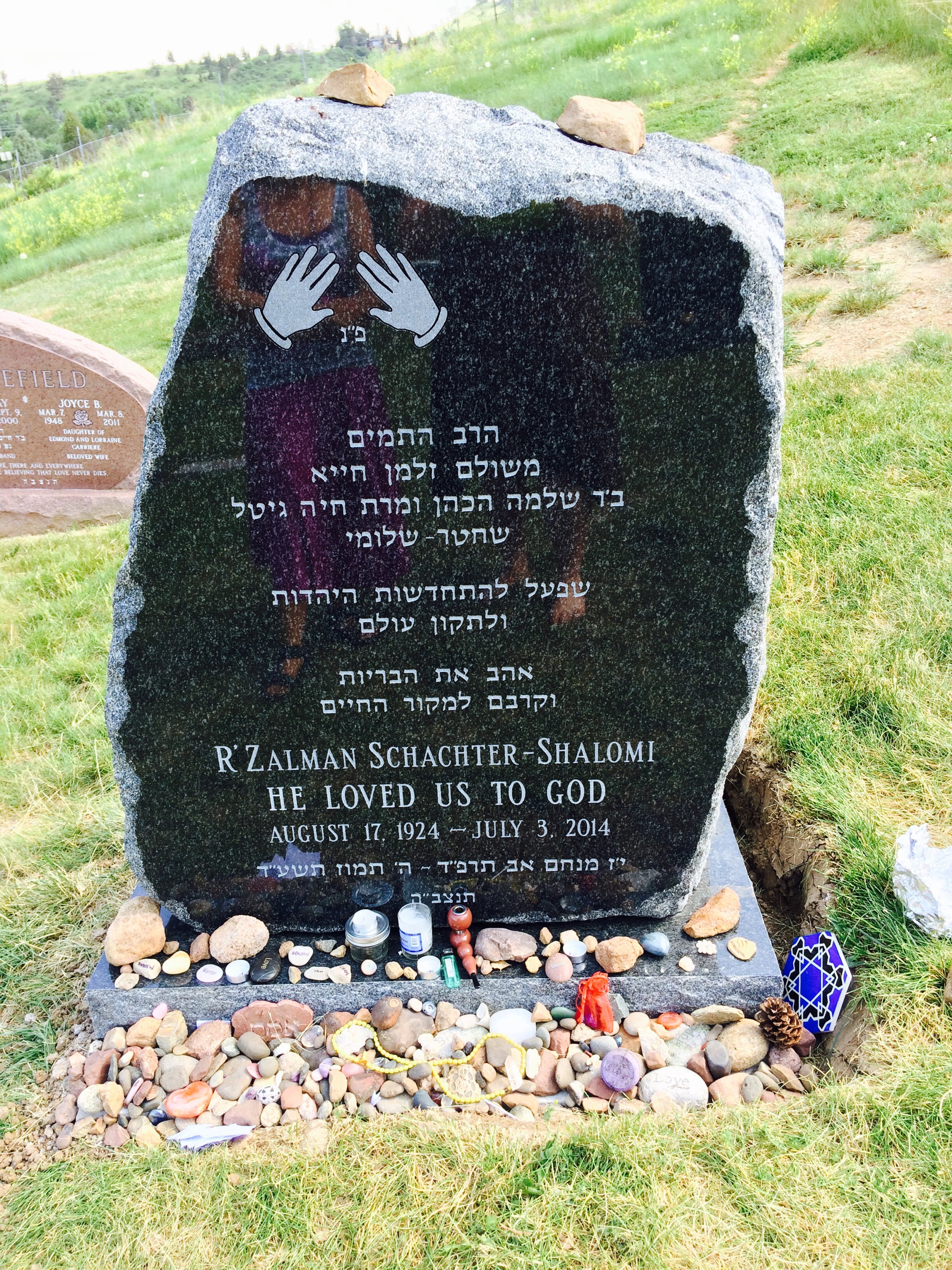
 My tears and my prayers continue to flow and I hope align with the millions and billions of others on this spinning orb dedicated to tikkun olam, to mending and working to repair what has been destroyed and what is wounded. I feel so un-alone, so completely held within the lineage of my teacher, the communities I belong to, the family I was born from, the friends I cherish, the people I encounter and all the angels in my life who continue to give me hope and help.

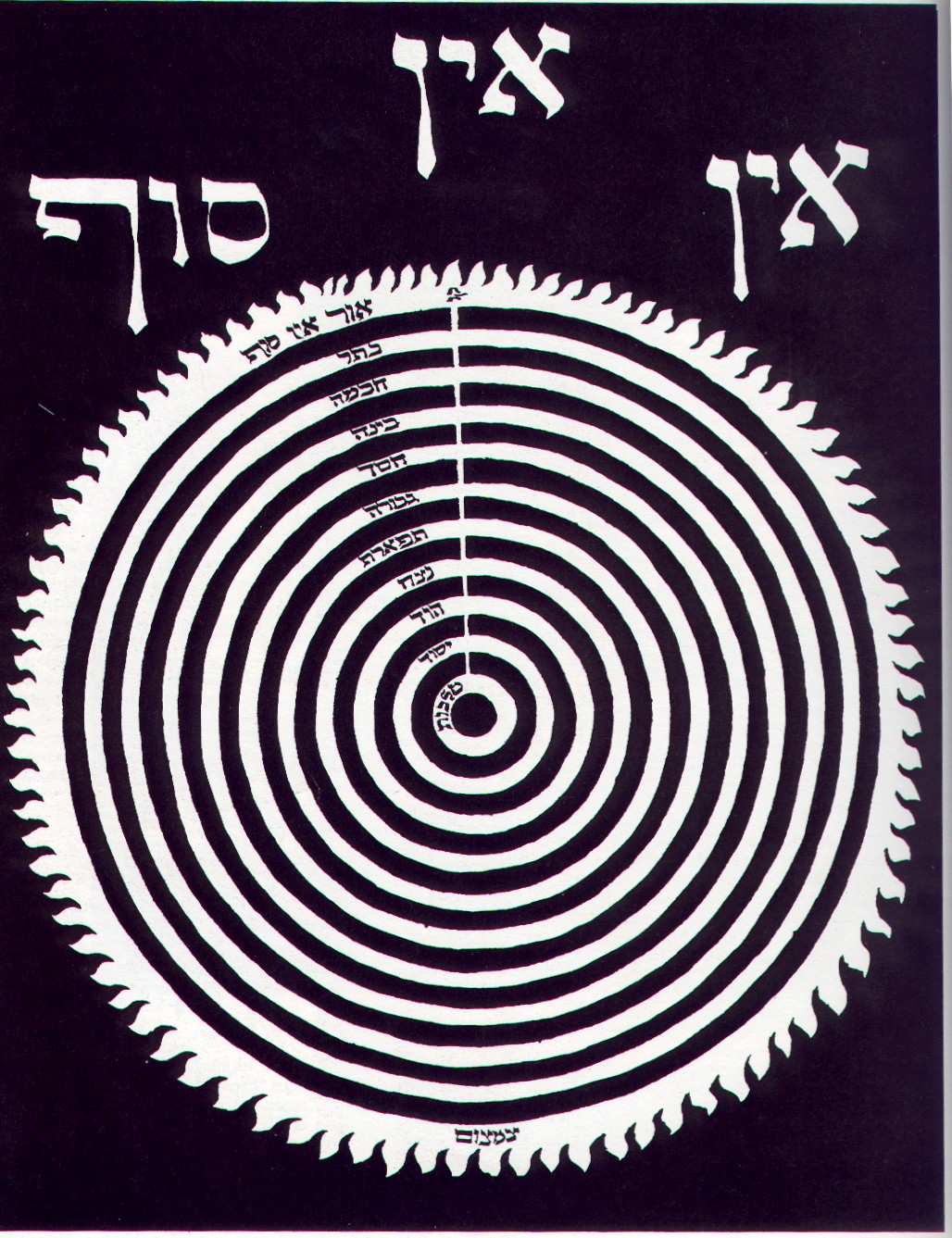
As I move backwards through my life and towards being alone and truly not surrounded by physical community, I am awed, once again, by the Great Mystery of Life, the Ein Sof, who placed me here, in Boulder at this moment of connection so that I could carry this feeling and this reminder with me.

I am not alone, I have never been alone, I will never be alone.

I am and always have been surrounded by the luminous beings whose presence lives in my blood and body and also by all the words and teachings and songs which dance through my heart and mind.

May you find your lineage and connect to it with passion and may if uplift and support you in all the work you do. May you remember how uniquely and magically and wondrously created and beauteous a being you are and may you find a way to know in your bones how truly un-alone you are.

nicole_logo3-400

from http://www.newkabbalah.com/images/ein.jpg

Shalom Aleichem, So Long, and Fare Ye Well

My soon to be new home

I’m off to play with the wild things!

In less than two months I will leave Arcata for my great big adventure. my solo sabbatical. I’m headed to the green hills of ancient Tara, to Ireland. I’ll be staying in a hermitage cabin by myself that is part of a community dedicated to solitude, silence and communion with nature and the Divine in contemplation. They allow folks of all faiths or no specific faith to spend time in their hermitage cabins, after determining if the person applying is someone who will work for them and their process, and this wild and wacky crazy Jewish woman, somehow made the grade. The fey folk and I go way back.

So, now I am moving through the hundreds of things that have to get done before I depart for this time away. There will be no phone and no internet in my small stone cottage. I will have a bed, a desk, a wood stove, a small cooking space, a bathroom and electricity to work my computer. I’ll be cooking my own meals with food provided for me from the gardens of the land I’ll be on. I’ll be sitting quietly on moss, swimming in cold rivers or lochs, walking to the beach and exploring the green, misted and very mellow and unpopulated countryside. I’ll be praying and writing and sleeping, resting, studying Torah, meditating, playing with watercolors and sleeping more!

My soon to be view from the desk, where I will be writing, writing, writing!

The last many years of my life, over thirty actively parenting children and years before that taking care of other people’s children and all the community work I’ve done, wherever I’ve lived, has taken a toll. I need a lonnnnnnnnnnnnnnnnng break. My tradition encourages us to attend to the Sabbath, every week, every year and every seven cycles of seven. Those of you who have followed my meanderings on these pages and perhaps also on my website/blog www.ohohands.com, know that I am in my Jubilee year. It’s time for me to get away and survive on the fruits of the last fifty years of my living and serving on this planet.

All leave-takings have an aura, a whisper of forever in them…

I am lingering in my hugs with folks. I’m weeping often. Here, at my desk, thinking about being away from my most beloved husband it is hard. As I prepare to go away from my lovely home, incredible and magnificent husband (yes, I’m repeating myself, because I am over the moon about this man, still, after 26 years) my children, community, and family, I am feeling the pain of loss. One never knows what will transpire when one goes on a sojourn away from family, community and friends. Who I am is always unfolding and changing, as it should be for all of us. I am not running away from all those I love with glee, I am clearly and consciously taking my leave of them for a time. It’s not easy or simple.

In March, in the pouring rain off of Lanphere road, as we all shivered and cried along with the sky, I led a memorial service for a local man who died suddenly in the arms of his beloved. He was in good health, had just started a new business and gotten a clean bill of health from his doctors. His children, friends, former partners and wives all were in a state of devastation and shock. There is no way to prepare for someone’s leaving in this kind of way.

As a friend of mine, who is a cardiologist, said to me upon hearing this story: “Sometimes the first sign of a problem is called sudden death.” Sudden death, is not something we get to come back from. I’m not planning on a “sudden death,” none of us are, but it can and does happen at the drop of a hat, at any moment.

In Pirkei Avot (Sayings/Teachings of the Elders) a book that compiles the wisdom of the elders of the Great Assembly, which contains sayings attributed to sages from (200 BCE) to shortly after (200 CE), it says: “Repent one day before you die.” This is a flawed English translation of very complex Hebrew. Teshuvah, which I’ve written about extensively in the past, doesn’t translate exactly as repent or repentance. Returning or reconnecting, or mending are more accurate and enriched meanings

Repentance, in and of itself, is a word with very strong connotations. I’m not opposed to the idea of repentance because it has much more meaning in Hebrew and it is an amalgam of the ideas mentioned already. Most folks in the groovy-new-age-be-mellow universe of non-adherence to responsibility or to strong ethical guidelines take issue with this idea. I’m not in that category. I believe in making amends and wrestling with wrong-doing and working hard to fix what I’ve broken or trying to get clear with someone I’ve hurt. So, I don’t mind the word repentance, but it triggers lots of people who are not religiously inclined and makes them reject, out of hand, a very important teaching.

How do any of us know which day is the day before we die?

We don’t.

Therefore, every day is the day to return to the path of goodness, wholeness, engagement with the Divine. Every day is the day to mend what we’ve broken, what we have destroyed or harmed. Every day is the day to reconnect with those we are fighting with or are distanced from. Every day is the day to say “I love you, you are precious to me.” There is no guarantee of tomorrow, there is only this moment and these hours and this opportunity for healing, connection, engagement and growth.

When we live our lives this way, we find grace and more importantly we create it.

As I say my farewells, I am endeavoring to be gracious and careful. But unfortunately I’ve messed up and been less than kind with friends, or not been as present or clear as I should have. Part of me is already gone. The Pirkei Avot teachings are the pillars in my life that make all the difference. They encourage me every day to be kind, clear and honest. So, even if I am erring, I am also continuously self-evaluating and working diligently to make things better.

Some troubles and issues are way too big or complex to fix or mend in one day.

I’ve been working on hard territory with people I love very much for long years. Teshuvah is a process, and even this longer-term kind of Teshuvah process will now have to move to another level, one that lives in my heart. All my work will be taking place beyond the mists, in a liminal, shrouded internal other place.

Part of my going away is about actively being free to engage with a completely different way of being, one that isn’t always tangible. I engage in prayer and practice every day for all those I love. It is my always practice to surround folks with light or see them laughing in joy or cuddling with a wished for companion, or resting in the wings of the healing angel Raphael. This will still be going on when I am away, but in a wholly deeper way.

Will those I love and who love me hear my prayers or know that they are being loved and cared for, even when they do not HEAR from me via email, letter, phone, or in person? If I’m not sending a care package, making soup for you or calling you to check in on you, does it mean I am no longer loving you? Of course not!

Being off the grid is something that I long for at this point. I’m crossing the ocean, and communication in physical form, will be on hold. Interactions that are coming from other realms will be ongoing and continuous for and from me. Will you hear me, when I say “I love you?” Will you feel the light, the healing and the hope curling around you? I hope so with all of my heart.

No longer engaged in giving birth or caring for children, no longer having the physical stamina to offer continuously as I have, what and how should I give to this planet, to those I love, to those in need. What is my offering as I go “over the hill?” Am I going to teach, pursue a Master’s degree in Religious Studies, or Judaism? Should I pursue becoming a rabbi? Should I open my own office of healing arts and “how to” lessons about connecting with the Divine within or “how to love” lessons? Am I supposed to write multiple books or continue to just do things as I have in the past with some modifications based on my physical reality? What really is the best way for me to serve going into the future?

I am dedicated, bound, completely and for all eternity to serving.

This is cellular for me and soul-deep. There is no reality I can imagine or want to be in where I won’t be endeavoring to find a way to serve. The question, as I age, is how to do that best? This is something I don’t have an answer for yet—and it is the ultimate reason I am venturing away from my life as it has been.

I am committed to having NO AGENDA or PLAN for my time away. I’m so done with both of those things, no “to do” lists and no forcing of myself into a space or time based on someone else’s needs. I am actively taking this brief moment of time between child-rearing and caring for elders in the coming years.

This time away is not just for me, even though it is a solitary time. This is hard for some folks to understand. My time away is about rest, yes and time away from doing, but it is also about finding out how the Holy One wants me to serve for the rest of my time on this earth.

I hope to find some of these answers in the moss, from the cool breezes, from my dreams in the ancient stone built cottage where I will be alone with just myself and the Divine. The body of my prayers in Hebrew and English and my tears, all my tears, these will be the Mishkan (sacred dwelling place created in the wilderness while the Jewish people ventured from Mitzrayim to the Holy Land). I will be creating and dwelling in this Mishkan built of my prayers, my years of working to make this happen, my kavannah (intention) and my desire. This Mishkan will also inform my process, being alone with just the Creator and the beauty of the creation around me will water the orchard in my soul. The hearth flames, the birds singing, the rolling green hills, the sound of the sea not too far off, these will be my companions and guides. I will wrap myself in my blue prayer shawl and call out to Ha-Shem and beg with all of my being for healing for this planet, for all those I love and know and for all those suffering on this spinning orb. May you feel the love for you that is in every dew drop, ray of sun, mossy knoll, and all of creation offering itself to you in every moment.

Byline is below from where this piece was originally published in the local paper where Nicole currently lives; The Mad River Union in two parts, on April 29, 2015 and May 6, 2015

~~~~~~~~~~~~~Nicole writes her last column, for a time, from her Bayside desk. She will continue to write and may post updates on her blog www.ohohands.com.  No matter where she is physically located, she sends Love, Prayers for a Refuah Shelemah (a complete healing) and lots of wishes for Shalom/Salaam/Peace your way.

Name-Change, Game-Change ~ Embodied Relationship to Who We Have Been, Are and Will Be

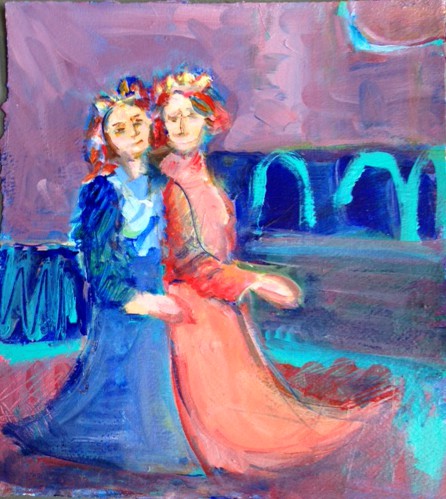
Twino Princesses by Marjorie Feldman
Twin Princesses by Marjorie Feldman

Last Shabbat, I completed a process that started a year ago on Yom Kippur. I  changed my Hebrew name. A Hebrew name is normally given to a Jewish person, who lives in the diaspora, who will be known by most people, by a name that is more common for where they live. In Israel, and in Orthodox communities around the world, folks generally don’t have two names, but they often will have a Hebrew name and a nickname.

My parents were not practicing nor even remotely engaged with their Judaism at the time of my birth. They may not have even known about the tradition of Hebrew name giving since their childhoods were both not religious ones. Consequently, I was not given a Hebrew name.

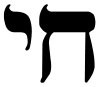
When I first got involved with Judaism, in my 18th year of life, my Chai year I was given a name by my dear friend Kendra. The Hebrew word for life is Chai (pronounced like the word “Hi,” but with a guttural ch sound). In Hebrew all letters have a numeric value/meaning as well as their sound and spoken meaning. Chai equals 18, my conscious Jewish life began then.  Because every word is also a number, or a series of numbers. or a math equation, depending on how you want to look at it, there are folks who read the Torah as they would a complex calculus equation.

Hebrew_Chai_Symbol.svg

Kendra and I met at my high school graduation party, when some of the kids from the “other” high school showed up at my party. She and I pretty much fell in love, but neither of us was gay, so we fell into a profound friendship. I believe we are all on a continuum where our sexual feelings occur, some folks gravitate firmly towards one end of the spectrum. They are “H” heterosexual or homosexual, but some folks really are all over the spectrum. This is also true for gender identity, which is a separate thing from sexual identity.

As I write and meander down one stream about one thing, other rivulets of thought come through. Everything is connected to something else and linkages are always occurring that press themselves forward and insist that I share them.

Kendra and I became friends and were inseparable. She brought me into relationship with my Judaism and took me to my first Shabbat in Boulder, Colorado. I found home in the sounds of Hebrew, in the songs of my people and in their practices. This home wasn’t one I knew I’d been gone from, but the homecoming for me was tidal in proportion. All my searching and seeking for spiritual relationship prior to this time was done outside of Judaism. After connecting with Kendra, who I still call “my Jewish angel,” I was Jewishly “all in.”

I realized that a Hebrew name was necessary. It was used for all kinds of things in our practices and I didn’t have one. I asked my parents if they had given me one that I didn’t know of, but they hadn’t and had no ideas or engagement with this practice. My name for them was exactly as they wished it. Nicole Andrée Barchilon. The  Andrée part of my name was from my sister Paula Andree’s name. Since, she had died right before I was born (See More than One), giving me her name, or part of it, was a way of honoring and remembering her. My younger brother was subsequently named Paul. What’s interesting here is that even though my parents weren’t practicing Jews, they did a very Jewish thing. Naming their children after a relative who has crossed over.

They did not give any of their three children Hebrew names. So, I needed a Hebrew name and Kendra said she would meditate on it and find one for me. I cannot remember how long it took her, but it wasn’t an instant thing. She is a deeply spiritual woman and I trusted her process. She came to me with delight and joy in her heart and told me she had found my name. It was Shoshana Adama Cohen. Shoshana means wild rose, Adama is from the Hebrew word Adam, which is the first human’s name.

From Google Images
From Google Images

Every Hebrew word is linked by its root. Hebrew words come in root pairs of two or three letters that form their core structure. Any words that share roots, share meaning or are connected, even if the words have wildly different meanings. If they share a root, they are linked and it is our job to look at that, also if they share a numeric value.

The word Adam in Hebrew is a mother-lode of meaning: Rebbe Nachman of Bratzlav writers: “It is for this reason that man was called Adam: He is formed of adama, the dust of the physical, yet he can ascend above the material world through the use of his imagination and reach the level of prophecy.” The Hebrew word “I will imagine” is adameh, same consonants, same root, different vowels.

Because Hebrew is a consonantal language, the vowels are moveable and by switching them up, you change the meanings of the words. There are NO vowels in the written Torah, only strings of root pairs/consonants. So, you really can change things dramatically by the vowels. We know what the words are because the Torah is an oral tradition and has been passed down across time, it is an ancient thrumming song, the song of my people.

For Rebbe Nachman, the movement (within the same root structure) from adama to adameh is very significant.  Adamah is ground or earth, and it can also be read as adameh, “I will imagine.” Since the vowels are not part of the root pairings, it is the consonants that create the word and you can play with all the vowels.

Also, part of the word Adam is the Hebrew word Dam, which is the word for blood. So, Adam, the first being, who was the complete spectrum, male and female in one body (study your Torah folks!), was not the first MAN. Adam was the first joined being who was made of earth, blood and imagination. We are all ancestors of the first beings made of earth, blood and imagination. And the first task of the Adam was to NAME all of the creation.

All this explanation to say that my middle Hebrew name, Adama means a lot to me. The third part of my name Cohen (is actually my paternal grandfather Jaime/Chaim Cohen’s last name). I am a Cohen. In the Jewish tradition, this has weight, and the name links me to the tribe of the Kohanim (the priestly tribe). This also connects me back through history and time to my ancestors Moses/Moshe and his wife Zipporah. When my father came to this country, after escaping Nazi-occupied Morocco and joining the Free French Forces in WWII, he chose to take his mother’s maiden name, Barchilon, as his last name. (See It’s a Small World posting for more details on this).

My Kendra-given Hebrew name of Shoshana Adama Cohen has worked for the last 32 years. It is a beloved name. When you pray for someone, or they are called up to the Torah, you say their name and the names of their mother and father. When someone is sick, we pray in the name of their mother, when they have died, we switch to calling them by the name of their father. When someone has done Teshuvah/Return/Repented and made amends for a wrongdoing, they can change their name to indicate that they are no longer the person who made that mistake.

In the Reform and Renewal movements, we include both mother’s and father’s name for all things. I still mostly pray for people when they are sick, in the name of their mother and if I don’t know their mother’s name, if they are Jewish, I say their name and then bat (daughter) or ben (son) of Sarah (the wife of Abraham). If they are not Jewish, I say bat or ben Chavah (Eve, the more specifically female part of the Adam spectrum).

So, why am I changing my name? I’m not eliminating any of it, but I am adding onto it. As I move into the next phase of my life, I want a name that fits the next phase of who I am becoming. I want to create that space to flow into. I also am changing in lots of ways and feel like a different person. I want to shed the old dried skin parts of who I have been and embrace the self that is now emerging fully. And, last year at Yom Kippur, my rabbi Naomi Steinberg, encouraged us to think about choosing and taking on a Torah name. I had never thought about doing this, but once she planted the seed, I started dreaming and thinking about it.

My meditation brought me to the name Miriam.

From a program for Tof Miriam Shabbat: http://marlaleigh.com/jewish-programs-2/tof-miriam-shabbaton-programs/

Miriam, as Moses’ sister, could have been my great, great, great……great Aunt. I claim her as family and mentor. Miriam was a prophetess, a leader of her tribe. She was the one who encouraged and nudged her brother Moses to take his place and do the job he needed to do. She was a community activist and agitator. She was fierce and strong. She led the women in prayer and song and dance. She was responsible for water flowing from the desert to the people. As long as she lived, the wandering Jewish tribes had access to water. When she died, there was no more magical spring that bubbled up at her command. Moses, confronted by the thirsty and complaining throngs, in the midst of his grieving, gets water for the people, but he does so the wrong way, causing him to not be able to enter the “promised land.”

The wrong way is the violent way, the hitting the earth and rock way, versus the Miriam way of calling up the water from the underground spring, of singing to and with the earth. Miriam has always been my hero. She’s an older sister, she’s not shy or afraid. She knows what to do and how to do it. My Alpha, Alpha female self really relates to all the stories of her, and I’m a writ large bold kinda gal, so connecting with her for the next part of my life feels really right.

So, before I changed my name, I wanted to call or find Kendra, who I haven’t spoken to in many years. I found a phone number for her and she picked up the phone. We both broke into tears and started apologizing to each other for how long it had been. Then I said, let’s not apologize anymore, we obviously love each other, are connected forever. So, we left apologies behind and talked for a long time.

What is really funny, is that Kendra is in the process of changing her name! We really are twins on some level. I found this to be powerful and significant. She is moving into her new name and I am moving into mine. I had a little ceremony at Temple Beth El, where I am a Lay Leader. It was very sweet and felt so good.

I will now be known, among the tribes of Israel  when I am called to the Torah or for prayers of healing, as:

Miriam Shoshanah Adamah Cohen bat Channah v’Jacob

For the English spelling, I added the letter “H” to both Shoshana and Adama a few years ago. This was because in the Hebrew they end in the letter “Hey” which is one of the letters in the four letter Macro/Super/Ultimate name of the Divine.

When Avraham and Sarah became Jews, they changed and the Holy One changed their names from Avram and Sarai to Avraham and Sarah.

Hey

The Hey letter was put into their names connecting them with the Divine. It’s a big long name, my new name. I only need folks to call me that when they call me up to the Torah, or if they are praying for my well-being. I’m still happy here in the Nicole Zone. A new name is very exciting and I’m super excited for it. One last teaching on Hebrew and why it is so powerful for me. This passage by Marcia Falk is excerpted from The Book of Blessings: New Jewish Prayers for Daily Life, the Sabbath, and the New Moon Festival (Harper, 1996; Beacon, 1999). Copyright © 1996 by Marcia Lee Falk.”The Book of Blessings by Marcia Falk http://www.marciafalk.com/index.html:

“There is for me a plumbline that drops from the center of my being down to the beginning of my history. At one end, álef, at the other, taf. If human language is, in large measure, what gives us our humanity—allowing me to communicate with you, distinguishing us from other parts of creation—then Hebrew is sign and symbol of my particular human identity, giving me my home as a Jew. Although my first language is English, I cannot imagine myself without the millennia-old language of my people. When I was fifteen, visiting Israel for the first time, an Israeli asked me what was my “mother tongue,” my s’fat eym. English, I replied is my s’fat eym, but Hebrew is my s’fat dam—the language of my blood.”~ Marcia Falk


My s’fat dam is also Hebrew, everything about it calls to me and moves me and even writing these words makes a river of tears flow out of me. I have a BLOOD relationship to it, it runs through my very being. As I go into silence and stillness—my Jubilee retreat is only a few months away now, HEBREW is calling to me.

I want to swirl and sing and dance in it, alone, just me and my s’fat dam. I will be diving into the waters of Hebrew while I am away, working hard to move this language from the underground wellsprings in my being, up into my frontal lobe and language and reasoning centers. I want to read it fluently, I want to be able to look at the Torah or the Talmud and not just have aha moments, but have a continuous flow of delight, questioning and dialogue. As Miriam, I will be able to do that more. I can feel her presence supporting me on this journey and I hear her timbrel calling me to the dance.

Tohu Vavohu

Tohu Vavohu by Marjorie Feldman


Moon and Mussar Musings on the Megillah

The 5 Faces of Paul oil painting -1981 by Helen Redman

Like a cat circling her spot before she can settle down, pawing and prodding the cushion or the carpet or the bed-spread, I also, have to create and circle my space before I can manage to write.

This has been difficult for me lately. I’ve just been posting recipes. Recipes are safe and easy and do not require too much from me that involves delving into emotional or personal territory. It is not lost on me that folks respond more to my recipes than to my musings. I have a loyal following of muse-niks (those who appreciate my musings), but there is a much larger following of recipe lovers. So, if you are a recipe lover, this post is not a recipe for some yummy dish. It is a sort of recipe/play on the themes of Purim. Full disclosure, I do not know how to make Hamentaschen and this post will not result in a good cookie!

Apricot Hamentaschen, NOT made by me. This is the only cookie you will be getting from me!

Tonight is Purim, and the full Moon is hanging brightly in the sky, urging me to get a little moon-mad, and instead of reading or hearing the Megillah being read, I am sitting in my meditation room, listening to flute music amidst incense and candles. Instead of dressing up and being wild and with a bunch of people, I am sitting quiet and still and writing.

This is a VERY unusual state of affairs for me. I have an internal barometer connected to the Jewish cycles of holidays, fasts, new moons, and all the weekly Torah readings as well. It is physically difficult for me to be absent from any of the rituals connected to my path. When I actually got involved with Judaism actively, as a young woman in the 1980s, it was with a profound sense of coming home and finally understanding and being able to make sense of so many things about myself. My family has been Jewish forever, but the practice part of that skipped a generation or two. This is not unusual and it is often the case that one generation will be very religious, the next one won’t be and then the grandchildren or great-grandchildren will find their way back. Many of us seem to spin on a generational wheel of sorts.

Some folks wander around or linger in one spiritual tradition or another and pick and choose that which works for them and discard or lay down the rest. Others are devotees of only ONE way to walk and be on the planet and with Holiness. Most folks are somewhere on this continuum, and of course there are those who completely reject any kind of spiritual path or directionality. It is not one size fits all, it never has been and it never will be.

My size and shape and relationship to Holiness is WRIT LARGE, I am the Jumbo size, extra-large variety in all my expressions. This is a difficult path, because it is not, in any way, quiet, petite, small, cute, sexy or easily dismissed, overlooked or ignored. People know when I am coming and where I am. I am louder without a microphone than most folks are with one. Friends with sensitive ears sometimes cringe  when I speak. I am asked to speak more quietly in many circles. My animation and volume are VERY strong. This applies in all areas of my life. If I had to name one of my “super powers”, I’d say it is my voice. Sometimes it feels like it literally can travel around the globe.

As I move through the thin middle place in the hour-glass of my life, and also as a result of my continuous mussar work, I am shifting things about myself all the time. I am actively looking at my volume and working to moderate it. I am adjusting the sands of my personality, grain by grain. I examine and attend to what goes on around me and through me very carefully. In Alan Morinis‘ most recent Mussar book, With Heart in Mind, I read the following passage today:

“Rabbi Moshe Chaim Luzzatto (1707-46) in the Mussar classic Path of the Just gives us another take on the spiritual value of fear. One who fears heaven ought not to be concerned so much with punishment from God’s big stick but with offending against the supernal glory that infuses our world. This is not fear of breaking a rule and catching the consequences, but rather acting in an unseemly way that besmirches the most precious, pure, and holy divine majesty, which, if we are sensitive to it, permeates every fragment of the reality within which we live.” pg 40

So, for me, who is “sensitive to it,” there is an element of fear/concern in my every awake moment. It is an undercurrent, not a blaring horn. Am I reflecting the supernal glory and holiness I experience accurately? Am I modeling healthy and loving relationship to the planet and all her beings? Am I remembering to be grateful, to engage others gently and with chesed/kindness? Am I living in a way that honors the creation and the creator? Am I living for Olam Ha-Ba and behaving in accordance with the “precious, pure and holy divine majesty” or am I just sleep-walking through my life?

These questions are not really answerable. There will never be a complete or finished answer sheet with checked-off squares, √ kindness done, √ honoring done,√ gratitude done. These are forever and all the time questions for me and they are part of my life and very real for me. How does any of this relate to Purim, you might be wondering?

Well, Purim is about many, many things, most of which we will never be able to grasp in this world/Olam Ha-Zeh. One of the things that I love and relate to the most about Purim is the idea of dressing up, trying on, the costume of your enemy or your dark side. This holiday is ancient and it asks us to get so drunk that we can no longer tell the difference between good and evil, between the heroes and the villains, between right and wrong, up and down, male and female, Jew and Muslim, and all the other polarities on the spectrum. It’s the one time of year you will see Santa costumes in Orthodox neighborhoods. It’s really funny, very straight men dressing as women, super religiously devout folks dressing up as clowns and Christian icons. It’s a weird wonderland of a holiday.

Nicole, not really in costume, revealing her third eye.

While we are simultaneously supposed to be getting really drunk, we are also meticulously supposed to be listening to every syllable of the Megillah (scroll of Ester), and it has to be read over if we miss a line or say one word wrong, from the beginning. “A megillah is a finely detailed account or book but the term by itself commonly refers to the Book of Esther.” ~Wikipedia emphasis mine!

So, Purim is a study in contrasts, extreme detailed focus on the script, and wild abandon of self and self-constraints. For those who have alcoholic tendencies, or who come from families with alcoholism, this can be a treacherous holiday. Many people imbibe and it can be difficult to be around. Folks get loud and strange, it’s truly not your usual religious service. You don’t have to drink to get expansive or loosen your boundaries, but this is one of the times in the Jewish religion where some kind of personality, boundary-crossing, mind altering substance is called for.

We are so very attached to our ideas of right and wrong, of good and evil, male and female, Jew and everyone else, black and white, trim and fit or large (and by society’s definition unhealthy just because of our size). Purim is the one Holiday that will still be celebrated once the Messiah comes. I will address the various and multiple views on Messianic consciousness in Judaism in the future. I mention it here only to underline my point.

This strange holiday, based on an ancient scroll telling a terrible story, with ugly and horrible things going on it, as well as miraculous and wonderful things; this model of alternative narratives and confusing roles is something that is so fundamental to the nature of this universe, that it will actually still have a place in Olam Ha-Ba.

What does that mean? For me, it means that I am never going to “get it.” I will never be able to wrap my head around anything and say, “I’ve figured it all out, I know the answer.” It means, I should expect to be surprised and confused and not think that Ha-Shem has a plan, like we do.

While talking with my dear friend and Rabbi, Naomi Steinberg, we were discussing our extreme frustration with the concept of “God’s Plan.” This idea is so human-centric. Naomi was expounding on the ridiculousness of thinking about the Divine having some kind of day-planner with notes about what was supposed to happen to someone on Tuesday at noon.

We use and need plans as humans, because the world is a majorly intense and confusing place to navigate. If I don’t have a plan, I might miss my appointment with the dentist or the job interview or the meeting with the principal or whatever??? I am a big planner, I am not demeaning plans, planners or planning (see my Organizing Optimally post for a real list of how to plans).

There is a huge difference though between my attempts to navigate and organize my life or events and how the Creator engages with the Universe.

Planning cannot be applied to the Divine, or to the Divine in each of us. That Holy spark reveals itself to everyone differently and in its own way and across space and time. I may think you look like a woman, but you may feel like a man. I may think you are someone to feel sorry for, because you are in a wheel-chair or blind but you may be wiser and healthier, in a deep way, than I could ever know.

None of us knows what is inside of others. Regardless, we have to try to make contact and reach across whatever divides us. We need to reach across the bridges of our differences and listen, listen carefully to EVERY word of each others’ scrolls. “Wait, I missed that part where you said you felt different, can you go back and repeat that again, so I really understand?”

Coup d'Oeil Marocain, 1971, pen, ink, collage on paper with (handpainted mat), 22"x16"
Coup d’Oeil Marocain, 1971, pen, ink, collage on paper with (handpainted mat), 22″x16″ by Helen Redman

We also have to play with who we are and be willing to actually be THE OTHER, to wear the skins of those we cannot imagine being, or to take a risk and wear the shape that is true to who we are inside, even when it doesn’t match who we are on the outside. It’s a crazy, wild ride. I only drank some mellow herbal tea tonight, but somehow I was able to expand without any mind-altering substances. I hope your mind and heart are a little more expansive as a result of these Moon-rich Megillah musings of mine. On the 15th of Adar, 5775, Shushan Purim, it was written and, at least, for now this marks the end of the Nicole-Zone Purimschpiel/Megillah. Amen!


Organizing Optimally, Nicole’s Outrageous Offerings on How to Navigate Large and Small Events

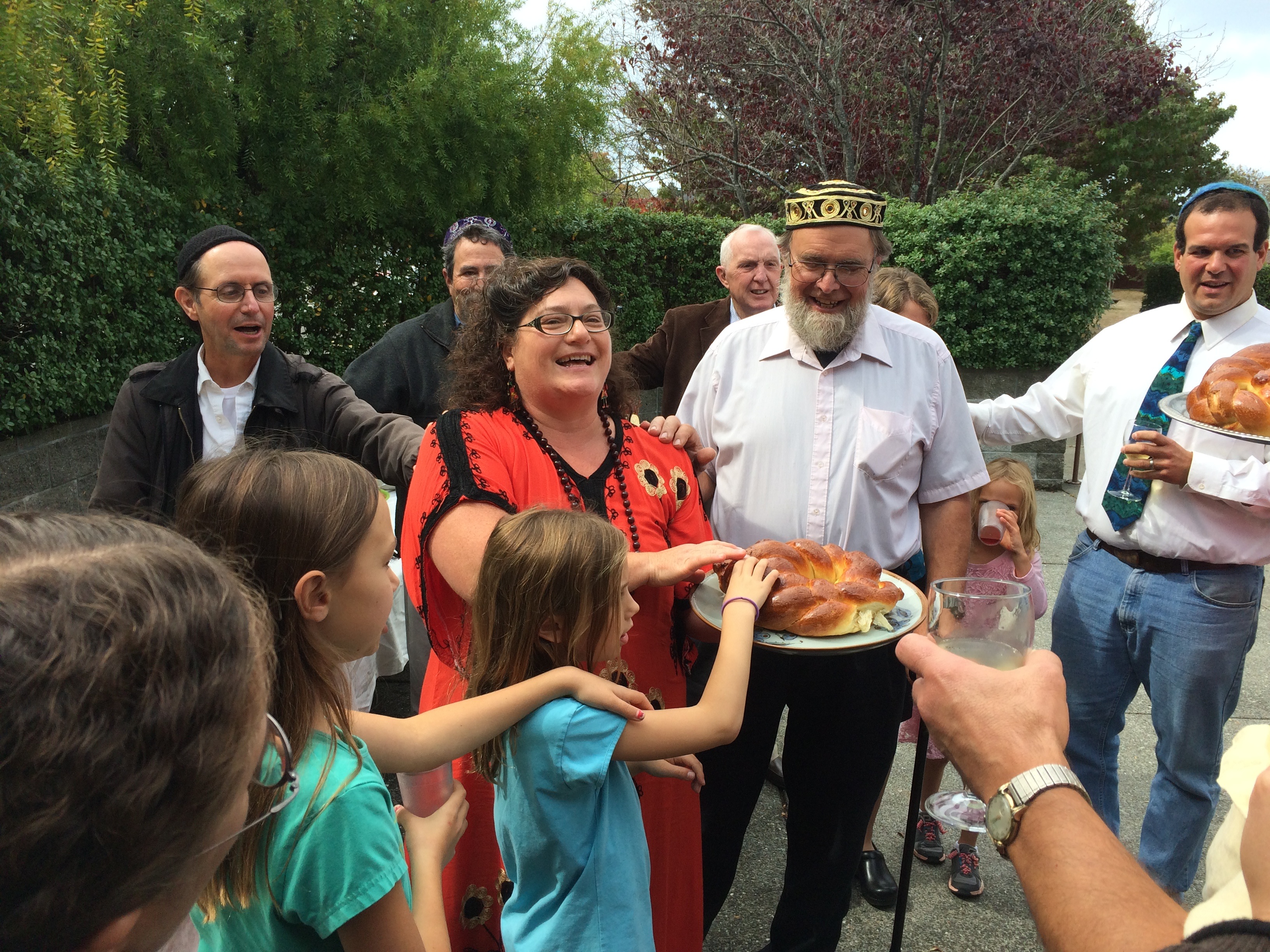
Pouring the Bubbly at a Rosh Hashanah Luncheon, which I organized for my Jubillee Birthday Celebration
Pouring the Bubbly or the Sparkling Apple-Cider at a Rosh Hashanah Luncheon, which I organized for my Jubillee Birthday Celebration, photo courtesy of Lorraine B. Miller-Wolf

1.     Do your homework: This means that you must approach any meeting or organizing you do from a place of knowledge and hopefully wisdom. It also means you are choosing to work as hard as you are and it isn’t on anyone else to do the same amount of work or to be as effective or extended as you are. This is your CHOICE. Just like with homework, if you are resourced well, you’ve slept and eaten and exercised and basically seen your therapist recently or done any number of things that you need to do for yourself, you will succeed and so will your event!

2.     Start at the End: Assign or find the folks who will be responsible for CLEANING-UP your event. Do this part early on in your process. I actually recommend getting this done as soon as you know the date and time of your event. When you are in charge of an event or care about it, you will be there early, you will be doing a hundred things, you will be EXHAUSTED by the time things need to get cleaned up. If you can’t find volunteers who will be in good spirits and energetic and capable to do this clean-up, HIRE someone! This is money well-spent, always.

3.     BE NICE: Expect that many things will go wrong, learn to breathe and be flexible and always BE NICE! Whatever your feelings are, no matter how valid they are, you will be remembered for your outbursts, rudeness and inappropriateness. So, try to get your anger out of the way before you organize people or communicate with large groups. People are more receptive to your agenda, your ideas and your visions when they aren’t being blasted with your (probably valid) feelings. This rule is for community organizing, not protest marches or confrontations with despots who need different approaches. Remember your community is your ally, not your enemy.

4.     DELEGATE: Get help and realize, at the same time, that if it matters to you, which it should, you will probably still do the lion’s share of the work. Do not expect other people to have your standards, your work ethic or your priorities. Be prepared to have everything stop happening if you decide to pull-out because you are overwhelmed or doing too much. Take it into consideration at the beginning of your organizing, so you don’t have to reach that place. Maybe you’ll get lucky!

5.    MONEY: You need Money, you need donations. Food is good! If you tempt people with goodies, they will come and partake. This means outreach in the community to get stuff donated for big events. This is where your presence as a nice person who people can count on is crucial. If you are a flake or unpleasant, people won’t be as interested in giving you money, stuff or time. This applies to getting musicians to donate their time as well.

6.     HUMILITY: Don’t be afraid to apologize or admit you are wrong. Community organizing means you are working with the community. Expect to learn something, to be challenged, to be confused or supported and recognize that the nature of community work is cooperative.

7.    BEING STRONG AND CLEAR WHEN YOU ARE IN CHARGE: Cooperative work requires humility but once that has been said and understood, if you don’t manage things well and take control when you should, things will either flop or get out of hand. So it behooves you to set clear agendas, have good facilitators and note-takers (this is especially important when issues are heated.)

8.    MEDIA: Media is crucial. Find out what you can get for free, there is lots of it, but all of it has deadlines and specific formats. This is the grunt work, if you can assign someone else this task, who will actually do it, great! If no one knows about your event or you don’t target the right places to advertise or alert, even if everything else is perfect, no one will be there to appreciate it!

9.    SLOW DOWN: Say less! Listen More! Slow Down! Please note, I am notoriously bad at all of these and have paid the price many times over for not following this advice. Being respectful of others is the best way to achieve your goals, no matter what is going on.

10.   YOU CAN’T DO IT ALL: Don’t try to tackle every issue. Find the category that really charges you. Some people are activated by the environment, some by social injustice, some by legal inequalities, some by police brutality, globalization etc… You will be more effective working where you have the most energy. All of these issues are interconnected though and there will be overlap.

11.   COMMUNITY: Use your community, involve yourself in where you live and work and you will find allies.

12.   BE ORGANIZED, (no kidding!): Develop a good filing system. Don’t laugh! This also applies to your computer data. Organize things in files and folders by date, organization, issue etc… If it takes you an hour to find the thingamajig that what’s his name gave you, you’ve just lost valuable time for no reason. Compile email lists and phone lists and keep them at the front of your folders so you can call what’s his name and actually remember who he is and get him to do the thing he promised. In this day and age, create a Google or other easy online Drive format and import all your contacts. Keep your contacts list current, delete old addresses/information. You don’t need 3,000 copies of your contacts. You need to have a back-up of them somewhere electronic, an online version and if you want to be very diligent a printout, so in case all computer related things stop (in a power outage for example) you can still hopefully reach folks you need to reach.

13.   REMINDERS: Remind everyone multiple times about meetings and events. I know it sounds like elementary school, but we’re all busy saving the world and one more meeting is easy to forget. I do this exclusively by email, which is unfair for all those who don’t use that system, but it is the only way I can manage to get it done quickly. If you are working with people who don’t have access to computers, you must develop phone-trees and quick post-card type reminders. Also, be early to all your meetings and endeavor to start things on time. If you care, you will always be there at the beginning and, usually be the last one to leave as well. (That’s the truth!)

14.   BE PLAYFUL OR PRAYERFUL: There is always time for a quick icebreaker activity/song or introduction circle with a brief one-word check-in or something like that. Help people arrive in the space by giving them a moment to be humans together in a room, before they tackle an issue or get down to doing a large job, this is what all coaches know, rev your team up before you send them out on the court, reassure them, remind them of why they are there and appreciate them.

15.   THANK YOUS: I endeavor to always personally write, yes, actually hand- write a note of thanks to the vendors who gave things, to anyone who really extended themselves, to your co-workers/co-leaders, to volunteers and to someone who always does things but never maybe gets a thank you. Believe me, the people you thank will remember that you sent them a thank you. This is not a minor step, just because it’s close to the end of the list. This can take two weeks or more to do, you don’t have to rush to do it, but if you were organized as you should have been, you will have the names and addresses of folks handy that you need to thank.

16.   BE NICE! I know I said that already. It just bears repeating. This is also related to “do your homework.” The more clarity you have as an individual, the more balanced you are, the more effective you will be in all that you do. When you are in the community, you are in the public eye. Your grace and intelligence will get you far, so develop them.


2014-09-26 17.03.20Breaking Bread Together at Temple Beth El, Eureka. Photo by Lorraine B. Miller-Wolf