Category Archives: Food

Mamma’s Marvelous Minestrone (Gluten Free or Gluten Full)

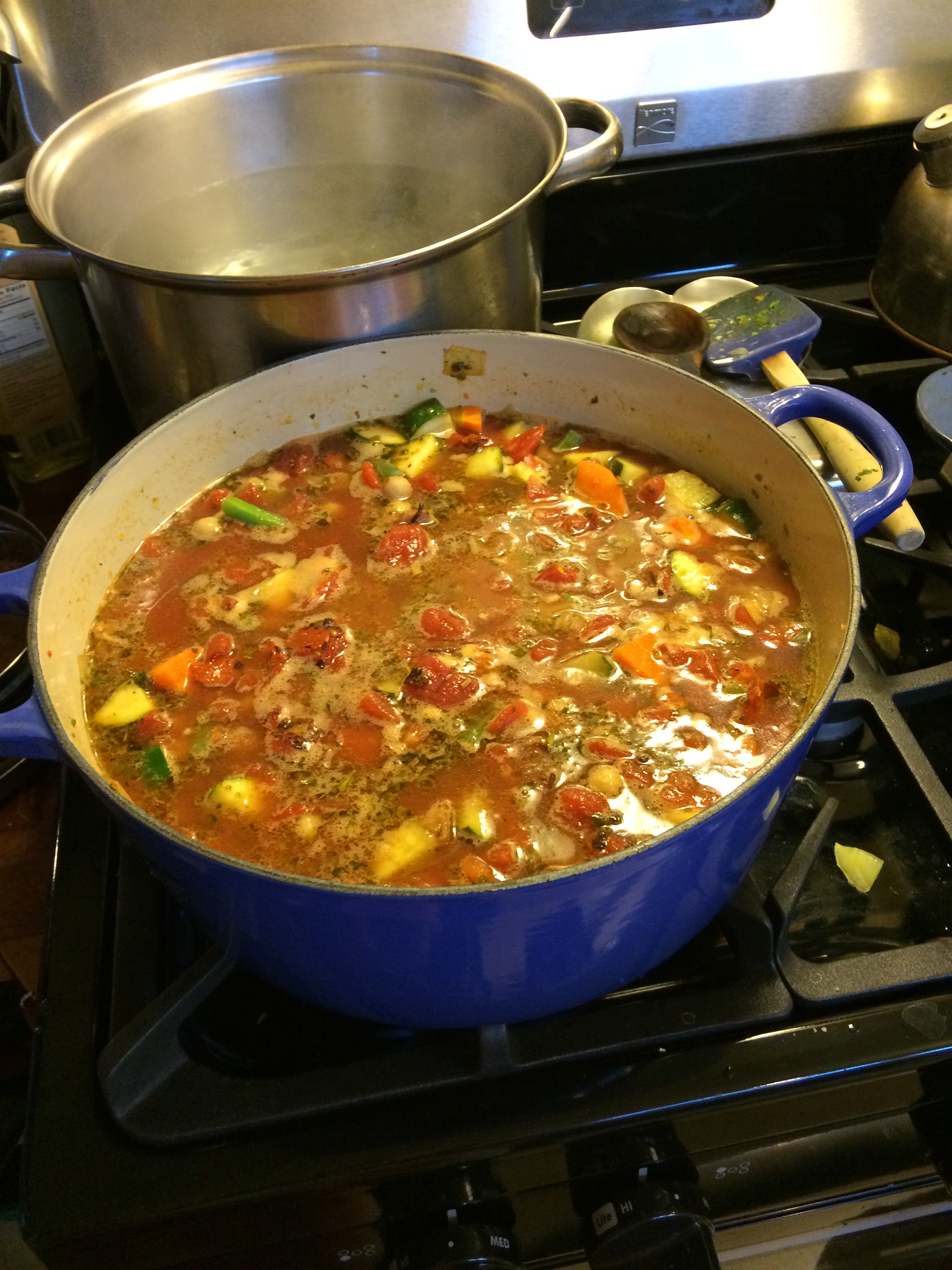
Minestrone Cooking on the Stove, smells gooooood!
  1. one to two onions (yellow) chopped medium to small
  2. 1/4 or so of really good olive oil. I buy Henry’s Olive Oil in five gallon buckets and selectively share it with others, but I go through five gallons pretty regularly. Whatever good olive oil you have locally, use that. Heavy, dark and green, not light and clear!
  3. three to four good carrots, not wimpy, limpy ones, cut into small halves or quarters (the smaller you chop something the more flavor you get, due to surface area being exposed. See The Ten Commandments of Nicole’s Kitchen
  4. two to four thin small zucchinis, I never use big fat ones for this recipe
  5. more garlic than you think you need (at least one whole bulb) and prepare it correctly, by removing the centers. See instructions at the end.
  6. several stalks of celery
  7. two to four quarts or more of canned tomatoes with their juice (yours preferably) or if you have to use canned tomatoes, use Muir Glen’s Fire-Roasted whole or diced tomatoes and a jar or so of tomato sauce
  8. freshly chopped herbs: oregano, thyme, and parsley. If you have to use dried herbs, use fresher ones, this means not the ones sitting in your cabinets for three years! Buy in the bulk section when you can for dried herbs, the turn over is much greater there, so they are fresher.
  9. good salt (see Let’s Talk Salt)
  10. coarse ground black or white pepper (some folks cannot abide black pepper, but most folks can handle the white pepper)
  11. cayenne to taste (optional for folks who cannot handle spice)
  12. red wine 1/4 to 1/2 cup (the better the wine, the better the soup, you can drink the rest of the wine with your dinner). If you live in Humboldt County, where I do, you can always check out Bob’s Picks in the wine section at  the Northcoast Co-op. He has excellent taste and the wines he picks are often not too pricey and they taste great.
  13. balsamic vinegar 1/4 cup or less (not flavored or thick syrup balsamic, just basic balsamic vinegar)
  14. two to three cups cooked beans, garbanzo, cannelloni, white, fava, whatever beans you want. I always do garbanzo beans and usually a white or Lima or cannelloni bean as well. I use Westbrae Natural canned beans if I am not cooking the beans from scratch.
  15. Parmesan or Asiago cheese or some other nice strong cheese to add as a garnish if you aren’t making this for vegans. If you are doing a vegan version, don’t add the cheese.
  16. a bag of cooked noodles (gluten full or gluten free). This is optional. I don’t eat a lot of gluten and don’t like the gluten free stuff too much, so I just enjoy the soup minus noodles. Kids love noodles and if you throw the noodles in to their bowls, not into the soup base, and cover them with all the veggies and soup, this is one way to get them to eat some veggies!

Okay, with all those ingredients, surely something magnificent should be the result, and it is. This is actually a very easy soup to make. Just sauté up the  onions first for ten minutes with the white pepper or black pepper in the good olive oil, then add chopped carrots and celery, sauté those up for another five to ten minutes. Medium heat for the duration of soup cooking, until the end.

Throw in the fresh herbs and the zucchini and the garlic and the first teaspoon or so of good salt. After a few minutes add the wine, and then add the tomato sauce and tomatoes. You can cook this for an hour or more, then add the beans and cook another hour or so. Add the balsamic vinegar when you add the beans, also the cayenne and more salt. You can cook this soup for hours if you want, the veggies get pretty soft though and the beans can break down if you cook it for too long. On the other hand, the flavors blend really well the longer you cook it. This is something you have to discover on your own. I generally plan on this soup taking at least two hours to prepare and cook/simmer. I have let it simmer on low for another hour or two. Do not cook it on medium for more than an hour or two. Once the ingredients have all had a chance to hang out together, put it on simmer and do something else. I don’t cover this soup, either, I love the smell it makes and so does everyone who walks in the door!

Right before you are ready to eat, if you are making noodles to add to the soup, make sure you have a pot of boiling salted water ready to put the noodles in. Noodles generally only take five to ten minutes, if they are fresher, to cook. Once they are strained and done, toss them lightly with olive oil so they don’t stick. Keep them in a covered bowl or in the original pot you cooked them in, so they stay warm. Another trick with noodles, when you are NOT making macaroni and cheese, is to rinse them with VERY hot water once you strain them. This removes the starch that makes them sticky. I only do this with regular noodles, not with rice or other kinds of pasta, which is more delicate.

The only other thing you need with this meal is a green salad and some bread, if you are doing the gluten route. Otherwise, it is a meal in itself. Oh, yeah, don’t forget the glass of good red wine or for those who don’t consume alcohol, just enjoy the soup!

Garlic Center Removing Instructions: All centers of garlic bulbs should be removed. They are bitter, older and not healthy to eat. If you take the time to remove the centers from your garlic bulbs, everyone eating your food will be happier. The only time I do not remove the centers of garlic is if I am roasting whole garlic or using very fresh, young garlic that has no visible discoloration or center part. Folks who cannot eat garlic, can and do eat food I cook with garlic and they do not have the same problems they normally do when eating garlic not prepared this way. The centers are the problem!

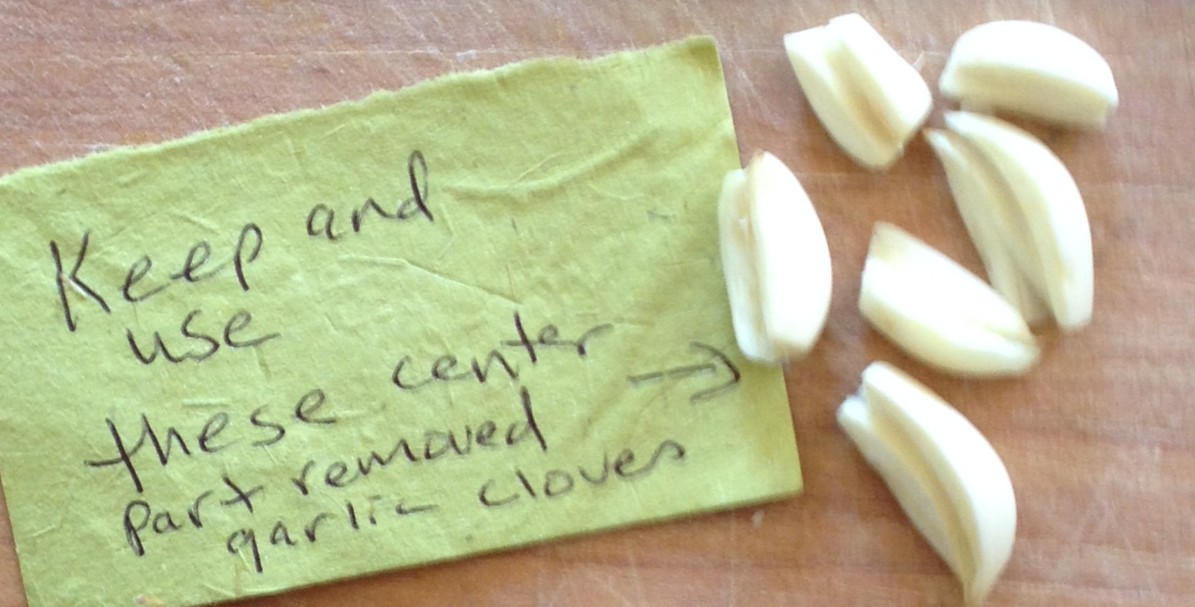
Discard, Dont Use!Keep and Use

Organizing Optimally, Nicole’s Outrageous Offerings on How to Navigate Large and Small Events

Pouring the Bubbly at a Rosh Hashanah Luncheon, which I organized for my Jubillee Birthday Celebration
Pouring the Bubbly or the Sparkling Apple-Cider at a Rosh Hashanah Luncheon, which I organized for my Jubillee Birthday Celebration, photo courtesy of Lorraine B. Miller-Wolf

1.     Do your homework: This means that you must approach any meeting or organizing you do from a place of knowledge and hopefully wisdom. It also means you are choosing to work as hard as you are and it isn’t on anyone else to do the same amount of work or to be as effective or extended as you are. This is your CHOICE. Just like with homework, if you are resourced well, you’ve slept and eaten and exercised and basically seen your therapist recently or done any number of things that you need to do for yourself, you will succeed and so will your event!

2.     Start at the End: Assign or find the folks who will be responsible for CLEANING-UP your event. Do this part early on in your process. I actually recommend getting this done as soon as you know the date and time of your event. When you are in charge of an event or care about it, you will be there early, you will be doing a hundred things, you will be EXHAUSTED by the time things need to get cleaned up. If you can’t find volunteers who will be in good spirits and energetic and capable to do this clean-up, HIRE someone! This is money well-spent, always.

3.     BE NICE: Expect that many things will go wrong, learn to breathe and be flexible and always BE NICE! Whatever your feelings are, no matter how valid they are, you will be remembered for your outbursts, rudeness and inappropriateness. So, try to get your anger out of the way before you organize people or communicate with large groups. People are more receptive to your agenda, your ideas and your visions when they aren’t being blasted with your (probably valid) feelings. This rule is for community organizing, not protest marches or confrontations with despots who need different approaches. Remember your community is your ally, not your enemy.

4.     DELEGATE: Get help and realize, at the same time, that if it matters to you, which it should, you will probably still do the lion’s share of the work. Do not expect other people to have your standards, your work ethic or your priorities. Be prepared to have everything stop happening if you decide to pull-out because you are overwhelmed or doing too much. Take it into consideration at the beginning of your organizing, so you don’t have to reach that place. Maybe you’ll get lucky!

5.    MONEY: You need Money, you need donations. Food is good! If you tempt people with goodies, they will come and partake. This means outreach in the community to get stuff donated for big events. This is where your presence as a nice person who people can count on is crucial. If you are a flake or unpleasant, people won’t be as interested in giving you money, stuff or time. This applies to getting musicians to donate their time as well.

6.     HUMILITY: Don’t be afraid to apologize or admit you are wrong. Community organizing means you are working with the community. Expect to learn something, to be challenged, to be confused or supported and recognize that the nature of community work is cooperative.

7.    BEING STRONG AND CLEAR WHEN YOU ARE IN CHARGE: Cooperative work requires humility but once that has been said and understood, if you don’t manage things well and take control when you should, things will either flop or get out of hand. So it behooves you to set clear agendas, have good facilitators and note-takers (this is especially important when issues are heated.)

8.    MEDIA: Media is crucial. Find out what you can get for free, there is lots of it, but all of it has deadlines and specific formats. This is the grunt work, if you can assign someone else this task, who will actually do it, great! If no one knows about your event or you don’t target the right places to advertise or alert, even if everything else is perfect, no one will be there to appreciate it!

9.    SLOW DOWN: Say less! Listen More! Slow Down! Please note, I am notoriously bad at all of these and have paid the price many times over for not following this advice. Being respectful of others is the best way to achieve your goals, no matter what is going on.

10.   YOU CAN’T DO IT ALL: Don’t try to tackle every issue. Find the category that really charges you. Some people are activated by the environment, some by social injustice, some by legal inequalities, some by police brutality, globalization etc… You will be more effective working where you have the most energy. All of these issues are interconnected though and there will be overlap.

11.   COMMUNITY: Use your community, involve yourself in where you live and work and you will find allies.

12.   BE ORGANIZED, (no kidding!): Develop a good filing system. Don’t laugh! This also applies to your computer data. Organize things in files and folders by date, organization, issue etc… If it takes you an hour to find the thingamajig that what’s his name gave you, you’ve just lost valuable time for no reason. Compile email lists and phone lists and keep them at the front of your folders so you can call what’s his name and actually remember who he is and get him to do the thing he promised. In this day and age, create a Google or other easy online Drive format and import all your contacts. Keep your contacts list current, delete old addresses/information. You don’t need 3,000 copies of your contacts. You need to have a back-up of them somewhere electronic, an online version and if you want to be very diligent a printout, so in case all computer related things stop (in a power outage for example) you can still hopefully reach folks you need to reach.

13.   REMINDERS: Remind everyone multiple times about meetings and events. I know it sounds like elementary school, but we’re all busy saving the world and one more meeting is easy to forget. I do this exclusively by email, which is unfair for all those who don’t use that system, but it is the only way I can manage to get it done quickly. If you are working with people who don’t have access to computers, you must develop phone-trees and quick post-card type reminders. Also, be early to all your meetings and endeavor to start things on time. If you care, you will always be there at the beginning and, usually be the last one to leave as well. (That’s the truth!)

14.   BE PLAYFUL OR PRAYERFUL: There is always time for a quick icebreaker activity/song or introduction circle with a brief one-word check-in or something like that. Help people arrive in the space by giving them a moment to be humans together in a room, before they tackle an issue or get down to doing a large job, this is what all coaches know, rev your team up before you send them out on the court, reassure them, remind them of why they are there and appreciate them.

15.   THANK YOUS: I endeavor to always personally write, yes, actually hand- write a note of thanks to the vendors who gave things, to anyone who really extended themselves, to your co-workers/co-leaders, to volunteers and to someone who always does things but never maybe gets a thank you. Believe me, the people you thank will remember that you sent them a thank you. This is not a minor step, just because it’s close to the end of the list. This can take two weeks or more to do, you don’t have to rush to do it, but if you were organized as you should have been, you will have the names and addresses of folks handy that you need to thank.

16.   BE NICE! I know I said that already. It just bears repeating. This is also related to “do your homework.” The more clarity you have as an individual, the more balanced you are, the more effective you will be in all that you do. When you are in the community, you are in the public eye. Your grace and intelligence will get you far, so develop them.


2014-09-26 17.03.20Breaking Bread Together at Temple Beth El, Eureka. Photo by Lorraine B. Miller-Wolf

Eggplant Parmesan, Maren Frank Style!

Plated Eggplant Parmesan with fresh pasta and green beans.

This recipe is based on years of experimentation and work by Kevin’s mother Maren, it far exceeds any pallid imitations or pretenders you might have encountered previously. I always double this recipe, but I’m giving you the smaller amount instructions here. If you double this recipe you will end up with the two large pans and one smaller one that you see at the end of this post. I don’t think it’s worth doing this recipe for a small amount. You can always invite the neighbors over. Also, this dish gets better as it sits, so left-overs are Divine.

  1. Four regular eggplants, not the Japanese ones (picked according to Nicole’s instructions; click on this link to my Iranian Eggplant post to see the correct way to pick eggplants)
  2.  Good Salt for eggplants (Kosher probably best, but Himalayan Pink okay as well, see Let’s Talk Salt)
  3. Egg/Flour mixture: 2 large eggs or 3 small ones, 2–3 tablespoons of flour, ¼ cup of water, a dash of garlic salt or powder, fresh or parsley chopped very fine or dried parsley and some white pepper also
  4. Cheese: 2–3 blocks of part–skim, low fat or whole, never fat–free mozzarella, ½ cup or more of grated Parmesan cheese

Olive Oil: Option A: about a pint of good olive oil; Option B: use two good nonstick pans, you will then use less than a pint of good olive oil. I sometimes mix a little sunflower oil or canola oil in this, but the olive oil really makes it taste better.

Tomato Sauce:

A pot of warm tomato sauce (see Sapta Rachel’s Best Tomato Sauce prepared a day or two ahead or add another several hours of prep time, prior to beginning to make this dish). If you are doing my sauce, do not put fresh basil in it, use a little dried oregano, this dish doesn’t do well with fresh basil in the sauce. If you have to use prepared tomato sauce, the final outcome will reflect your choice. Maren recommends Prego, and only Prego, if you don’t have me handy or if you didn’t take the time to make my sauce, shame on you! I prefer organic sauces so I use Muir Glen or a locally made one from the Italian deli in our neighborhood. The fresher the better.

Breading:

One container of Contadina or Progresso Italian Flavored Bread Crumbs (don’t try other fancy, organic ones unless you are sure they have the same weight and consistency as these). We have tried the other kinds and been upset by the results. Since this recipe is a three to five hour effort depending on if you have helpers, it is not worth making a mistake. Follow our instructions and you will be pleased, stray from this path and feel the ache in your back and the frustration of a lot of time spent to yield something that isn’t that great.

Optional: Sauté up some mushrooms in butter, garlic, salt, pepper and parsley to use in one of the layers, or to serve on the side.

What you will need that isn’t a specific food item:

  1. Two large Baking Sheets
  2. Two large non–stick frying pans or two well–seasoned cast iron frying pans or one of each
  3. Two large casserole dishes
  4. Lots of clean counter space (see the Ten Commandments of Nicole’s Kitchen)
  5. An apron
  6. A sous–chef and a clean–up crew (these last two are highly recommended, if you can’t do this dish with a helper, make sure you have some good red wine handy to fortify yourself with ½ way through)
My super sous-chef Issac Frank, showing off his bear-paw hands, really good for frying and chopping and hand-holding too. Photo by Shakia Spink

Peel eggplants, slice into ¼ inch round slices. Place a layer of paper towels on your baking sheet. Put a layer of the sliced eggplant down, sprinkle very lightly with salt. Put another layer of paper towels on top of these and repeat this whole process until you have used all your eggplant slices. Make sure you put a final paper towel on the top, then put the other baking sheet on top of all of this, weigh it down with your large cast pan or several heavy cans of food. The object here is to help drain the eggplants of extra water, the lightly salted layers release their water out into the paper towels and the weighting down further encourages this process. This must sit for at least ½ hour, during which time you will prepare the following:

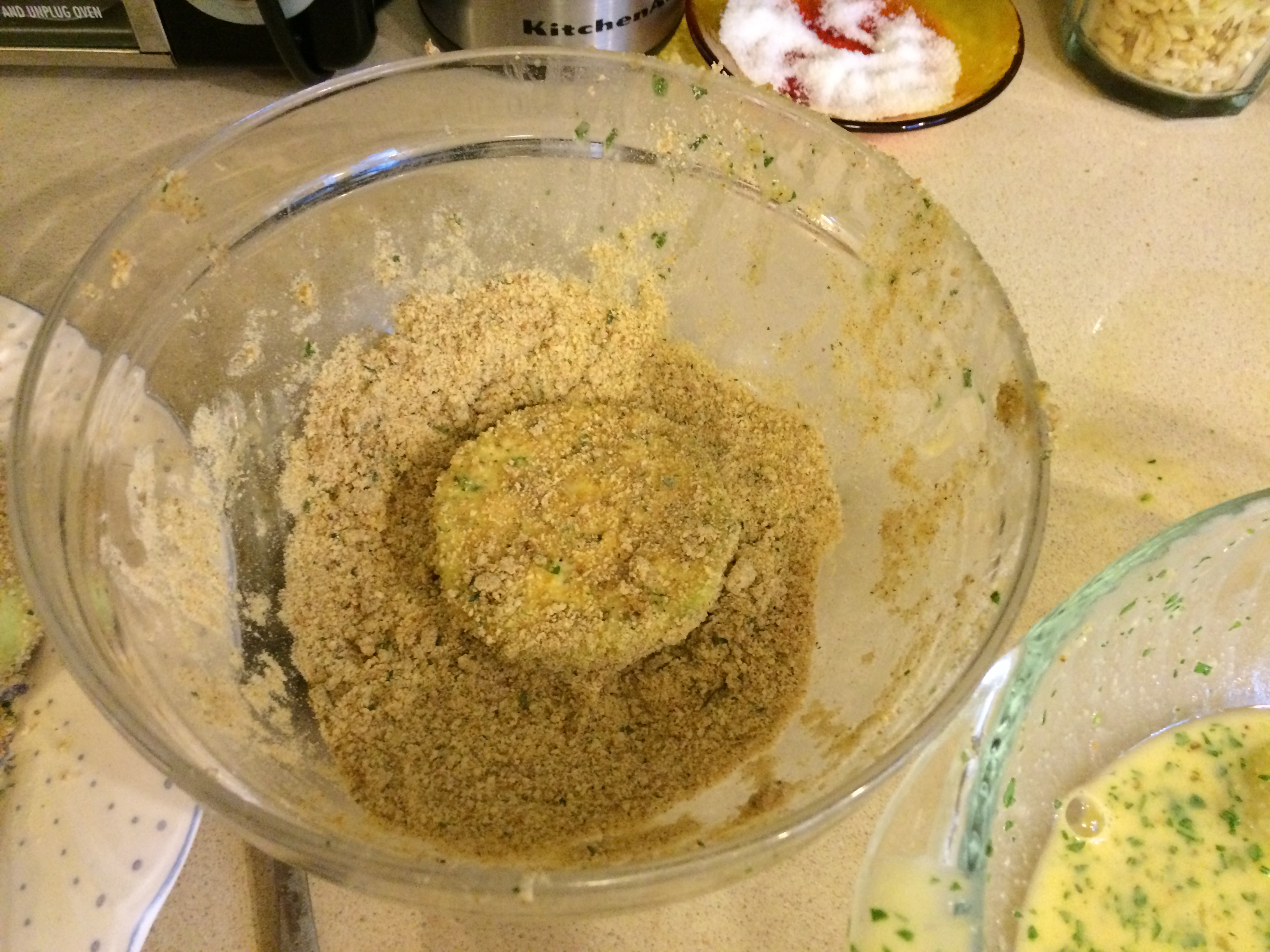
Egg/Flour mixture: in a small covered jar, shake the ¼ cup of water and flour together so they are well combined. Beat eggs in a shallow dish or bowl. Add the flour water and mix, add white pepper, and garlic and parsley. In another shallow dish pour a small amount of breadcrumbs, if you pour a lot in, they goop up and get clumpy, which is not what you want. You want a light layer of bread crumbs.

Turn your oven onto 350° at this point.

After the ½ hour has passed, remove the top weights from over your eggplant layers and pat the top layer with paper towel.

You will need a couple of plates or platter to put the breaded eggplant on. We recommend arranging your counter space in a kind of assembly line. Eggplants, then egg mix, then bread crumbs, then plates.

egg, flour, herbs and water mixture for coating eggplant
2015-02-03 15.32.57
small amount of bread crumbs to coat eggplant after it has been in the egg mixture
2015-02-03 15.33.04
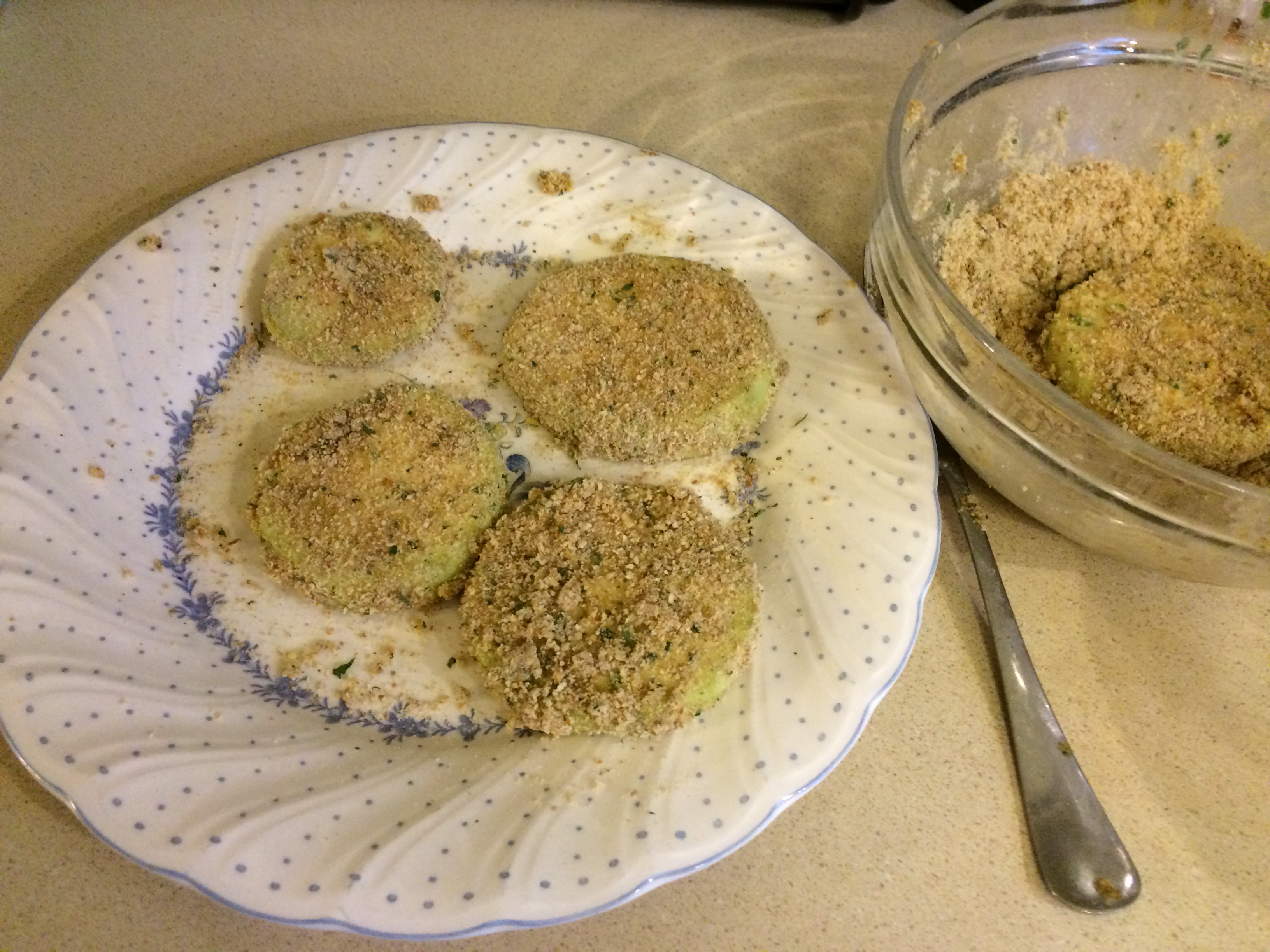
plate getting loaded up with eggplant rounds for frying

Dip each eggplant slice in the egg mixture, then in the breadcrumbs so that it coats on both sides, place on your dish. Continue on ad–infinitum, until all the eggplant slices have been dipped and coated.

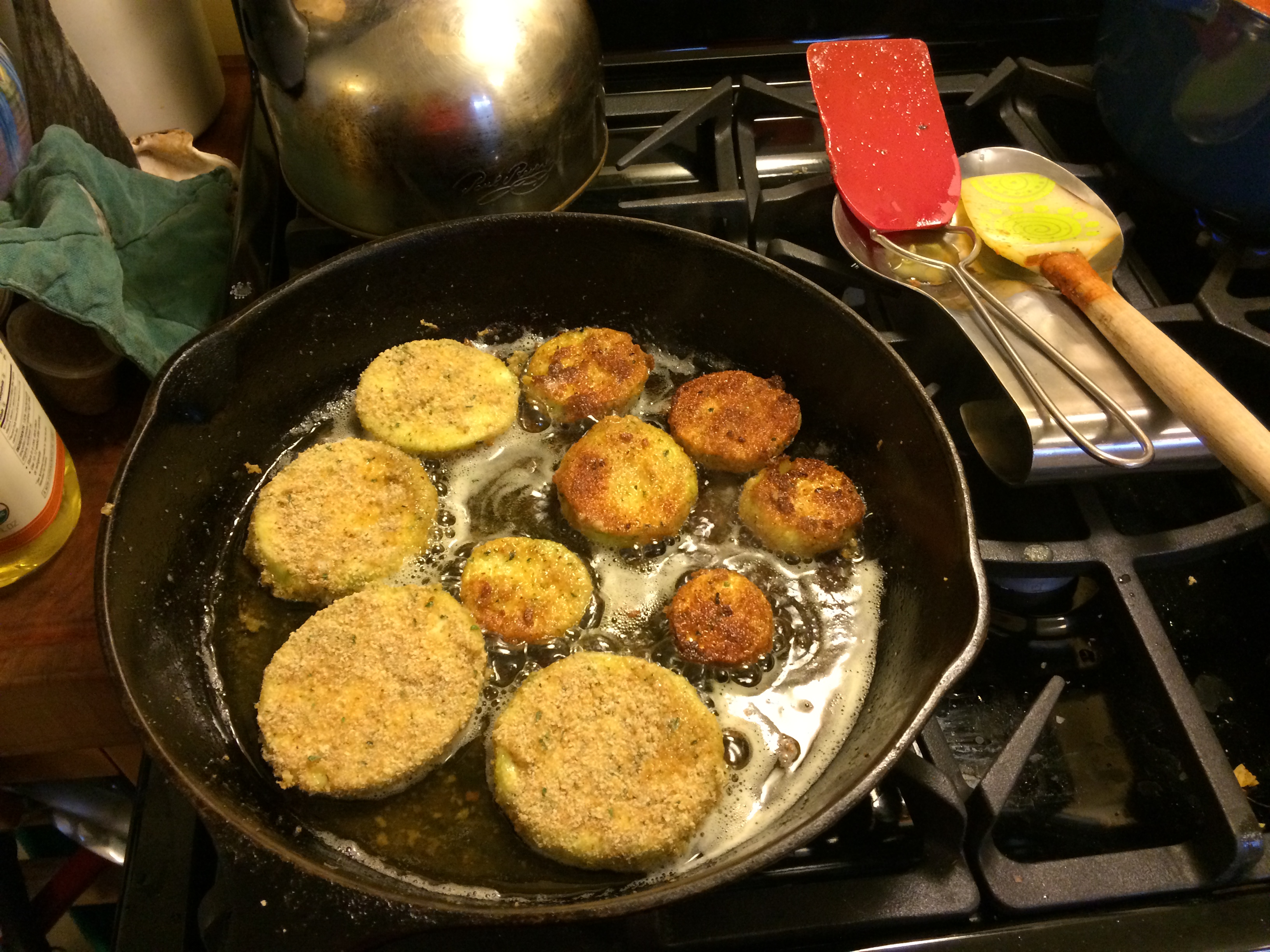
Now, over to the stove we go. Have your baking sheets clean and on hand to receive the fried eggplant. Take a deep breath or two. Pour olive oil into your pans, less for non–stick, more for other kinds, you need to cover the bottom of your pan and then have some extra, if you use a good amount, you won’t have to add oil in later to a smoking hot pan. Once the oil is hot, not smoking, it should be on a medium setting, fill each pan with the eggplant. Cook these a few minutes on each side, so that they brown a little.

Frying eggplant rounds in olive oil, the brownish red color is what you want. Once browned on both sides place on baking sheet for 20 minutes.

You don’t want them to burn, PAY ATTENTION! Remove from stove and layer onto baking sheets. Once you have filled up a baking sheet, repeat frying procedure with remaining eggplant. This method allows you to use less oil, which makes a difference. Bake in the oven for about 20 minutes. Remove the baking sheets from the oven and put the baked eggplant rounds on fresh paper towels over cooking racks or grates, this step helps get rid of extra oil. You can layer paper towels and cooked eggplant onto a plate as well, if you don’t have cooking racks or grates.

Have grated or shredded cheese in a separate bowl and the Parmesan cheese also in a separate bag, bowl or container.

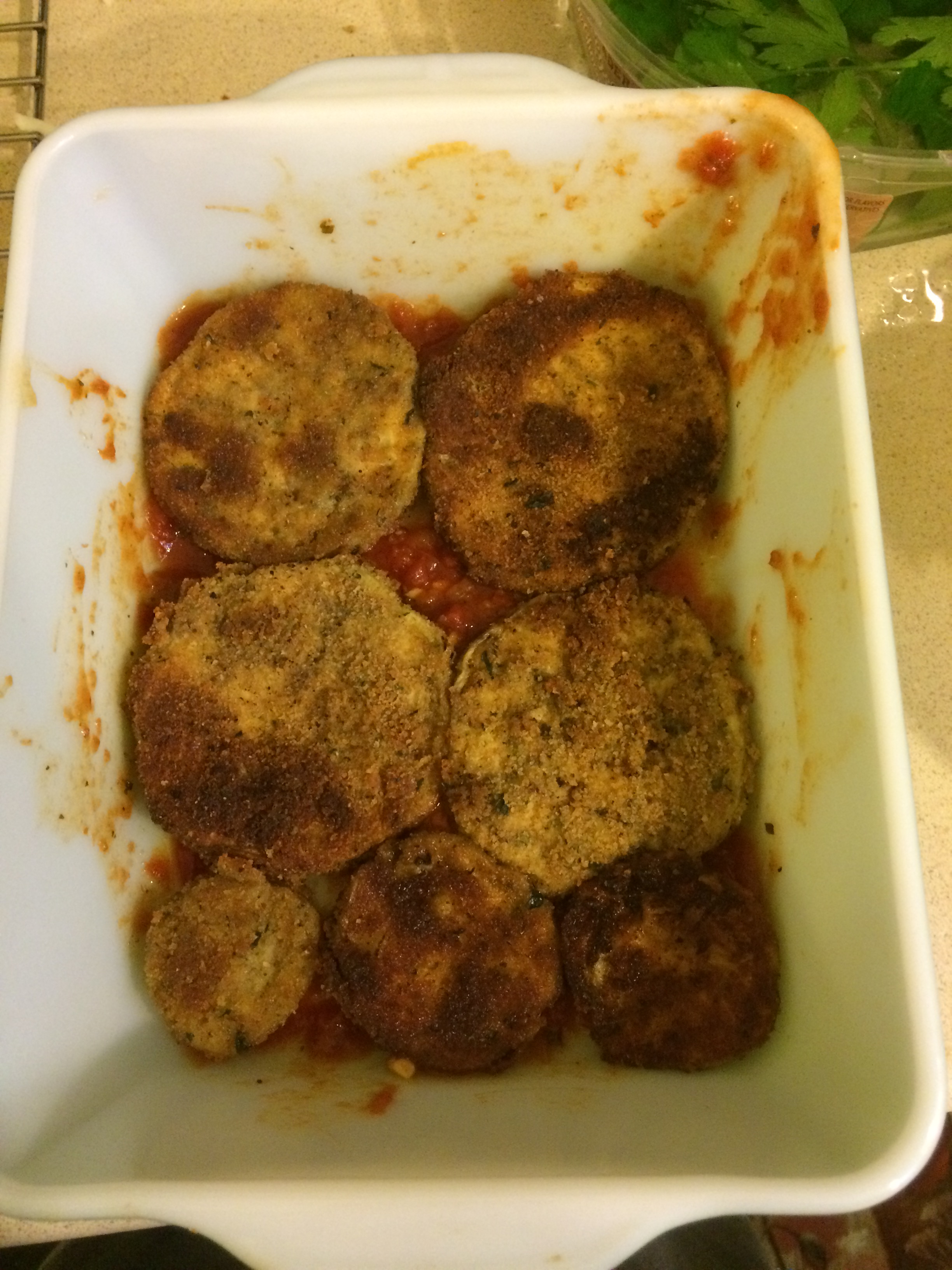
Now we are back to the assembly line process again. Assemble the Eggplant Parmesan in the following manner. Put a small amount of sauce on the bottom of your pan, just a little bit. Then you will put one layer of eggplant on the bottom of the casserole dish.

sauce on bottom, first layer of eggplant rounds

Now, take several spoons of the sauce and spread it lightly over the top of each eggplant slice, don’t pour a large amount. You want the end result to be moist, but not runny.

sauce on top of first layer of eggplant rounds

Sprinkle a generous amount of the grated mozzarella over this, then sprinkle a little bit of the Parmesan cheese over this, then repeat the whole procedure, don’t do more than two full layers per casserole, because you don’t want a gooey oven mess.

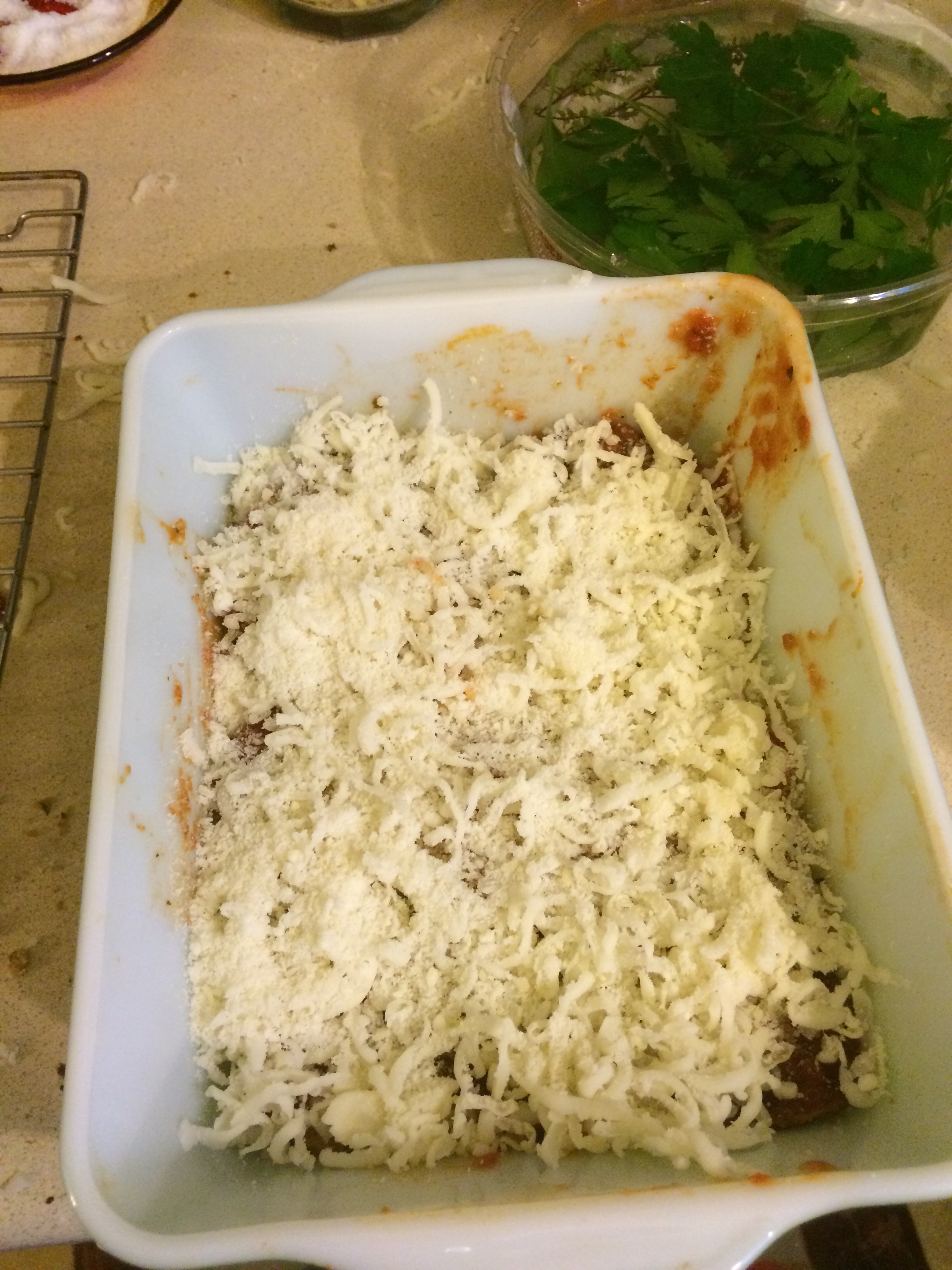
cheeses on top of first layer of eggplant rounds and sauce. Next step is to repeat the whole process.

If you are into the mushrooms, you can insert the sautéed mushrooms after the first layer of eggplant, before the cheese. Your final layer, must always be the cheese. Use a little more Parmesan on the final layer. If you use too much this dish will be too salty and you’ll be sad.

Put them in the oven and bake for 45 minutes or more until the cheese is starting to get brownish. Remove from the oven. You are done! Except for the clean up which will take at least an hour or two. This dish is really only made for those your truly love, or those you are hoping to have love you for the rest of your life!

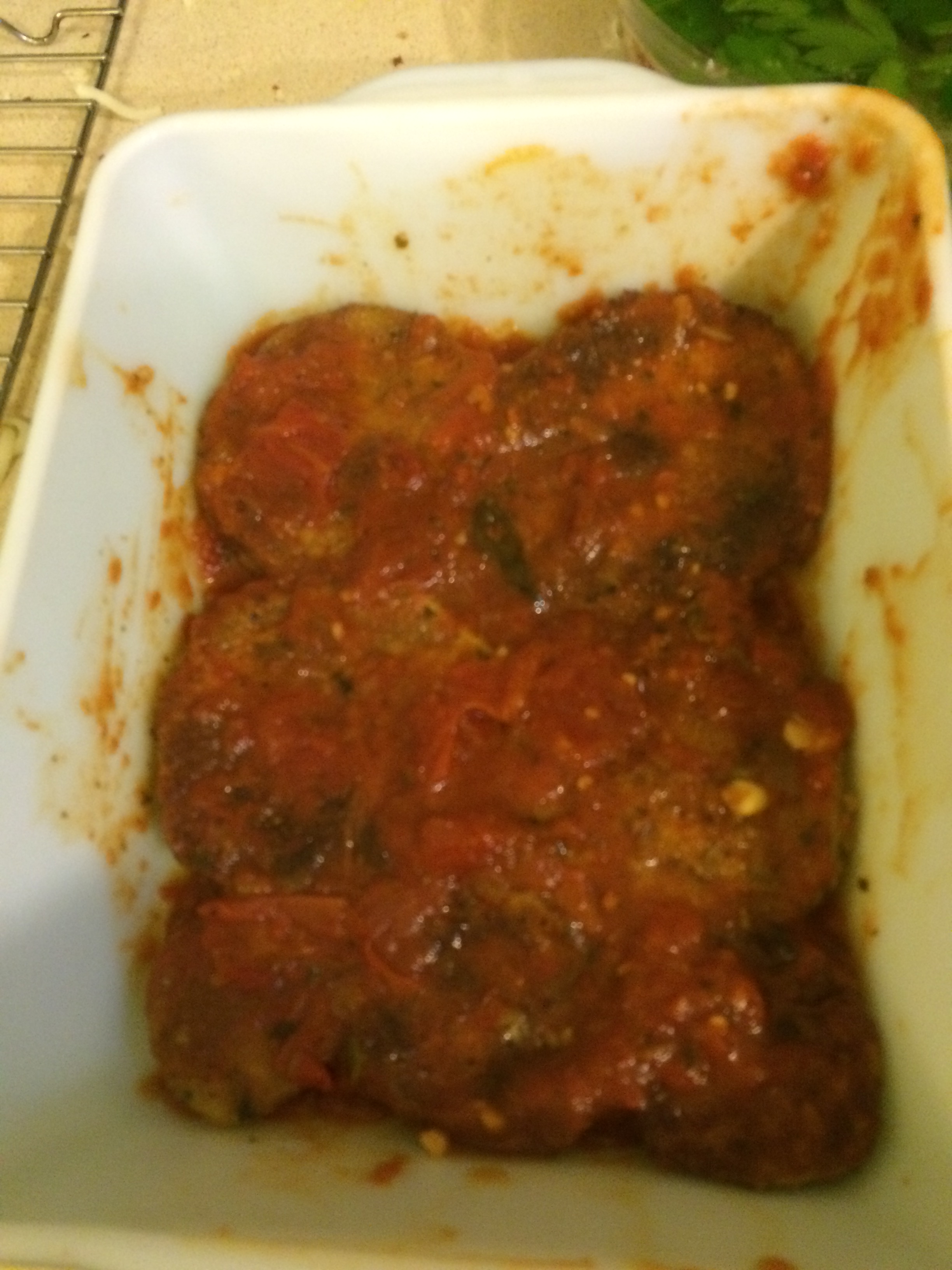
The finished masterpieces!

Applesauce and Hanukkah!

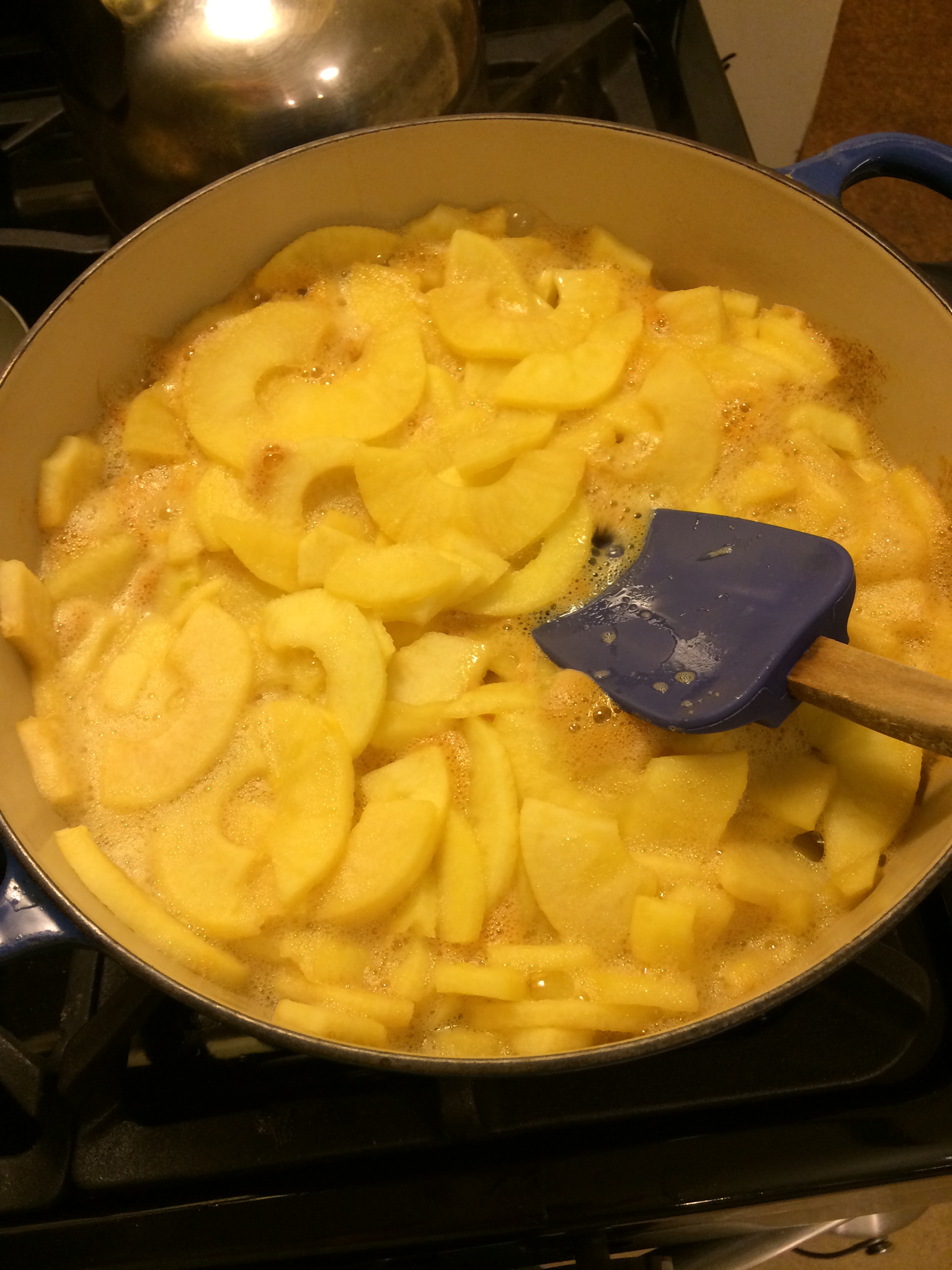
Peeled and Sliced apples cooking in applejuice.
Peeled and Sliced Apples cooking in apple-juice.

Perfect applesauce is not hard to make. Mine is sugar free as well. The apples are sweet enough, especially if you cook them in pure apple-juice (organic, unfiltered) or apple-cider (unsweetened). The thing is, like most of my recipes, time is the crucial ingredient. It takes a few hours, really to make applesauce, at least two. It’s a process. First you need to peel lots of apples, why bother making fresh applesauce if you are only making a little bit? It keeps for a while, you can give it away or you can preserve it. However you do it, it’s worth making a significant amount.

I have an old fashioned apple-corer/peeler that is hand held. This makes my apple-peeling and coring much easier. But you still have to navigate the stray peels and parts that don’t come off. Or you can just peel by knife. I like to have help when I am doing this job, so it goes quicker, and also because having help in the kitchen is the way to go.

I put enough juice in the pot to almost cover the apples, a little less or more, won’t make a big difference. You do want enough liquid though. I cook on a medium-low heat, uncovered for a long time, stirring frequently until there are no recognizable apple pieces and it gets very broken down and looks like brown mush. It’s done then. I put a dash of salt, just a dash and sometimes add a 1/2 teaspoon of vanilla as well, (optional).

Applesauce, of course, is the perfect complement to Latkes (potato pancakes) for Hanukkah. It’s best to make the applesauce a day or two ahead, because making and cooking the Latkes is time-consuming and messy (see my gluten-free Latke Recipe). You can enjoy applesauce all year round though. I don’t think using old apples is always the best. I use different apples based on who has dropped off a bag of them at my house, or what I find in the stores. This batch, photographed above, was made with Fuji apples, and it came out great.

I’ve used “applesauce” apples, meaning they were the rejects or less than appealing looking apples. Using older apples often means you have to cut out a lot of bad parts. I am not a fan of using less than excellent ingredients in what I cook. You can make good applesauce with funky apples, but you can make great applesauce with good apples as well. That said, making applesauce with older apples is a good way to use an apple that is no longer appealing to eat fresh. I would prefer if you used an older apple in a crisp or something because the crisp has sugar and butter and oats also happening and the apple is part of the story, not the WHOLE story. Apples are the WHOLE story when you are making my applesauce. Please, do NOT add other things to my applesauce recipe, if you do, then it is no longer my version. Lots of people like combination applesauce versions; peach/apple, apple/cranberry, apple/pear etc.. I think those are fine, but this is not the recipe for those, since I’ve never made those. I am a purist in certain things. I guess applesauce is one of those things!

Applesauce is also a really good first food to give someone after surgery, once they’ve been cleared for that kind of food, or for folks who are feeling under the weather. Serve it warm, not cold, it makes a person feel better. It is for sure a comfort food. See my Surgery Support: Pre and Post Lists for Optimal Recoveryand the other fabulous thing about making your own applesauce is how your home smells while it is cooking, Absolutely AMAZING!!!!!

Enjoy your applesauce and check out my Latke Recipe also, Happy First Day of Hannukkah/Channukah/Chanukkah/Hanukkah (however you choose to spell it!)

Latkes, Latkes, Latkes: How to Make them, How to Eat them, How to Survive them!

Naja Luz Tepe’s plate with one of my Ladino Latkes, and Nicole’s Home-made Applesauce

How to Make Them:

There are as many ways to make Latkes, as there are Jewish homes. Everyone has their own style and preferences. Here is my Ladino Latke Recipe

  1. Yukon gold or russet potatoes (8-10)
  2. 1-2 yellow or white onions
  3. 5-10 garlic cloves pressed (always remove the centers)
  4. a good handful of parsley, chopped up
  5. 2-3 carrots
  6. juice of 1-2 lemons
  7. salt & pepper to taste (a goodly amount)
  8. lots of eggs (7-10)
  9. A cup or more of Matzah meal which I prefer to flour
  10. lots and lots of sunflower oil or canola oil or schmaltz (oy vey!)
  11. Fresh thyme
  12. Freshly ground turmeric root
  13. Feta cheese (optional, but I highly recommend)
  14. Aloe Vera juice and ice-water on hand for when you burn yourself, and you will probably burn yourself, I do and I’m a seasoned pro!

So, I hand grate a lot of potatoes, uggghhh! It takes a long time and you have to be careful not to get your fingers grated in the process. I have made them with a food processor, but I have to tell you, the grater gets the potatoes thinner and into smaller pieces that cook quicker and absorb slightly less oil. You can make your own decision about this. I never bother peeling the potatoes, but I do clean them really well and remove any bad spots. Use a big bowl for this. I have also experimented with grating them into water and straining them. I’ve concluded that this particular idea is just one more step in a long and intense process, and it doesn’t seem to make any real difference. So, I no longer do it. I just grate them into a big bowl and try and pour out as much of the potato juice as I can.

I add the juice of one or two lemons, depending on how many potatoes I’m using, and stir that up, then I grate two or three carrots. The ratio of carrot to potato should be 1:3. So, one carrot for every three potatoes, for the non-math oriented folks. Since I am one of those kinds of people, it’s always a good idea to repeat myself when numbers are involved. You may have noticed, I rarely give exact amounts or numbers of things in my recipes. My apologies, I just don’t do numbers very much or very well. It’s an organic kind of thing in my kitchen with amounts shifting all the time.

I throw in some chopped parsley, fresh thyme and freshly pressed garlic (remember to remove the center parts, see Esti’s Parsley Sauce for pictures), lots of salt and pepper and then about 7-10 eggs and a bunch of larger crumbles of feta. If you are making these gluten-free, then you are done with the batter. If you want to add some Matzo Meal or flour then go ahead and put some of that in. I’ve made latkes so many different ways. I have not yet experimented with coconut flour or almond flour to see how that works. I often just go flour-less, since so many folks are not eating wheat or gluten these days.

You then will need three frying pans, four is too many to manage. If you use only one or two, good for you, it will take you another hour to be done, but you probably won’t burn yourself and need the aloe. Since I am always making these for a crowd, I am the three and sometimes four frying pan kind of woman. You can use any oil you want, but this recipe is about frying things in hot OIL.

Oil-rich foods are traditional for this time of year and this holiday because they are an additional way to get oil into our celebrations. The oil connects us to the miracle of the sacred oil lasting for eight days in the re-dedication of the Temple that is part of our traditional Hanukkah story. So, frying foods in oil and having lots of oil is just part of the holiday. I alternate between sunflower oil and coconut oil, depending on which I am more in the mood for. Both flavors are good.

Heat the oil to medium high, you can turn it down once you get going, but it needs to be pretty hot. Have lots of pot holders on hand and dishtowels on hand. Have two or more trays in the oven with cooling racks over them so you can put finished latkes on the rack and let the extra grease drip onto the pan below. Keep the oven on 250º so the latkes you’ve made stay warm, while you keep frying the rest of them.

This is the tricky part and the time-consuming part and the get yourself burned part. I wish I could say there was another way to do this, but basically, it’s a labor of love or love of tradition or some form of craziness. Take a slotted spoon, or a 1/2 cup measure and ladle the latke batter into three or four patties in the hot oil. Let them cook for a good five minutes or more per side, depending on the thickness. Smush them down so they are flatter after you turn them. I sometimes turn them too soon and then they are not golden brown and so I have to fry them on that side again.

The speed of this process and the timing are pretty hard to get down perfectly. It’s sort of a dance between flipping, checking, frying, ladling and then putting them on the trays in the oven so they stay warm until you are done. If you want to be just a servant to your guests, you can omit the keeping them warm in the oven part and just fry them and then dish them out. People always say they only want one or two, but end up eating four or more. I promise you they will eat more than they say they will. There’s just something deeply compelling about a latke, cooked properly and served hot.

How to Eat Them:

You can serve them with applesauce (see my recipe) and sour-cream, with Esti’s Parsley Sauce and Greek yogurt, with hot-sauce of your choosing, with whatever condiments you like. There will rarely be left-overs, but if there are, they are good with eggs the next morning.

Apparently, if you cool the potatoes the night before, by putting them in the fridge, they cook better. This is the tip I got from the appliance repair man who was over at our house this morning. I cannot verify this, but am putting it in as a tip that may prove to be true. I only make these ONCE a year and last night was the night, so my testing this particular theory will have to wait. You can let me know if it makes a difference for your latke frying.

How to Survive Them:

To survive Latkes, only eat them one of the nights of Hanukkah, not all eight! Or make sure you eat lots of bitter greens (like mustard greens) or radishes, daikon is my favorite, and lots of green salads as well. This is the secret to making your tummy happy with vegetables and flavors that compliment the fat-oil zone you get into this time of year by over-eating latkes. You can also substitute yams for the potatoes, but those are very different tasting, and still need to be cooked in lots of oil.

Also, if you want a different/alternative Hanukkah story, check out my Midrash, The Woman Whose Pockets Gave Light.

Happy Hanukkah!