I just finished making up a batch of these to bring to my friend’s home for Shabbat. It was her request. This recipe comes from my Moroccan Grandmother, Perla Barchilon, I re-learned how to make it in Israel with my cousin Poussy (this is her nick-name) her name is also Perla. I will put up pictures of my Grandmother Perla and her amazing artwork in the near future. I want to get this last post out before I light candles for Shabbat.
bell peppers (an assortment) I recommend at least 5 or 6 peppers
pressed garlic 1:1 ratio. The ratio to garlic and peppers should be 1:1. One pepper equals one clove of garlic
juice of ½ lemon
¼–½ cup of olive oil
Chopped fresh parsley
salt and pepper to taste
Use 2 of each kind of bell pepper. You can use green, red, yellow or orange peppers for this. I like to combine a few of each. This dish can be saved and actually gets consumed fairly quickly so it is worth making more than you might eat by yourself. Wash peppers and place in the broiler and forget about them for awhile. When you think of it, open up the broiler and turn them over, until you’ve gotten them blackened on all sides. Some peppers have 3 sides, some have 7, and every pepper is different. This step usually takes about ½ hour or so, sometimes longer. The point is to sear/burn the outside skins, which also cooks the peppers. You can have them pretty close to the open flame. If you don’t have a broiler, you can do this on the stove-top over a gas flame, but it makes a mess of your burner. After the pepper or peppers are blackened, place them in a paper bag or a glass container with a lid and close it up and let it sit on your counter. If you are using the bag, it will leak so don’t put it near something you don’t want to get wet. You can place the bag on a dish if you wish.
After the peppers have cooled a little, you can prepare the dish. Fill a bowl with cold water and have it handy nearby. Place another empty bowl near your cutting area. Take one of the peppers from the bag and start peeling it. Use the cold water bowl to keep your fingers from burning and to wash off the seeds and insides of the peppers. Don’t put the whole pepper in the cold water. The juices from the pepper need to be preserved as much as possible. Once you’ve peeled the pepper (it will usually start to dissolve into sections while you are doing this) make sure you remove the top/stem part. Then slice into very thin strips and place in the clean, empty bowl. Repeat this process with all the peppers. When you’ve got a bowl of slimy, thin strips, drizzle olive oil over them, add the lemon and press the garlic over it all. Add salt and pepper and the parsley to taste and mix it all up. You can serve it warm right away or let it sit for a few hours, but not in the fridge. If you are making it for a different day, take the peppers out of the fridge an hour before serving so they are at room temperature. These peppers will keep for a fairly long time.
Here’s a little Shabbat Flower Sweetness for you. May you have a delicious Sabbath or Weekend or Restful Moment!
A vinaigrette, made properly, is spicy and stings the tongue just a bit. It enhances the flavor of anything it touches, bringing out the best elements. A true vinaigrette also cooks whatever it touches and if left unattended, on a salad too long, leaves you with a wet, warm mess. And it becomes bitter if neglected Such was the life of my father, both as he lived it and as it affected those around him, spicy, intriguing, flavorful —not so good when neglected.
The truest recipe for his vinaigrette will keep in mind its origins and its tender and true qualities. This ode to my Papa was written several years before he reconnected with Judy. Now, at the age of 90, my papa has been happily married to Judy, for over fifteen years and his life is too sweet to really reflect the earlier taste of tang a true vinaigrette requires. Just because his life has gotten sweeter doesn’t mean you can substitute some fancy raspberry or strawberry vinegar. This vinaigrette needs the bitter, sour, strong tastes that are included here.
The Original Papa Vinaigrette 1–2 teaspoons or tablespoons of Grey Poupon Dijon mustard. No stone ground substitutions will do. You may be able to find a different fine French Dijon mustard and use it. I have not yet discovered an organic variety that works. It must be finely ground, have a little bite and no sweetness. If you use a lesser mustard, this dressing just won’t ever taste the way mine does.
1/4 cup red wine vinegar (NOT BALSAMIC) 1/4–1/2 cup olive oil salt pepper garlic granules fresh thyme or some fresh dried thyme a dash of nutmeg mix everything together in a jar with a tight lid and shake vigorously.
The New Nicole Version (I think this one is better, but I’m biased)
Combine in a small bowl or in a jar with a lid
Dijon like above (don’t be afraid to use a really healthy amount of Dijon) juice of 1–2 lemons (fresh only, don’t ever use anything else!) a dash of white wine vinegar salt, a good amount.
It is important to do these steps in order, the vinegar, lemon, mustard and salt need to all be very well mixed before you add the olive oil. Add the olive oil about a 1/2 cup olive oil either in a slow drizzle while stirring with a spoon if you are using the bowl method or in the jar with a lid, “shake, shake, shake that booty/dressing.” Then you can add some freshly ground pepper.
Optional additions 1–2 tablespoons very finely cut fresh shallots a bunch of fresh tarragon leaves, whole but removed from the stem, chopped small or left in large sections.
You can also add any fresh herbs from your garden to this except rosemary, I don’t believe this dressing would work with rosemary. I’ve never tried it. I have a sense about these things.
Some Salts Sweetly Sitting Strongly Sending Savory Suggestions
Most folks are clueless about salt. I mean this with no disrespect, but I have found it to be true. Salt is not your enemy, nor is it bad for you. It is only a problem when you are eating too much processed foods or if you have a specific medical condition. Even then, talk to your doctors, but I bet if you eliminated processed foods you could actually salt your food with real salt.
If you really want to know more about Salt, beyond what I am sharing here, please read Mark Kurlansky’s book Salt: A World History. If you can, please order directly from his website or your local bookstore.
I no longer use soy sauces of any kind, even gluten-free tamari has left my cooking. I tried the coconut aminos, and occasionally when I am doing something with a particularly Japanese, Korean, or Chinese kind of flavor and I feel it absolutely needs that kind of taste I will use those instead. Some folks really hate all the soy alternatives and need that flavor. If you are mostly cooking from that part of the world, you may need to use soy based products, but I prefer not to at this point.
Just say YES to SALT
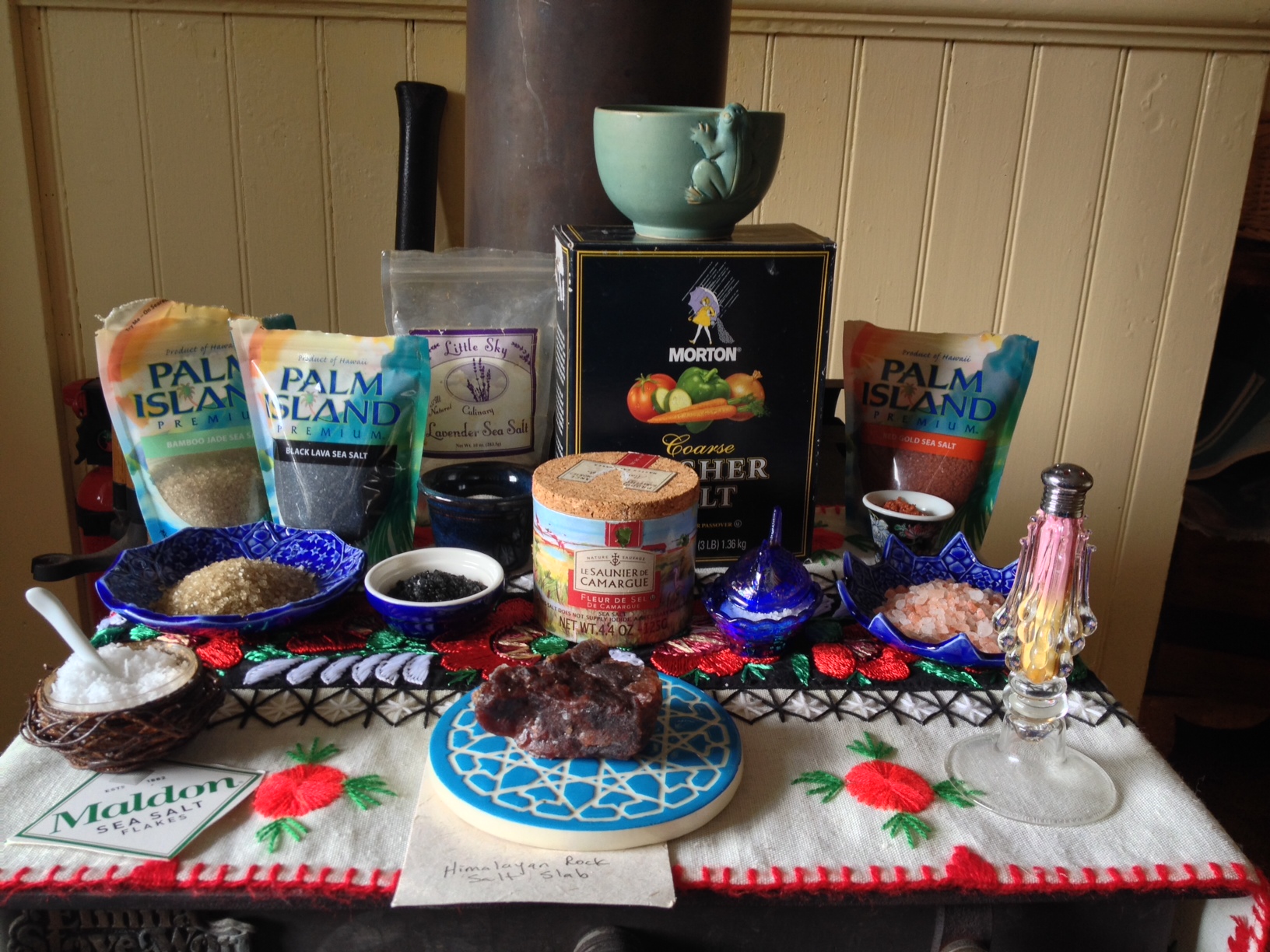
So, let’s talk salt. I usually have on hand at least five or six different salts, as you can see from this picture above. I am always on the lookout for different salts and will tell friends when traveling, “if you want to bring me something back, I am always in the mood for salt.” One friend while traveling in the Himalayas returned with a purple rock and reverentially handed it to me. “I said what is it?” He said take a lick, and I did and sure enough it was a sulphur flavored salt slab. This is the purple salt in the picture sitting on one of my brother Paul Barchilon’s coasters. The green and large pink rock salts are also on dishes of his.
Sometimes, when I want to engage folks with their taste buds and they are up for it, I give them the Himalayan purple slab and tell them to take a taste. Most folks are not happy with this particular salt’s flavor, but I love the intense mineral taste that brings me to the stark and high-peaked mountains. One lick and I am standing above it all, yet grounded right here in my body.
Nicole’s Salt Rules: (Salt does RULE!)
You don’t need a lot of salt to make things taste good.
Experiment with different salts and combining or pairing them with what you are cooking.
If you cannot afford a wide array of fancy expensive salts, and most folks cannot or wouldn’t dream of spending a lot of money on salt, you can get away with just having kosher salt flakes. Kosher Salt flakes are cheaper than any other salts and stand far above almost any other salts that the average person buys. Rock Salt can be found cheaply now as well. Also Real Salt, from Utah, if you are in the U.S.A. or bulk pink Himalayan Salts are not that expensive.
Salt your food at the very end, not while you are cooking. This is almost always the case, but sometimes I salt mushrooms or soups close to the end of what I am doing. I also salt meat, chicken or fish before cooking them or have the salt in the marinade, but not during.
Salt changes things, it is a chemical, it is powerful, it shifts the flavors, either enhancing them or transforming them. A little can go a long way, if you do it right.
If you are cooking fish it is a good idea to soak it for at least 1/2 hour in a large stainless steel or glass bowl (NEVER PLASTIC) with about 1/2 cup or so of kosher salt flakes. When you do this, you will see a scummy layer of stuff that is in the water. Salt purifies and removes toxins. It is not a guarantee that you are getting all the nasty chemicals in our oceans and rivers out of your fish, but it helps. Rinse the fish off and then marinate or cook. You do not need to salt your fish too much.
Brine, Brine, Brine your poultry. If you cook chicken or turkey and you don’t brine it, you are missing out. There is a world of difference. There are many different brining recipes, but I stay pretty simple with mine. I use about a cup of kosher salt, a half-cup of brown sugar, lots of fresh ground black pepper, some red pepper too and whatever herbs I’m in the mood for, tarragon, oregano etc… I combine the salt, sugar and herbs in a large one quart glass mason jar and pour boiling water over it and let it sit and shake it up so it all combines nicely. I then pour this into a large brining tub/bucket that I use only for this purpose. This bucket is filled 2/3 way up with cold water and the brine. I then put in a whole chicken or two and stick it in my fridge. It does take up space. You can also do this in a cooler with ice if you don’t have room in your fridge. You can use a stainless steel large soup pot as well. Please always clean all your surfaces when handling raw chicken. I always do this in a clean kitchen and use a natural cleanser on every surface the chicken touched or I touched, including faucets, sink and counters. I recommend leaving the chicken in the brine for at least 24 hours, but I’ve gone 48. When you remove the chicken to cook it, repeat the cleaning steps. You’ll have to go to one of my chicken recipes to get suggestions on cooking. But you can just remove the chicken from the brine, and pat it dry or let it air dry in the baking dish you will be cooking it in. Contact me if you have questions about this and I will clarify.
Some folks say that if you use metal and salt together you eliminate the benefit of using a better quality salt. This is complicated and I am not going to address it in full here. I do tend to salt my food in the dish I am serving it in and have taken to stirring or tossing the food when I can with a wooden serving utensil. I always use my fingers to distribute salt, since they are better indicators of how much I want than any spoon or measuring device. I keep salt shakers on my table for those who don’t want to do that, but I also always have several small bowls with different salts on the table, for those like me, who prefer their fingers. Remember commandment # 6 from The Ten Commandments of Nicole’s Kitchen.
This recipe was given to me by an elderly Israeli woman who I used to visit and help. She was an amazing woman and this sauce, while slightly adapted from her original (I like mine spicier) is in memory of her. I should also warn you, this stuff is addictive and some of my friends just eat it by the spoonful.
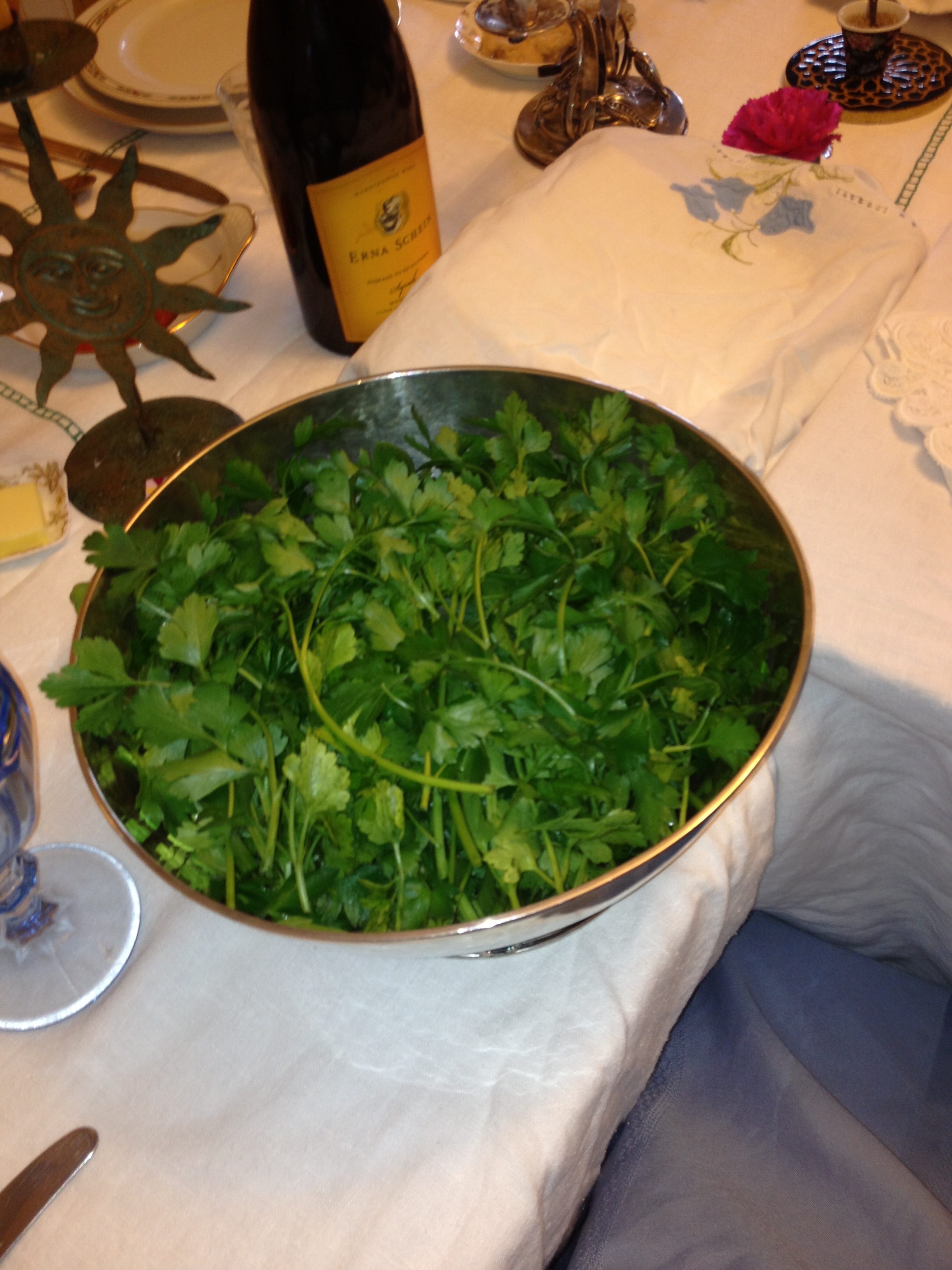
The tops only of 1–3 bunches fresh parley, Italian flat preferred, washed very thoroughly, the bucket method (putting all the parsley in a large bowl or bucket of water, soaking it, then draining and doing this two more times over ½ hour to an hour). Then dry or drain so the parsley is not too wet. You can do this the day before and keep the parsley that has been washed in a cloth bag or dish towel in your fridge.
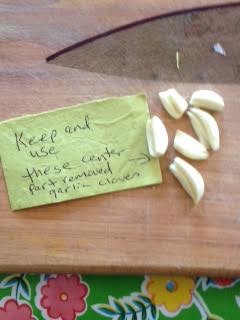
One whole bulb of peeled cloves of garlic per 2 bunches of parsley (2:1 ratio, 2 bunches of parsley to 1 whole bulb of garlic). The garlic must have the centers removed from each clove, this takes about 20 minutes to a ½ hour depending on your technique. Do not make this recipe or any recipe using raw garlic without removing the darker colored centers of each clove of garlic. The only exception to this rule is if you are using very fresh garlic that is young, it won’t have had time to spoil in the center. Also, if you are baking garlic you can avoid this step, but for any raw garlic dish, not doing this will make your recipe harsh, and bitter and will upset stomachs as well.
One to two whole bulbs of garlic, not cloves, but bulbs, the whole bulb times two. This garlic MUST be prepared as described and shown or else the sauce will not be good. See the Ten Commandments of Nicole’s Kitchen (in reference to following my directions, refer to commandment #1).
Juice of 1– 2 lemons per bunch of parsley
1–5 fresh green whole jalapeños or serranos (just cut off the very tops)
1/4 cup -1/2 cup or more of virgin olive oil
Salt to taste (at least 1/2 tsp or more of good salt, please see upcoming posting “Let’s talk Salt”
Combine all of these ingredients in the blender and blend away. This sauce is to die for. Put it on everything and anything, bread, fish, meat, tofu, veggies. Don’t cook this sauce though or use it as a marinade. It is best cold and will keep for about 5 days in the fridge. You can use fewer peppers if you want less spice, or more if that’s your desire.
This series of three combined into one long posting together here was written last year right before Passover/Pesach in the Spring of 2013. The story is relevant now, but the time references are from last year. I have also been preparing for Pesach right here in real time this year.
“It’s a small world after all.” That was my favorite song when I was little and I guess, in many ways, it still is. As I rush around getting ready for Pesach (Passover) and also for a trip to Spain and Morocco WAHOOOOOOOOOO! I’m a little bit more crazy than usual. And, I am trying to ride the WAVE of this time, rather than get smashed by it.
My name, Barchilon, comes from my paternal grandmother’s Moroccan name Perla Barchilon. My paternal Moroccan grandfather’s name was Jaime Cohen. When my father came to this country after WWII he didn’t want the name Cohen. It was way too Jewish and so he took his mother’s name Barchilon. Barchilon is a Jewish name too, it comes from the city of Barcelona, most likely. When my grandmother Perla’s ancestors were expelled from Spain in 1492 (the year the Jews were forced to flee Spain, convert or be killed), like many immigrants, the name of place left became the new name. The name Barchilon may also come from the Hebrew bar shelanu, or some form of those words which mean “son of ours.”
This journey I am going on with our son Ethan is through his school, the Northcoast Preparatory Academy. When I heard about this trip I told him, YOU ARE GOING! Then he asked me to come along. What’s money anyway? Who needs it? So, despite the cost and the challenges I decided to come along. My mother and my step-father graciously offered to help and since this is a once in a lifetime opportunity for me with my sixteen year old, I am on board. My husband also felt that it was of great benefit and supported the choice.
Part of why this trip appealed to me for our son Ethan, is that he and the other students going are acting and performing in a play in Barcelona. This play, “The Sheep and The Whale” was written by Moroccan playwright Ahmed Gazhali. The play is about crossing the Straight of Gibraltar and about illegal immigration, the hunger for a better life, murder, violence, poverty, and the longing for home and country that lives in the heart of many immigrants. It is based on a true story:
“ June 8th, 1992, at 2 AM a small wooden boat transporting 20 Moroccan illegal immigrants sank in the Straight of Gibraltar. A Russian freighter, that happened to be passing through the Straight as the drama was unfolding, managed to save one person and to pull out several bodies from the sea. In order to return the survivor and the bodies to the Moroccan authorities, the freighter was obliged to pay right of entry fees to the Port of Tangier. Negotiations dragged on until dawn…This event occurred a few days before Aïd Elkebir, The Festival of Sacrifice.” ~From the Moroccan newspaper, L’Opinion, 11th of June, 1992
Well, my father illegally crossed the Straight of Gibraltar as a young man on a fishing boat under a tarp of fish. He was with one other young man, they were both fleeing Nazi-Occupied Morocco to join up with the Free French Forces who had a large fleet ship in the port of Gibraltar. My father made it to that ship and joined the Free French Forces. He emigrated to this country after the war and that’s how I got here, although I was born in Paris. My father will turn 90 in Paris, while my sixteen-year-old son plays an Islamic Moroccan immigrant in a show in Barcelona. How could I not have my son be part of this story about crossing the Straight illegally and going to Marrakesh and Barcelona?
My father’s family lived in Morocco for over 500 years, it is only in his generation that they left Morocco. Before they left Morocco, they were in Spain, and before that they lived in the Holy Land of Ancient Israel and Palestine. I have one Uncle still living in Morocco, my Uncle Maurice Cohen, whom everyone calls Bébé (which means baby, since he was the youngest). My Uncle Bébé is now 86. He was a Moroccan tennis star when he was younger. Another small world connection, Ethan loves tennis and is currently number two on the “ladder” at his school. We will see my uncle when we go to Marrakesh, he lives in the mountains about two hours from there.
It feels absolutely monumental to me that I am getting to have this experience, earth-movingly huge. I am crossing the globe, this small planet with my son, flesh of my flesh of my father’s flesh, of his parents flesh, etc… back to our homes from not so long ago and from VERY long ago. Our family stories cycle in many many ways. This particular circling is one of choice and joy and yet, I can’t help but be thinking about all the folks forced to flee their homes seeking a better life or respite from war, famine, and oppression.
My own life has been one of abundance and love, with plenty of hurt and mess too, but not because of oppressive governments, war, religious intolerance or grueling poverty. The story of my people is one we tell every year in the present tense, never in the past. As long as there are people oppressed and endangered the story of fleeing oppression is not over. My son accompanies me on this journey, where he plays an illegal immigrant, a man torn in two by his need to connect with his people, his family and his home in Morocco and also a man who loved a woman and hoped for a different life. The character named Hassan is forced to confront his story on the freighter amidst great turmoil. He’s been living a life of lies with his Parisian wife and the story unfolds on stage and in real life, every day.
So, as many of you sit down for your Seders or celebrate spring in all the various ways we do in this country, I hope you will remember that the story is not over. Our re-telling and remembering must be followed up with ACTIONS to make this whole small world a place of peace, justice, kindness and goodness. A place where the flavors, colors and tastes of home are not forfeited as the price for the possibility of living with dignity and hope. Isn’t it time, really time, now to see everyone on this planet as members of our own family and to embrace them, not shun them, for their differences, languages, practices, gifts or wounds? It’s a small world after all.
Nicole will be winging her way to Barcelona and Marrakesh as you read these words, she will try to pen some thoughts while in the lands of her ancestors, and she sends you wishes for sumptuous feasts around your tables, with room for guests unknown and perhaps who don’t have home, but who might find it at your table if you invite them in.
The picture here is from a building on Calle Perla. My grandmother’s name was Perla, my Sephardic grandmother. I am surrounded everywhere by the history of my family. Every street feels familiar, every balcony seems like it could have been mine. The city feels like a friend, someone I had to leave behind but who never really changed.
Today I went on an Orange Donut Tour with Lisa, the other Chaperone on this trip and my friend Shullie’s parents Rona and Bernard. I am at the Ristorante Compostela waiting for them because I just couldn’t walk much further. City life is all about walking, walking, walking.
Walking is wonderful and my weight and feet make it hard for me to do everything at the same pace as thinner, more determined to see and do everything folks and also all those younger folks.
I love the neighborhood where we are. Each quarter or area has its own flavor and energy and unique character. There are currents here that, like in a fast moving river, you cannot always see or be aware of in advance and that catch one unawares. The whole Catalan vs. Spanish issue here is huge and I don’t know the signs of who is who yet. So, for example, I have been trying to learn and speak as much Catalan as I can, really just Thank You and a few other words. Thank you in Catalan is different. It is moltas gracias (spelling phonetic, no idea how it is spelled in the actual language). So, while I was at the Ristorante Compostela, which was not in Gracia, where I am for the most part, but which is in the Gothic Quarter, where the Cathedral of Barcelona is and where the Pope stays when he is in town, I said “Moltas Gracias.” The waiter looked at me like I was vermin practically. Clearly, I had left Catalan without knowing it. I did have the best coffee (cafe con leche) of my life there though, so I guess I can handle the look. Actually had two, ’cause one just wasn’t enough.
It is 5:05 a.m. as I write this, sleep is complex here as well. I am in the home of a single mom, Belen, who has rented out three of her rooms to guests from Airbnb. The others here are the other mom Lisa, who is a chaperone with me on this trip, and two German Opers who look to be in their early twenties, perhaps. They are sharing a room. It is great here and for $32 a night, completely unbeatable.
The toilet is a tiny room, with just the toilet, and no room to really pull your pants down though, so you kind of have to have the door open a drop to get that part done, then sit down and close the door to do your business and then vice-versa on the way out. And, this is not because I am big, the space between the door and the toilet is about five inches and the word water closet describes the space pretty accurately. The flush handle is the old fashioned pull down kind.
The tile in this place could be hundreds of years old at least, the flooring is all tile. The shower is outside in a small room but is magnificently hot and strong. The stairs up to the bedrooms are about six inches maybe wide, so I have to put my feet sideways on them to get down and brace myself on the walls as I navigate the twisting small steps.
I will fill in more about the students next time, but wanted to get this off to those of you following me on this adventure. Today, I will accompany the children for their presentations at the host school here as they talk about Arcata and NPA in the English class at the IES school here in Gracia. Then, Ethan’s host family has invited me for lunch, which is called diner at 3, which is when they eat that meal. What we call dinner is eaten around 9pm.
MOLTAS GRACIAS for accompanying me on this journey, in your hearts, wishes and thoughts I feel supported! Big Love from the Casa de Belen y Mario (14 month old angel who is the baby here).
Bread and Salt
Mireia Nicole Kiss with Flowers
I am sitting at the Vegetarian Indian restaurant not far from where I am staying in Gracia, Barcelona. I slept until 12:41 today and I needed it. The last few days have been very long and very intense, full and wonderful as well as a little too rushed for me. We leave tomorrow, for Marrakesh, and from the moment we landed it has been a running at full speed kind of experience. The kids especially have been put to every imaginable test and are rehearsing for their play, interacting with new families and experiences and foods while adjusting to life in an ancient and large city with thousands of people on the streets. It is about as far away from Humboldt as one can imagine. The show last night was phenomenal and I only regret that my technological acumen is shoddy and hope that between Marceau’s camera and my ipad mini I managed to capture most of the play. I have yet to see if any of it came through.
So, today, Saturday morning, which is Shabbat, no matter where I am, required a slower pace and I guess those extra hours of sleep guaranteed that. Best moments are so plentiful for me here, to put it in Rabbi Naomi Steinberg’s language: “this celebration is in the top 5,000,” a reminder that we shouldn’t rate joyful or prayerful moments. Very hard to do.
Comparing and rating are easy to fall into. Being in the moment with exactly what is going on requires something different from me. When I allow the present to flood my being and stop focusing forward or backwards, true magic occurs.
Friday afternoon, was just such a moment. I took a brief siesta on the sofa of Ahmed and Mireia before the small Shabbat I was going to observe before the show in the evening. Ahmed is the playwright of the Sheep and the Whale and together with his wife Mireia they are Jiwar a residence for artists that hosts workshops and creates home for folks to come and be creative. Their house in the center of Gracia in Catalonia was our home away from home, complete with a lovely garden courtyard. I should say that the whole endeavor wouldn’t work without the help and support of Mireia’s parents also, because in Spain, la familia is part of everything. So, the two small sons of Mireia and Ahmed were often there in the home or hanging with their lovely grandparents and the whole endeavor runs better because of this extended family that is not an anomaly, but the norm in this part of the world.
After my tiny siesta on their sofa, I prepared a little Shabbat moment for us on their table. It was a first Shabbat moment for them. Ahmed, my new Moroccan brother and Mireia, his Catalunian wife and my new sister. These two folks, immediately felt like my family, the nicest, warmest best folks ever. I want to be part of their family forever and hope for many years of connection to all of them. While Mireia and Ahmed were on their computers, I made myself at home in their kitchen, something I do in most homes I enter. I found some salt and located a small bowl from their china cabinet. I had brought some wine and some bread and arranged the flowers I had given them and finally I set out the candles.
I invited them to join me and unfortunately, at first, we all regretted that it was just the three of us. We wanted the kids and the grandparents there. But, as it turned out, I couldn’t get through any of the prayers without crying and there were tears in everyone’s eyes. I am not sure if this would have been the case with a fuller cast of characters. In the play that Ahmed wrote and Ethan and his classmates performed, there is a line about Europe and Morocco having had bread and salt together. This line kept playing in my mind and I reminded Ahmed of it. He said, he had never had bread and salt together like we were and that this line in his play, written over twenty years ago, came from some memory inside his being, but not from his actual having lived it. This exact moment we shared together on Shabbat eve, was the first time that his internal tribal kind of memory experience and this actual living present moment came together and made a new kind of sense. Europe, America and Morocco, Christian, Jewish and Muslim all breaking bread together with flowers, wine, salt and olive oil. The water for all of us, was our tears and the warmth flowing through our hands and hearts in hope and shared companionship.
I long for these moments in my heart all the time, with everyone. The times when barriers completely dissolve around a shared table. When the conversations, tastes and flavors of our lives all become common and precious and the feeling of family is palpable.
I hope you will all find ways to break bread and salt with anyone you encounter and especially those you imagine might be other than you. The more we sit around each others’ tables and share our lives, the smaller and more whole this aching and wounded planet becomes and the task of mending all the brokenness becomes as doable and perhaps as simple as sharing a meal.
Room with a View
View of Cemetery from Riad in Marrakesh
The View from the terrace at the Riad Spa Luxeux Bachawya. So, this is a cemetery across the street from where I am staying in a home that is over 1500 years old and that was the home of Moroccan royalty. My first day in Morocco so full already and now I am home and resting. It is 6:16 pm my time as I write these words. I put my friend Arik Labowitz’s first CD on and I will try and put down what is in my mind and heart while I listen to his divine Hebrew and the flute of his music mate Maxine.
After taking the taxi from here to downtown Marrakech and finding Ethan and the other NPA students along with their host families at the American Language Center, I walked from there, about twenty minutes to find my Uncle BB. He was waiting for me at the McDo (McDonald’s) across from La Grande Poste. There he was looking very young for 86, thin as ever with his very large nose, the nose of my grandfather, the nose that identifies one as a Jew, even if practicing Judaism is the last thing on your mind. BB, like my father, has no interest in his Judaism. BB and I walked to his car, parked about five blocks away, an old blue chevrolet. He took me on a long drive into the mountains to get the “best tagine” in Morocco. It was very good. I do not have much to compare it to. What was the best was just being with family. My ties to family are beyond description and this is something all of us know, or should know. A feeling of complete home that emanates from the connection.
In Spain and here as well, folks are “chaleureux.” This word does not translate well, it is more than being warm, it is being hot and friendly and warm all combined. Warm, just doesn’t communicate the feeling. Everyone holds hands, hugs, kisses, and is physical. There is a palpable heat that is from connection, not just from the sun. It is so different from the colder world of the United States. I feel so at home here, I am not an anomaly here. My size, largesse of expression and behavior as well as of body is just fine. It is pretty wonderful to not feel other and of course I am other. I have a very different life that what most folks do here.
BB kept referring to himself as gatté, with an accent on that last “e”. This means spoiled. We spoke of many things and he is more like a young boy than an old man in his eyes and in his expressions. He has no children, but many friends. His wife of 40 years died not too long ago and so he speaks of her still very much. It has been many years, but she is still present for him. He told me about his piano playing, something I had no idea about. It turns out that Ethan and him will have so much more in common than just a blood tie. Ethan plays piano and tennis and has some of BB’s last child qualities, a well-taken-care-of-ness. It is a kind of ease that comes with being the last baby around. As a mother, with Ethan, everything is precious, every moment there is a sense of “this is the last time.” Perhaps this is true for all last children. I like comparing them in this place and time, even though, they are also very different.
I am going to go lie down now. Just wanted to get these few words off to those of you wondering about how I am. Tomorrow, Ethan and I will leave NPA here and go off with BB to his home in the mountains for an overnight stay with him. Every single hour here is packed with more feeling and emotion than I can possibly convey. It will take me many months to capture any of this in depth. I am grateful for the stream of consciousness style writing that flows easily for me. I am also wanting to spend time with each feeling and thought and that is something I cannot do here. Everything is on full speed ahead and I am already aware that by this time next week, I will be flying home to California.
Shalom/Salaam
Omar and The Bowls
Thinking about serving, serving the Divine, serving others, serving family, serving a meal, being served and encountering a servant. While I was in Morocco this last April, I met Omar. Omar is my Uncle’s servant. There is no easy way to say that. The word itself is primed and full of meaning. It connotes both positive and negative things for me. My first encounters with servants were in Morocco as a child. My grandparents’ home had three full-time servants; Hassan, Sadia and Fatimah. Sadia and Fatimah did the cooking and the cleaning and my grandfather was tended to by Hassan.
I vividly remember being surrounded by these large warm women, who smelled heavenly, unlike anything I’ve ever encountered before or after. The combination was something like sweat, cinnamon, heat, roses, musk and cumin, vanilla and linden flowers. If I could swim in this scent or be near these women again, I don’t think I would ever emerge. I can’t describe it properly, but their smell, their warm arms wrapping around me and carrying me around or chasing me around the kitchen is something I carry with me and which I long for. It is the smell of work, of service, of excellence, of laughter and care and anger and heat and heart and some mystery too. It is the opposite of contained or relaxed or mellow and so very not of this place here.
My whole trip back to Morocco has really been a trip back inside of myself and into myself. I find I am reluctant to land fully here in this country, because so much of who I am is actually embedded in where I have been and in these memories, but also in the work of service. It’s a very foreign concept in this country. We don’t have servants, or at least most folks don’t, and unless you are active in a religious community or other non-profit organization “serving” is not always viewed as positive. The idea of being an actual servant to someone is frowned upon and rightly so, for many, many reasons in most work situations. I am not trying to justify servitude to a flawed system, servitude to a wealthy unjust boss or factory here. This kind of service though is not the only kind of service. I see no use in hiding from what is true for me and what I know from my life and my experiences that are the positive side of service.
My own service to others is a primal choice on my part in many ways. It is something that gives me tremendous energy and is a kind of tuning or truing. There is a tuning fork in my soul and when I am following the call of the Holy One, the sound inside of me is so pure and so whole and so right that I can’t imagine it being otherwise. That feeling doesn’t always manifest, often if I am asked to be of service or find myself pulled into it, I am not happily singing inside. I can be resentful, tired, frustrated, worried and so many other things, all of which are human and okay for me to be. The difference between those feelings and the feeling of being in tune is an order of magnitude difference.
The proper alignment puts me in a groove and there is the touch of the infinite there. I could lift a car off a person, or have a conversation with a star as it is being born somewhere light years away or back here on earth I might find myself helping someone to cross over the river Jordan singing them to their next destination. It’s just not a common experience or a mundane one. I feel blessed and lucky and grateful whenever I find myself there, amazed and renewed, awed and lost and full of tears. It’s the feeling of being a true servant, of serving the Creator and of wanting to do it again and again and to do it well and joyfully and of being so glad I was asked to do it. There is trembling and awe and a deep shaking and rushing to find the core of the task and to rush to do it well. In the Jewish tradition there is a teaching that one should RUSH to do a Mitzvah, not hesitate or stand back, but rush and hurry to do what is being asked. We don’t do this for people we don’t love or beings we don’t revere. If you are in service to a tyrant, you might rush out of fear, but you would never rush out of joy to serve.
I’m not serving a tyrant, so my movements are ones of speed and force towards the hope of helping or healing or finding the right words or actions or moment to grow some love in the world. I am so not alone in this. And, I am so very far away from serving humbly and with grace. Which, brings me back to Omar.
Oukaimeden, Atlas Mountains
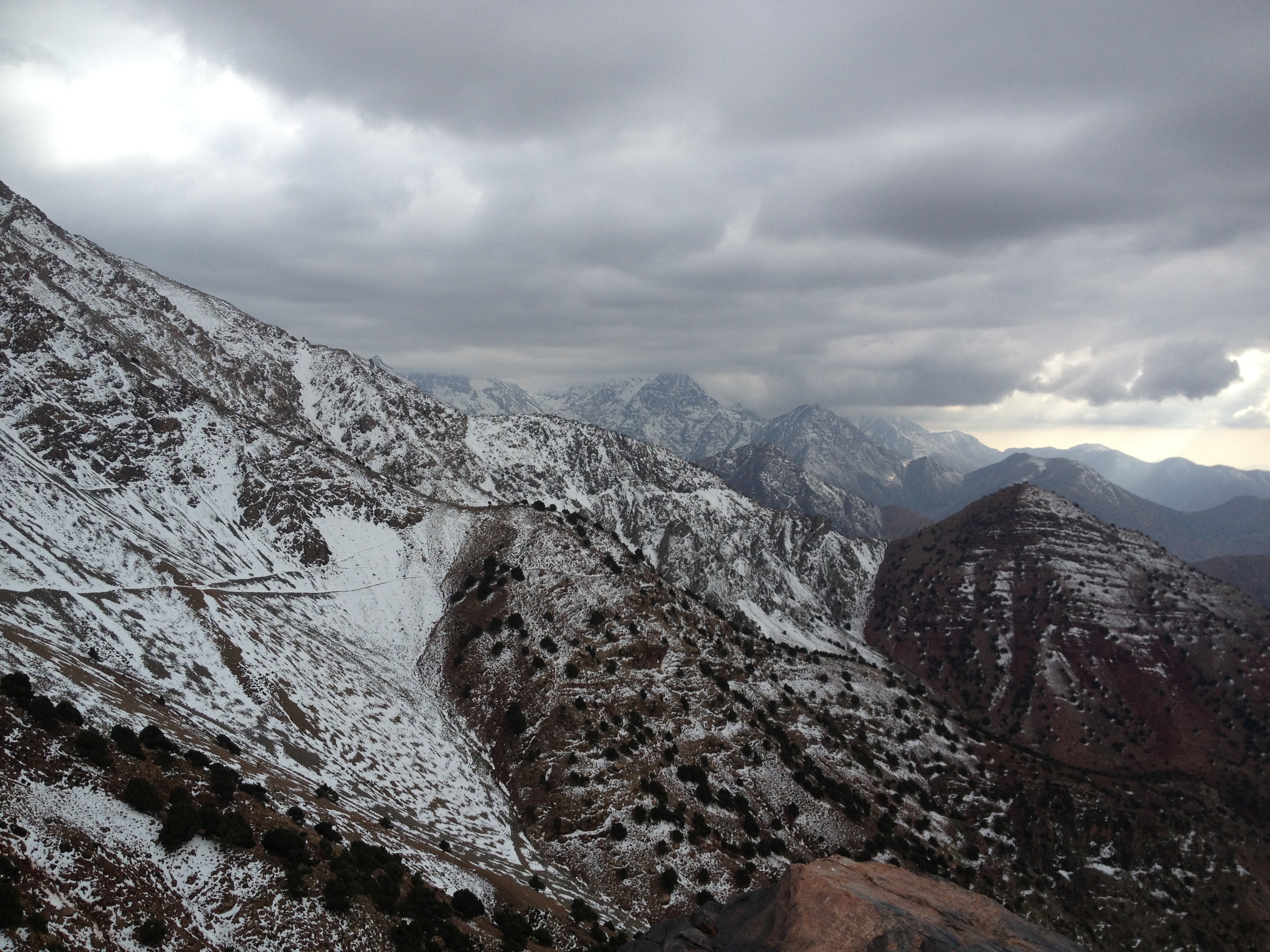
When we arrived in Oukaimeden, where my Uncle lives, about 9,000 feet high in the Atlas mountains, there was snow on the ground. It is a ski-resort during the winter months and my 86 year old uncle BB still has a ski rental shop there along with his home. This is where Ethan and I came to spend our one night with him. Omar lives downstairs in the small cabin and my uncle lives upstairs. Omar has a wife and two married children in a village about twelve and a half miles away. He rides a large motorcycle and could be anywhere between forty and sixty. I couldn’t tell. He made the fire in the cabin when we first arrived. In Marrakesh we were burning up with heat and the temperature was in the 90s. In Oukaimeden we needed a fire. Omar prepared dinner, he served us dinner and then sat in the kitchen while we ate it, he cleared our plates and did all the cleaning up. He smiled at me, he smiled at Ethan. He speaks no French. I speak only a little Arabic. I said Shukran about fifty times. Shukran is “Thank You.” Omar just smiled.
After dinner we prepared for bed. My uncle gave Ethan and I his bed and he slept on the sofa near the fire, something he insisted he did regularly so he would be warm. Omar prepared the sofa and went downstairs. Ethan and I said goodnight to my uncle and climbed into the large and lumpy and cold bed that was graciously given to us. We read a little bit from The Crucible by Arthur Miller and then we tried to go to sleep. There are no street lights in Oukaimeden, most of the homes don’t have electricity.
It was VERY dark and very cold and just a little spooky. Ethan got up to use the bathroom which was a tiny room full of dusty, grimy, half-used bottles and looked like most bathrooms I’ve seen that belong to older folks or those who are otherwise-abled and who can’t see or get to the dirt. Ethan came running back into the bedroom and he was hyperventilating. He said that while he was peeing a giant spider the size of half his hand started to drop down from the ceiling towards him in his exposed state. He ran back into the bedroom.
Needless to say, I wasn’t too excited when it was time for me to use the bathroom in the middle of the night. There was one tiny light and everything looked creepy. I didn’t want to wake up my uncle so I was trying to be quiet but also doing the Nicole is tapping on the floorboards in a funny way dance. This was my “Spider if you are here, please do not come out, there’s a large person here and it’s better if you stay away” dance shuffle. I’m sure all spiders understand that this particular combination of footwork, shuffling, tapping, scooting, and slight jumping that I was doing is universal code for “do not disturb or emerge.” I tried to use the toilet, but was so terrified of the spider and unsure if my message had been properly translated or received. I made it through the event and quickly rushed back to the bedroom. I didn’t get much sleep, but at least I didn’t need to go into the bathroom until morning again and clearly, along with French and Spanish, I can now add Spider Language to my repertoire.
We had a lovely morning walking the area and then got ready to head back to Marrakesh, which was a three hour drive on twisty roads in the old blue 1976 Chevrolet with no air-conditioning being driven by my 86-year-old uncle who told me he needed a new glasses prescription, ummmm, that’s a whole other story. I wanted to buy some ceramics, small things, to bring home and my uncle said Omar would help us negotiate better prices and would accompany us part way down the mountains on our way back to Marrakesh. I was very happy to have the help. We had to drop something off at the only hotel in Oukaimeden and so I was sitting in the car with Ethan waiting. Several men came up to the car with their arms covered in necklaces and jewelery of every kind. I didn’t want to buy anything, so I tried to ignore them, but to no avail. All of a sudden Omar was there, he took off all the jewelry on one man’s arm and he picked through it and handed me ten necklaces. I tried to shake my head no, but Omar would have none of it.
No money was exchanged and I couldn’t communicate with any of these men. My uncle came back and I explained what had happened. He told me that this man owed Omar for something and now that debt was partially forgiven. I said, but I didn’t pay Omar and what is Omar getting from this? I asked my uncle if I could give Omar some money, but he said absolutely not and it would insult Omar. I arranged to give my uncle some money and asked him to do something extra for Omar or his family and then we went down the mountain looking for ceramics.
Omar stopped us at a roadside hill that had thousands of ceramic tagines and bowls and tiles in piles making up columns and columns and rows and rows of red clay, unpainted bowls stacked on top of each other which were entirely covering the hill leading into the factory. There was a tiny path with small steps through these columns into a large dark building. To my right, once my eyes adjusted, I saw a man who was kneading a large bunch of red brown clay with his feet; stepping in and out of the clay in a large square tub. As my eyes got more comfortable, I saw thousands of bowls and dishes leaning every which way in stacks of tens and twenties and more. It was a jumble of sizes, shapes and colors. I walked through trying to find something small I could safely pack in my bag and bring home. I found some beautiful white and blue bowls with a thin strip of silver lining on the bottoms and around the lip of each bowl. I asked the merchant the price and he said they were the most expensive ones and quoted me a price I didn’t want to pay. At that point I noticed some others that I also liked and they were smaller and didn’t have the silver. He told me those were made in this factory here, unlike the others I had previously selected. He quoted me a price and Omar nodded and I paid him.
On our way back to the car, Omar handed me the two other bowls, the expensive ones. He had bought them for me without my noticing. I couldn’t understand. I asked my uncle why and he told me Omar said I was family and he wanted me to have them and to have joy and that it made him happy to think of me with them. This man, who I only just met, was rushing to do something for me. He owns no home, he has worked for over twenty years or perhaps thirty for my Uncle, and he couldn’t stop trying to serve me, to offer to me. I didn’t and don’t know how to properly thank him. His gift was coming straight from his heart. He had the largest grin on his face, so happy with himself. This generosity and desire to please was radiating off of him. I told my uncle to thank him and tell him that I was so happy with the gift and that I would treasure these bowls and think of Omar always when I used them in my home in California.
I gave my uncle some more dirhams and asked him to pass them on however and whenever he could as he saw fit for Omar or his family. Even if I hadn’t had a penny to give, Omar would have been and done exactly as he did. He wanted to make me happy, he wanted me to smile, he wanted me to be served and he wanted to do the serving. He served me. He is serving me still, because I can’t get him out of my mind or heart. His simple kindness, his generosity, his humility, his smile, his strength. All these qualities and more dance around in me and beg me to pay attention.
Serving with joy, serving with kindness and with no thought of reward, serving out of a sense that the person before us is family or Holy or just deserving, this is the service I want to embody. How am I family to Omar? I am family to him because we are all family. My Omar bowls have a special place in my home and every time I see them or use them, Omar is with me. The jewels he gave me also connect me to the Moroccan soil, they come from the red earth and the mountain caves of the African continent, the birthplace of humanity. When I wear them, I feel myself connecting back to the Atlas mountains and to an ancient reality, to a warmth and strength and beauty and even to the large, prehistorically large spiders that come down in the night.
Nicole serves herself by writing to you from her home in Bayside, where she has a lot more to say about serving, but she’ll keep you on edge, waiting for the next installment in her Spain and Morocco narratives.




 Open Heart Open Hands