Monthly Archives: April 2017

Gevurah, Grounding and Getting To It

IMG_3708
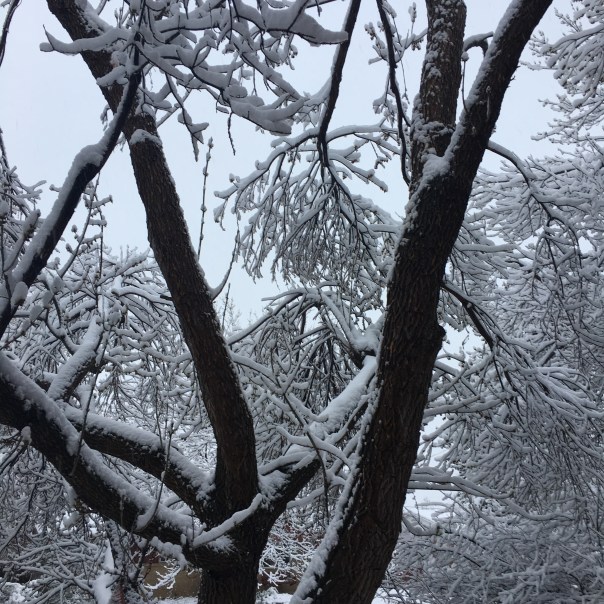
The Tree Bark, Beautiful and Boundaried

This is the week of Gevurah/Din, which I cannot easily translate. Here are some ways to think about Gevurah: Judgement, Severity, Boundaries, Strength, Discipline, and the Angel Gavriel/Gabriel, whose name shares the same root. Gavriel is the angel on the left side of our bodies, who girds us with strength and protects us.

When I say this is the week of Gevurah, that needs explaining as well. Starting on the second day of Pesach/Passover, observant Jewish folks count the Omer. We count seven cycles of seven, which = 49 and then in the evening of that last day, it’s another day, the 50th day and this is the holiday of Shavuot. Shavuot is about the first grain (Wheat) offering, it’s a pilgrimage festival, like Pesach and Sukkot. It’s also considered to be the anniversary of when the Torah was given on Mt. Sinai and so we stay up all night studying Torah, specifically the Book of Ruth, but all of this is weeks away.

Right now, we are in the second week of the seven and each week is linked to the lower seven Sephirot/Energies/Attributes of the Divine, on the Tree of Life. Last week was Hesed/Loving-Kindness, this week is Gevurah. Gevurah and I have been connecting only in the last few years of my life. Prior to a conscious choice on my part to get into balance and make serious changes in my life and the way I engage with the world, most folks who knew me in the past would laugh and say: “Boundaries and Nicole, in the same sentence or space, that’s an Oxymoron”
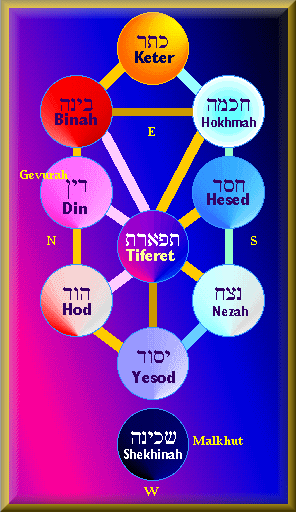
Tree of Life

The Panoply of Symbols for the Sefirot

The Kabbalah assigns every symbol to one or more of the Sefirot. Here is a list of some of the many symbols and correspondences one can find. It comes from Dr. Eliezer Siegel in Calgary. Each of the following lists for each Sefirah is found on Jewish Virtual Library under the name of the Sefirah. Nava Shoham (1-800-ketubah.com) collated all of these entries onto one page, which I’ve reproduced here (using some of her font colors) with some corrections. This image of the Sefirot here is found all over the web. I’ve added directions and some alternate names in yellow to the image. If anyone knows the source or artist please let me know….Rabbi David Seidenberg


Please visit Neohasid.org for a fuller description of all of these teachings. I cannot do the Sefirot justice here. I do want to talk about the work of Gevurah and my engagement with it. Fundamentally, we have all these energies in us, available to us and truly we can find and move into balance. It is not beyond us. This task, this work of counting the Omer is always complex, but it allows me daily engagement with specific energies. By paying attention and counting, literally and also figuratively, I attune myself to the Divine, to the world and to my deeper and truest self.

So, onto the Gevurah, Grounding and Getting to it! As an Empath (see Isn’t It Always Love) I feel it all and I have struggled to have any kind of boundary. I’m extremely grateful for this Omer practice and for the teachings of the Tree of Life, because they have enabled me to seek out and gain some semblance of relationship to the boundaries I needed to cultivate. For me, implicit, in the idea of a boundary, is that I am not creating a hard wall to keep anyone or anything out. I am engaged in creating a porous, but still strong web or fluid that surrounds me, or whatever needs surrounding. It is not a hard boundary.

I have very few hard boundaries, I’m not a hard person.

Nicole Clare Red dress pre.final mikveh
Me, in Ireland, surrounded by my companions, the trees and the river and the fire. This is right before my last Irish Mikveh/Immersion in Living Waters in the very cold water just behind me.

My Gevurah practice is about getting grounded in the earth, recognizing that all of creation has structure of some sort and that this structure is necessary and good. The tree is surrounded by bark, the stem of the flower is a tube carrying nutrients from ground to flower, the seed has a hard shell around it until conditions are right for it to break open. All of these are examples of Gevurah in the world. A boundary that allows life and bounty to unfold.

My own boundaries are like these, I have had to create a boundary circle around certain areas of my life in order to live my life. For my Jubilee year, I took a nine month retreat, this was a boundary circle around interaction with other people, with caring for others and with feeling and doing for others. (You can read all about this is the Jubilee section of this blog)

The majority of people in my life, my children, my family, my friends, my colleagues were outside of my circle, I was inside of it with the Holy One and Creation. I was isolated, in a cabin in Western Ireland, at a Carmelite Hermitage called Holy Hill. I was not alone. The birds, the Angels, the Divine and I were in communion. The ivy on the trees, the flowing river outside my window, the stars and the wind, these were my companions. They were great companions.

I was also blessed with fellow hermits and retreatants who were on similar journeys of contemplation, stillness and engagement with what emerges when you aren’t on the treadmill of the world. We prayed in silence together and shared a common meal once a week, when and if we wanted to be with others. Sometimes, I felt called to being with others, sometimes not. My boundaries are always flexible, this is how I do Gevurah.

My friend Arieh David Scharnberg asked this question on FB:

Looking for advice:

This is the week of Gevurah in the Omer Counting, usually associated with ‘discipline.’

How do you practice self-discipline in ways you can commit to and in ways that don’t induce stress?

What I mean is, every time I think about ‘ok, I need to get more organized’ or ‘I need to be more focused at work’ or ‘I need to do x or y once a day,’ even if it is taking things one step at a time and breaking things into smaller increments, any time I think of a change in my behavior that requires a commitment to that change, I either feel incredible anxiety in trying to commence (a fear of failure) or at best resigned if not despair when I find I have an inability to maintain that change.

Thank you in advance for your wisdom and insights!

This post is my answer to him. Gevurah requires grounding, earth-based practice that is rooted and  attended to, in order for it to be lasting. This doesn’t mean all my boundaries now stay in a permanent fixed place or that my discipline is perfect. It means that I get better all the time at walking this walk and engaging with this energy. It’s a practice, not a goal that I will reach and cross the finish line where a throng of folks will be cheering. It’s subtle and continuous and small sometimes, even just one small action will create a shift in my direction that allows the boundary to get stronger.

And, here’s the thing about all of this, right now we have to pair each of these energies/sefirot with others. We take the week we are in, this week it is Gevurah and align it with each of the other seven, so today, as I write this, I am in the week of Gevurah paired with the Sefira of Tiferet (glory, beauty, harmony). So, how do I relate to these two qualities? Here, in Jamestown at the home of my sister by Love, I am secluded, boundaried. I have taken myself away from the hustle and bustle of my family’s current crisis. I am not needed in this moment, my brother and others are doing the work that needs doing. I am preparing for Shabbat, which is a boundary I observe EVERY week, a time of stillness and honoring of Tiferet in my life, when I actively court the Divine and rest in many, many ways. But, I couldn’t do this if I didn’t create the boundary. Many folks now understand this about me. People no longer expect anything from me on Saturdays or Friday night. I don’t get phone calls or even many emails and I don’t respond to them either as I mostly turn off my technologies that are external and focus on my spiritual relationships.

My Shabbat practice is a Gevurah practice linked with Tiferet and all the other elements on the tree, but it starts with creating the boundary circle around this day, every week and I get better and better at it. I can go outside the boundary, when I need to, or choose to, again, the boundaries are never going to be hard and brittle for me, that’s not who I am. This Gevurah gate in my life has allowed me to create others because there has been and continues to be so much value generated and present for me as a result.

So, whether you practice this very intense and complicated counting or you are just looking at ways to feel protected, boundaried, held in by a structure that is healthy and supportive, I encourage you to go outside, meditate on the bark of a tree or the stem of a flower. Take the time you need to create spaciousness for yourself in any area that you need to by creating a boundary that is real and healing and healthy between yourself and the forces that love to pull you and all of us off our center.
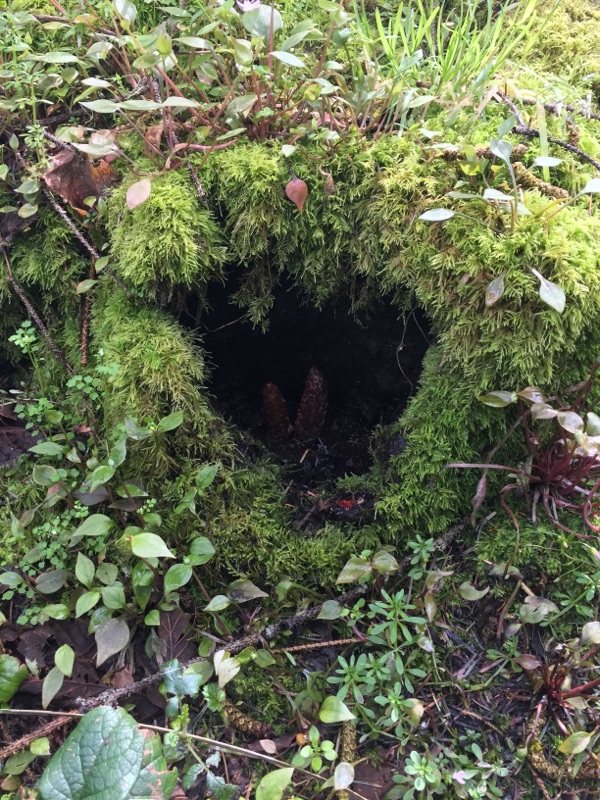
IMG_3680
Heart at the bottom of a tree. Photo taken by my husband while we were on a walk together in Humboldt County, where we live, love, find and hopefully create harmony and balance, for ourselves and for all those we encounter.


Pointed, Prickly and Profound Pesach/Passover

IMG_3711

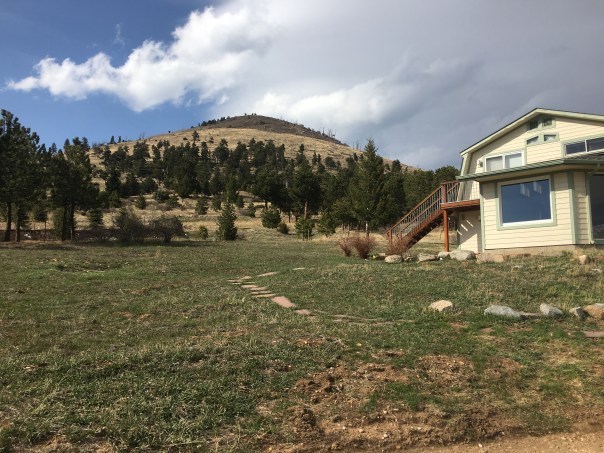
This is where I spent the first night of Pesach up Sugarloaf road in Boulder, Colorado. I had planned to be with my dear friends in Oregon, but life intervened. My 94-year-old father fell and broke his hip and then two days after his hip-replacement surgery had a minor heart-attack. I flew out here to help my brother and family navigate all of this.

My father, never at ease, with care or emotions, was very upset to see me when I first got here. He requested that I not come into his room alone. He said that I was “too emotional” and my presence distressed him. I was actually expecting this, because this is his default around me and emotions. I refrain from all emotional expressions around him and have for years. But, he was so uncomfortable and unhappy already, my presence served as a reminder that things were dire or difficult.

I am the person folks usually want around them when they are sick, 99% of the time. Folks love when I bring food to them, help them navigate tests, hospital staff, doctors, end of life care issues and everything in between. I am regularly consulted, and in the company of folks who are not well in hospital and home situations. It’s something I do from my heart with confidence and skill. The fact that my father denies me the opportunity to give to him, in the ways I am most able to, is one more opportunity for me to grow.

My Mussar/Jewish Ethical practices and teachings ask us to look at whatever is present in our world as our “spiritual homework.” This idea works for me because I am someone who tries to address whatever is difficult as an opportunity. I am not always successful in this, but I do use this concept as a framework for my life.

So, my brother, his partner, my daughter, various other family members and I have been trying to do a very complex dance. There are lots of steps behind the scenes and various curtains opening and closing, in sync hopefully, and lots of improvisation. I have respected my father’s wishes, for the most part. I found that he was open to good soups and foods, which I could make for him and send with my brother. This worked for a little while and then it was “too much fuss” and “too much foods,” even though it was a small box in the hospital patient refrigerator with some cheese, yogurt, olives and soup.

My father asked where I was several times when my brother came to spend time with him and my brother reminded him that he had told me not to come. I spent my pre-Passover time cleaning my brother and my daughter’s homes and kitchens and cooking for them and my father to support all of them, behind the scenes. I drive my brother into Denver frequently, and stay in the waiting area, and try to make it easier for my brother to handle all he is handling. It’s a family affair with one person on center stage looking like he is doing it all, my brother, but there are lots of things going on in the background.

This element of caring for folks, whether they are old, or not, is critical to understand. It is often the case that only one member of a family or friend grouping will be the one the person who is not well feels the most comfortable with. It’s important to not take it personally when you aren’t the person wanted. I know this intellectually, emotionally it’s another story.

So, I have cried, done a phone session with my therapist, gone to multiple services at Bonai Shalom and been on the phone with my husband and sisters and others and processed. I’ve gotten massaged at Siam Sensation, my favorite place in town and gone swimming and taken walks in the woods. I don’t swallow poison or hurt, when I am awake and aware. I take my pain to the Holy One, to my support crew of friends and family and to my sister’s grave as well. I lay it all out and down and work on trusting that my love and care will be of help and that someday it will all make sense or improve.

Heads together Paula Grave
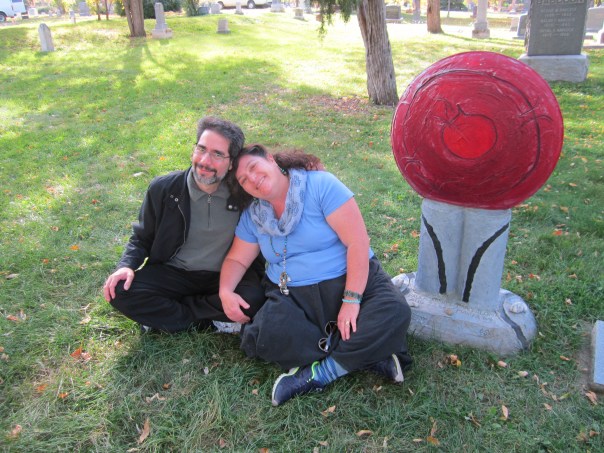
My brother and I at our sister’s grave. It’s a place of healing and calm for me always. See More than One, for more thoughts on my sister and I and grave-side practices.

Everyone is unique in how they navigate illness and stress and difficulty. There is no cookie-cutter form that works every time. Patience and calm and trust are always great tools to have if you can figure out how to have them in a crisis, no small task. Even though my father was reticent initially to my arriving and my involvement, he has warmed up to me and to my help. My presence makes a difference for the other folks in this situation. It’s not what I thought I’d be doing, on the other hand, this is what is.

How this relates to Pesach and Passover is also relevant. We look at all the ways we enslave others and are enslaved at this time of year. We look at all the things that are leaven in our lives, all that puffs us up and that is not necessary. Our pride, our lack of awareness about the suffering of others, our over-consumption, our fear and our lack of faith are all examples of things we need to look at deeply. We always tell the story in the present tense and we are not only reminded once, but repeatedly, over and over and over, that the Exodus is not something that happened once. Our story is something that is currently happening and that is happening for us and for refugees and folks in bondage everywhere right now.

We live the story in this moment.

So, in my now, having to traverse the territory of my pride around my ability to care for folks in need, I can see it as one more form of leaven in my life. Ceding the care-giving to my brother and taking a back-seat, that’s not my normal setting, nor is it easy for me, but I can and am doing it. Letting go of my childhood pain and sense of rejection around my Papa is also a way to liberate myself further from things that I no longer need to be tied up in knots about.

My father loves me, he has never, and will never understand me. Big deal, what’s new? This is the story for so many people. While it is painful, I am not alone, I am not three or twelve. I’m fifty-two years old. I have a plethora of folks who do understand me and don’t reject me. My father is actually not rejecting me, he’s rejecting having to feel things that he doesn’t have the energy or ability to handle. I represent emotions and feelings to him, I hold that space in his mind and in his experience. Just being around me stimulates him in ways that are not comfortable for him. He still thinks I should be a lawyer, which is just beyond laughable.

Soup, I can send him, through another person, that works. Yesterday, I felt a strong call, on the second day of Pesach, about ten days into my visit here, to go see him. So, I called him, he is now at a rehabilitation facility.  I asked him if I could come for a brief visit and bring him some maztoh ball soup that my friend, a former student of his, had made. He said, come visit, but no soup, and only if I was already in Denver. I lied and said I was, but that it would be a few hours before I arrived. I drove in, during rush hour to see him. It took an hour and a half to get there and an hour to get home. When I got to his room he said: “I’m going to make you very happy and let you rub my feet.” This is something I’ve offered before, when visiting with him, but that he’d always refused.

So, I washed and massaged Papa’s feet, which felt good for both of us. While I was there, the Executive Director came in and asked how things were going. My father said “fine,” but then started to complain about the food. He then he raved about the tomato basil soup he’d had at the hospital and said they should hire away the cook at the hospital. This was funny to me, since he’d complained about the food there to my brother. I told the director to just have the kitchen always put some lemon on my father’s tray and that would help him enjoy whatever he was eating.

A little later, dinner was served and the cook came up. My father apologized profusely for complaining to the director and the cook assured my father, that he wanted to provide the best meal possible for him and that it was his job to do so. He asked my father where he was from originally and my father said: “France, we are French, from Morocco originally.” The cook said: “I’m from Palestine, I’m Palestinian.”

I immediately said “Salaam Aleicum,” and he shook my hand and said Aleicum Salaam and smiled. Jews and Muslims share this form of greeting. We say Shalom Aleichem, they say Salaam Aleicum, both of these things mean the same thing, Peace To You, and the response is Alecheim Shalom or Aleicum Salaam, which means To You Peace.

My father then said it was a “bloody ridiculous mess” in Israel and Palestine and that all the bloodshed and arguing was wrong. The cook didn’t say anything more to this. I shook his hand again and thanked him in Arabic, “shukran, shukran.” He smiled and departed. There was lemon on the tray they brought my Papa for dinner. And, of course, he would have preferred the soup my friend had made, but he’d told me not to bring it, so I hadn’t, trés typique, as we say en français.

We attend to the details of Passover more intensely than any other holiday. It is considered of benefit to go longer, go deeper, do more, make things sparkle or have more meaning, discuss it differently, cook more dishes, clean more, and in general go a little crazy in your preparations and expressions for this holiday. So, likewise, with my father in his situation, the details are maddening, complex and continuously shifting and challenging. It requires great attention to detail and flexibility.

I’m blessed to have a family that has consummate skills in this area. So, as we wander in this new wilderness, this place that is wholly different from what we are comfortable and familiar with, we look around us and see we are not alone. We are helping each other along, we are laughing, we are crying and we are falling down and picking each other up. We are finding ways to do what needs doing in the face of complex emotions and situations.

Let me be very clear as well, it’s horrifying to me, when I think about how hard and how much work we are doing for my father, who has health-insurance, who is in clean and calm facilities, who has children who can afford to drive or fly in to help. What is horrifying about this, is that so many folks don’t have this kind of support or care. The vast majority of people in the world, who are suffering all over this world, don’t have the resources or the facilities that my father does. My father is an American but he wasn’t born here. He emigrated here after World War II. He got his college education here in the 1950s and became a French professor at CU Boulder. He worked for over thirty years there and planned intelligently for his retirement. He found his truest love at the age of 75 and has been happily married to her for almost twenty years now.

  1. How can my situation, which is challenging, but not horrific help me to be a better person?
  2. What can I do differently so that the suffering of others is lessened?
  3. Where are there places in my life that I can explore further that will enable me to be freer to give with my whole heart and serve the Divine more fully?
  4. How can I release what constricts and binds me so that I am truly free to show up for exactly what needs showing up for?

These are my four questions for this holiday, not the typical ones, but they are the ones I’m wrestling with. May your forays into this Holy Spring Time, whether you are Jewish, Christian, Pagan, Hindu, Muslim, Buddhist or any other stripe or way of connecting to this Wholly and Holy Amazing world, be full of joy and thoughtful contemplation. May you find your way out of whatever binds you, into full-on service to what needs doing and what is for the good.

You are not alone!

IMG_3695
The altar I made for my father the day I learned about his hip fracture. The wine, in the center, is for us to drink to his health, the photos are of my father and my daughter, my father and his mother, my father and his wife and two of my favorite angel images. The bowl holding the candle is the bottom of a Moroccan couscoussier and one of my brother Paul Barchilon’s ceramic coasters is holding the light.