Monthly Archives: August 2014

Jubilee Part Five: Encountering Death Consciously

Singing the Bones by Helen Redman, 1993

When it is my time, the Holy One will take me. I’d like the folks left behind here to know that I am not gone when that happens. In my tradition there is a teaching that the only thing you can take with you to the other side are your mitzvot. I use the translation of this word here as deeds of loving kindness or rightness. So, if my deeds of goodness follow me and come with me, I should do a lot of them! It’s not a reason to engage with mitzvot, but rather a consequence of living my life as if I was already in Heaven, a place where kindness and beauty reign. There is plenty of Hell here on this planet. I have never been afraid of going to such a realm, I just want the suffering on this planet to be done. So, I orient towards Heaven on earth, bringing beauty, goodness, love, warmth, comfort and delight into this time and place. My need to walk this particular path is coded in my core. I feel pulled and guided by that force constantly.

Taking a retreat from engagement with the folks I love and who I just know and encounter on a daily basis is a radical step. I am interested in a specific kind of departure from the norm. I want to explore leaving this world consciously. If I dip into the absence/death-well, while I am still living, I get to practice to navigate territory that is very uncomfortable for all of us. This choice, on my part, about why I need to do this is so complex. I am not talking about taking my life. I have never felt inclined to do so and I doubt I ever will. Looking at death in depth and consciously, is different from venerating it or reaching towards it.

If I were Hindu, I would just say I was going to spend some time with the Goddess Kali and that would make sense to folks who were steeped in that tradition. Buddhist practitioners engage in years of contemplation and “practice” around death. There are complex meditations that involve envisioning your death, the death of those you love and death in general. In the modern secular world, we have a fascination with vampires, zombies and ghosts. But engaging with those ideas as entertainment or story-line is very different than looking at the reality of death head on.

I’ve been looking at it literally with my head on (using my mind and body to be present around death) all of my life. Over fifteen years ago, when a dear friend became ill with cancer, her final wish was that our community endeavor to bury her according to Jewish tradition. This meant engaging in study around traditional Jewish practices and creating a Hevra Kadisha locally. Hevra Kadisha translates literally as Sacred or Holy Community/Society, most folks think of it as the Jewish Burial Society.

The service of a Hevra Kadisha is done anonymously and involves preparing a person for burial according to ancient beautiful Jewish practices from Torah. In my 49 years on this planet I’ve gone from fishing for gravestones in a stream (see Jubilee Part Four) to gently preparing those who have died to enter the earth.

We enter a river of blessings in this process as well as doing the heavy lifting, purifying and cleaning. I do this work with four or five other people mostly in silence with only specific prayers recited as we engage in the various tasks. We bathe and cleanse and lovingly robe folks in simple linen garments modeled along the lines of the High Priest from the Torah. We wrap them tight in a shroud, like a cocoon and place them in plain wooden boxes. We place broken shards of pottery over their eyes and mouth to signify that their soul has broken free of its physical vessel. We lovingly praise and honor their physical bodies as the homes of their souls and we ask forgiveness if anything we do while preparing them wasn’t done properly. This service is considered a mitzvah/commandment/obligation that is of the highest order. In my community, we do this for free. In all Jewish communities, if you do this work, you are actually doing it for the person who has died, and they cannot thank you or pay you, which is why it is considered to be a very special mitzvah.

My service with the Hevra Kadisha has brought me in contact with death in real time and with real humans whose bodies I have engaged with. I have also had the privilege of being present with folks as they were dying and on their journey across the “River Jordan.”

The Other Side of Birth by Helen Redman, 1994

Intrinsic to my need to go on retreat is a concept called L’Shem Shamayim: for the sake/name of Heaven. Underneath my desire for stillness is a strong and always flowing current of connection with the Divine. I need to see what it is that the next phase of my life is supposed to be oriented around and towards. I need to find out what I can do for or in the name of L’Shem Shamayim and for the world to come/Olam Ha-Ba. This idea of a world to come can be interpreted to mean tomorrow or the world we create, not just the world on the other side of life, but that is also part of its meaning. So, taking time away to explore through prayer, through meditation, through engagement with solitude and nature and through active study are all ways for me to connect to Olam Ha-Ba.

In this world, which we call, Olam Ha-Zeh, I am also taking time away to get still and see what unfolds in a place that is less stimulating and full of others and their needs. I am often seen as the “spiritual” one in my family, in a group or gathering. I do not like this, when it separates me from others and makes me seem or look different. While I am happy to be seen as a woman engaged with Torah, with Holiness, I do not want to be the placeholder for Holiness in other peoples’ lives. I want everyone to engage and have relationship with what is Kadosh/Sacred/Holy to them.

I also don’t want connection to a spiritual reality to be seen as something that can only be done in a big way. Folks who are quieter or less obvious and vocal are just as capable of connection with the Divine as I am. There is no singular or right way to connect or be engaged with spiritual practice. Although there are tried and true and well-researched and practiced spiritual technologies and teachers that can improve our ability to connect and experience Holiness or Deep Mystery.

“The root k-d-sh occurs nineteen times in Parashat BeHukotai, the last reading from the book of Leviticus, in which there are altogether 152 occurrences of this root. The Torah nowhere defines the concept of kedushah, what we might call in English “holiness” or “sanctity.” Nevertheless, the use of this root has developed extensively, so that today we speak of making kiddush on the wine, or of reciting the kaddish and the kedushah in the synagogue service, or of marrying a woman through kiddushin (the ring ceremony), and we behave as if we understand the concept of being kadosh (holy) which is present in each of these actions. We tend to forget that holy is a divine (transcendental) concept, and therefore, like the concept of G-d, is above human comprehension.”-Dov Landau

As a Jewish woman, as a mother, as a wife, as a sister, as a grandmother, as a friend, and as a daughter, taking a year off from my family and friends is a very intense thing to do. It will be a death of sorts. This is time of absence and death-like being away from those I love is a risk I am willing and need to take. I do so knowing that while it will be hard for those who love me and who I love, it can also be a blessing and an opportunity. Getting up close to and intimate with absence and death or separation is a very hard thing for most of us to do. Taking this path consciously, for me, and hopefully for those who will miss me, is a way to flow into and explore THE RIVER of space and time, beyond our physical bodies and all their coverings and ways and means. I’m looking intently towards and across that mysterious “River Jordon.” I have no desire to cross over yet—but I am very curious about the territory.

to be continued…..

~byline from the original piece published in the Mad River Union on August 13, 2014:

Nicole peeks across and around all kinds of corners, rivers and edges wherever she abides and she endeavors to speak of this as she walks along the way. Sometimes, she can be found in her home in Bayside, but you are just as likely to encounter her swimming at Big Lagoon or meandering along the aisles of your local health-food store.
Jubilee Part Four: Preparing Others for My Departure, Death and Distance

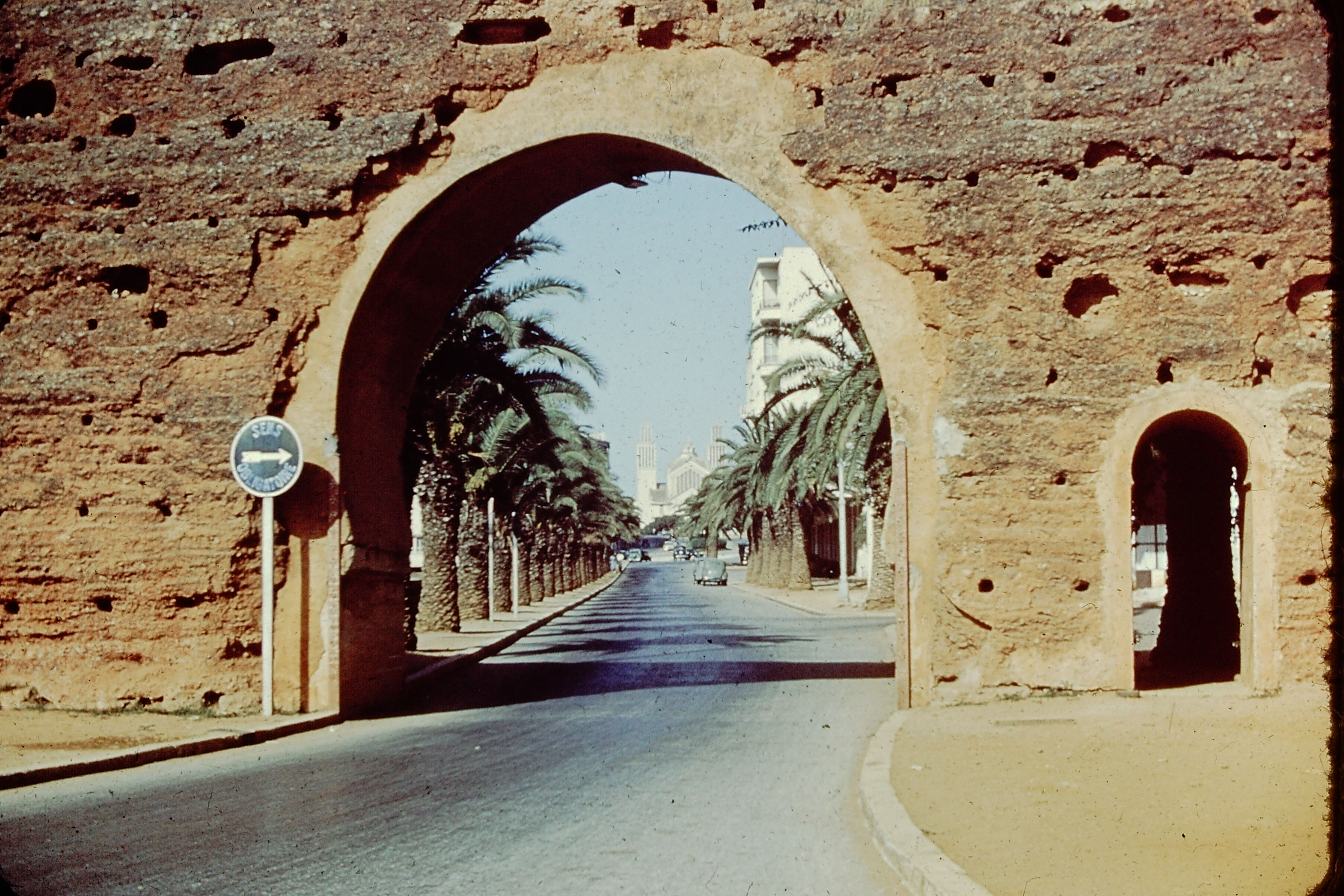
Moroccan Wall/Gate/Passage

I finished yet another fast, from sundown on Monday, August 4th until sundown Tuesday, August 5th. This year, that day was Tisha B’Av. The Jewish day starts at sundown in the evening and goes until the following sundown. “…And there was evening and there was morning, one day.” B’reishit/Genesis 1:5

As my Rabbi Naomi Steinberg says:

“Every year in midsummer the Jewish calendar brings us a challenge – the holy day of Tisha B’Av, the Tenth of the lunar month of Av, the day that commemorates the destruction of the ancient Temples in Jerusalem in 586 BCE and 70 CE, and also the day when the Jews were expelled from England in 1290 and driven from Spain in 1492.”

It’s a really, really, really bad day. Many years either Hiroshima or Nagasaki day is also falling on or around Tisha B’Av. I used to fast on those days when I was younger, before I ever connected with my Judaism. The thought of eating or drinking on a day when so many innocent people were murdered just has never been something I could stomach. When I learned of the Jewish fast, it was one more link in my chain of connection to Torah and to Judaism.

This is just always a VERY horrific time of year. It has been for Jewish people for thousands of years. It is Now in Israel, it is Now in Palestine, it is Now in Syria, it is Now in Somalia, it is Now in Afghanistan, it is Now in Pakistan, it is Now in Nigeria. It is NOW everywhere that folks kill and maim and wound each other for reasons that have never and will never make sense to me. While I seek out and look for understanding and guidance around death, I have never wanted to encourage or support killing. I am always and still a pacifist.

Even so, death has been part of my journey in life from the beginning. My mother was six months pregnant with me when my almost two-year old sister Paula Andrée Barchilon died. I came into the world with death at my heels and connected to a sister who left the earth before I entered it. We crossed and have crossed paths, all my life, in a liminal space, in an other kind of place.

Maternal Echo by Helen Redman, self-portrait of my mother with me in utero two months  after my sister Paula's death.
Maternal Echo by Helen Redman, self-portrait of my mother with me in utero two months after my sister Paula’s death.

So, death has never been far away or to be avoided as a subject of exploration and study. I used to go to the cemetery where my sister was buried as a young girl. It was a quiet and special place for me, almost a secret place because it was never crowded with living folks and it was calm and ordered and beautiful. When I was a young teen my dancing partners and I used to go there in the summers. We would try to restore the graves that had been vandalized. There was a small creek running through the graveyard and idiots would break off grave-stones and throw them in this water. We would be in our leotards which were very similar to one-piece swimsuits and wade into the water and try to heft these pieces of gravestone out of the water. We would then attempt to locate the grave they went with. I remember doing this as if it were yesterday. I also remember sitting at my sister’s grave and talking to her.

I wasn’t born yet when she died, so my relationship with her was completely something happening in my heart and soul. She was my first angel, my first guide beyond this world. This connection to death started in the womb, but has continued in me as a beat that I was tuned to and interested in. All my life I have sought out knowledge and information around death.

I have also studied how other culture’s navigate and approach death and the afterlife. For almost all cultures there is something beyond this world. It is only recently that the Religion of Proof in Physical Evidence has come to the foreground of many folks’ ideas about death. I have no need to change anyone’s mind or convert anyone. People believe and engage across a great divide and along a continuum from absolute rejection and negation of anything Holy or Divine to complete engagement and relationship with Holiness. Death is a part of that dance, regardless of what you believe or don’t believe. We are all going to die as are the people we love and the ones we hate. Death is a sure and constant reality.

One of the underlying reasons for my Jubilee retreat revolves around my desire to prepare folks, as best I can, for the eventuality of my death. I hope it is fifty years from now. I’m in reasonably good health and don’t anticipate leaving this earth anytime soon. Nevertheless, I don’t know the pull-date on the Nicole Andrée Barchilon Frank label.

As I contemplate taking a retreat to look at death more fully and to give folks an opportunity to encounter my physical absence, it is with a heavy heart and a desire to grapple with something completely impossible. I need to have the freedom to yell, rage and engage with the Divine around all of this. I cannot do that with anyone other than the Holy One and I need the space and time, one needs in an intimate relationship, to tackle really hard issues. It’s not a short conversation.

…to be continued….

Nicole writes to you about death and life from her very active home in Bayside, where she will now attend to watering her garden and doing the laundry (two very mundane but solidly of this world kinds of tasks).

This piece was originally published in the Mad River Union, on August 6th, 2014. It has been slightly altered for this post.

Quickish Summer Eggplant

Japanese Eggplant
Japanese Eggplant: Photo from Photobucket:

(This recipe is adapted from Joy of Cooking)

  1. 3–7 Japanese eggplants, the long thin kind
  2. salt
  3. olive oil
  4. 3–5 fresh tomatoes
  5. garlic 1:1.5 ratio, one eggplant to 1.5 cloves of garlic pressed
  6. lots of fresh ground pepper
  7. feta cheese (I prefer French sheep milk feta, it is less salty and softer) If you won’t be using this kind, your dish will be saltier, so use less salt in your preparation.

Heat ¼ cup or more of olive oil in a non–stick or well–seasoned cast iron pan on medium heat. Slice the eggplants lengthwise in long thin oblong strips about 3–4 per eggplant. Slash them with a knife on the pulp side two or three slashes per strip and give them a quick slight dash of salt. Place them in the hot oil and fry them until they are reddish brown on both sides. Layer them into a glass baking or other nice baking dish, one layer only, so use a larger dish if you need to. Grind fresh pepper over each wedge. When all the eggplant has been fried, empty the oil out of the pan and grate the tomatoes, with a cheese grater over the pan, this is the quick way to peel tomatoes, because the skin stays in your hand and the pulp goes in the pan. Heat the tomato pulp on medium for awhile. You are trying to burn off the liquid, stir frequently. You shouldn’t need to add olive oil, because the pan was previously coated in it. Add the pressed garlic and a dash of salt. Let this cook down until it’s mostly a thick pulpy sauce, not too watery, 20 minutes perhaps. Spoon the tomato sauce over the eggplant and sprinkle the dish with the feta. Cover with an oven–safe lid or aluminum foil and cook in the oven at 375º for about 20 minutes. Serve with a nice fresh salad and some corn on the cob and good bread to soak up the juices.

Eggplant Realities and Recipes

All the eggplant dishes I cook require the following knowledge; picking the proper eggplant is what makes the difference between a dish that is bitter and one that is sweet and lovely tasting. Whether the eggplants are Japanese style or your traditional fat purple variety; the key is how heavy they are. The only proper way to pick an eggplant is to get involved in the veggie bin or with your farmer. If you are at your local market you may need to rearrange or make a mess for the grocery clerk to deal with. I actually recommend budgeting the time to arrange the eggplants back when you are done so as to ensure future harmony between yourself and the person who stocks your groceries. The deal is, you have to pick up every eggplant and compare it with every other eggplant. The heavier ones go in the reject pile, the lighter ones go in the keep pile. If there are ten eggplants and you only want three, after you’ve selected the five lighter ones, repeat the process with your remaining five until you’ve got the three lightest eggplants. If they are all heavy, make a different dish because it just isn’t worth the time and effort. All the eggplant recipes I know take hours to make, (with the exception of this recipe and Baba Ghanoush) so if you don’t have a good eggplant to start with, why bother?

Enjoy!

Nicole

Iranian Eggplant, Sooooooooo Goooooooooood!

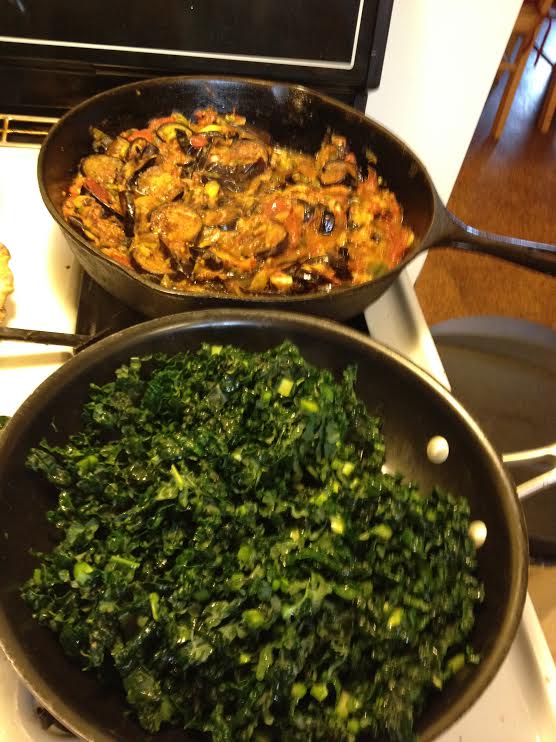
Iranian Eggplant in my favorite cast iron skillet

Eggplant Realities and Recipes

All the eggplant dishes I cook require the following knowledge; picking the proper eggplant is what makes the difference between a dish that is bitter and one that is sweet and lovely tasting. Whether the eggplants are Japanese style or your traditional fat purple variety; the key is how heavy they are. The only proper way to pick an eggplant is to get involved in the veggie bin or with your farmer. If you are at your local market you may need to rearrange or make a mess for the grocery clerk to deal with. I actually recommend budgeting the time to arrange the eggplants back when you are done so as to ensure future harmony between yourself and the person who stocks your groceries. The deal is, you have to pick up every eggplant and compare it with every other eggplant. The heavier ones go in the reject pile, the lighter ones go in the keep pile. If there are ten eggplants and you only want three, after you’ve selected the five lighter ones, repeat the process with your remaining five until you’ve got the three lightest eggplants. If they are all heavy, make a different dish because it just isn’t worth the time and effort. All the eggplant recipes I know take hours to make, (with the exception of Baba Ghanoush) so if you don’t have a good eggplant to start with, why bother?

The following recipe is an adaptation of one from Madhur Jaffrey’s World- of-the-East Vegetarian Cooking. This cookbook is in my Top Five Cookbooks List. Check out Ms. Jaffrey’s blog and link to her books above.

  1. three to five eggplants (depends on size of eggplant, this dish always amazing, so making more means left-overs and this dish is amazing a day later as well)
  2. olive oil, grape-seed or canola oil (at least 1/3 inch or more so you cover the pan for frying the eggplant in)
  3. two to three large tomatoes or 5 small ones (chopped small)
  4. one bunch of green onions (chopped finely)
  5. one bunch of fresh Italian (flat leaf) parsley, chopped finely
  6. fresh ground pepper
  7. lots of good salt (kosher or other high quality, see Let’s Talk Salt for details)

Slice the eggplants into rounds, not super thin, ½ inch thick. Cut into wedges or halves if you are using a big eggplant or just keep them in the rounds if you are using the thinner japanese style eggplants. Sprinkle with a goodly amount of salt and put them in a colander. Place the colander in a large bowl so the liquid that sweats off the eggplants can drain. They will have to sweat for at least 30 minutes.

I recommend having 2 non–stick or well–seasoned cast–iron pans going to speed up the cooking process. Heat a lot of oil, olive oil is my preference, or some combination of olive oil and another oil, about 1/3 inch of oil per pan until the oil is hot, but not smoking ever! Medium heat will work fine. Lay out several clean dish towels and put the salted eggplant rounds or wedges on the towels. With another dry dish towel pat the eggplants dry. I endeavor not to use paper products in my kitchen, but if you have to use paper towels, I’ll never know.

Place the dried wedges in the oil. They will be in the oil for a while, until they turn reddish-brown, then turn them over somewhere between three and five minutes per side. Have another colander next to your stove, also sitting in a bowl. When the wedges are reddish-brown on both sides, take them out with a fork, letting as much oil as you can drip back into the pan, and put them in the clean colander. This process is the time-consuming part of this adventure in cuisine . It will take about 40 minutes to an hour or more standing over several pans of hot oil with lots of wedges of eggplant in them for a dish that everyone will love and which will be consumed in ten minutes.

You have to love your guests to make this dish for them. While the eggplants are cooking and you are checking on them, you can prepare the tomatoes and the onions. Chop finely the parsley, and green onions. You can do the tomatoes in smallish chunks, not tiny, and place all of this in a bowl together.

When all the eggplant wedges have been cooked, drain the largest of your pans (that has a lid) of the hot oil. Do not wash out this pan just drain it. Put it back on the stove and turn it on low, put the cooked eggplant wedges and all the other ingredients in the pan and stir them up so they are combined well. Grind a ton of black pepper over all of this, mix and cover. Cook on low heat for about 15–20 minutes, stirring two or three times. You won’t need extra oil or salt.

Serve this with Paul’s Perfect Raita and some fresh greens. You can make a grain like couscous or rice and some kind of tofu or fish dish or just eat this plain with a good ethnic bread. Make sure you scrape the pan of the yummy juices when you are done. This dish is also great a few days later, so if you want to make it ahead of time and then refrigerate it, that’s fine. It takes two to three hours from start to finish to make. Important tips, using more than one pan to fry wedges in, lightly wiping the salt or salt sweat off each wedge, breathing a lot and not attempting this dish with children nearby. If it didn’t take so long to do, I’d make it every week in the summer months when eggplants and tomatoes are at their peak.

Iranian Eggplant and Fresh Kale

Enjoy!